


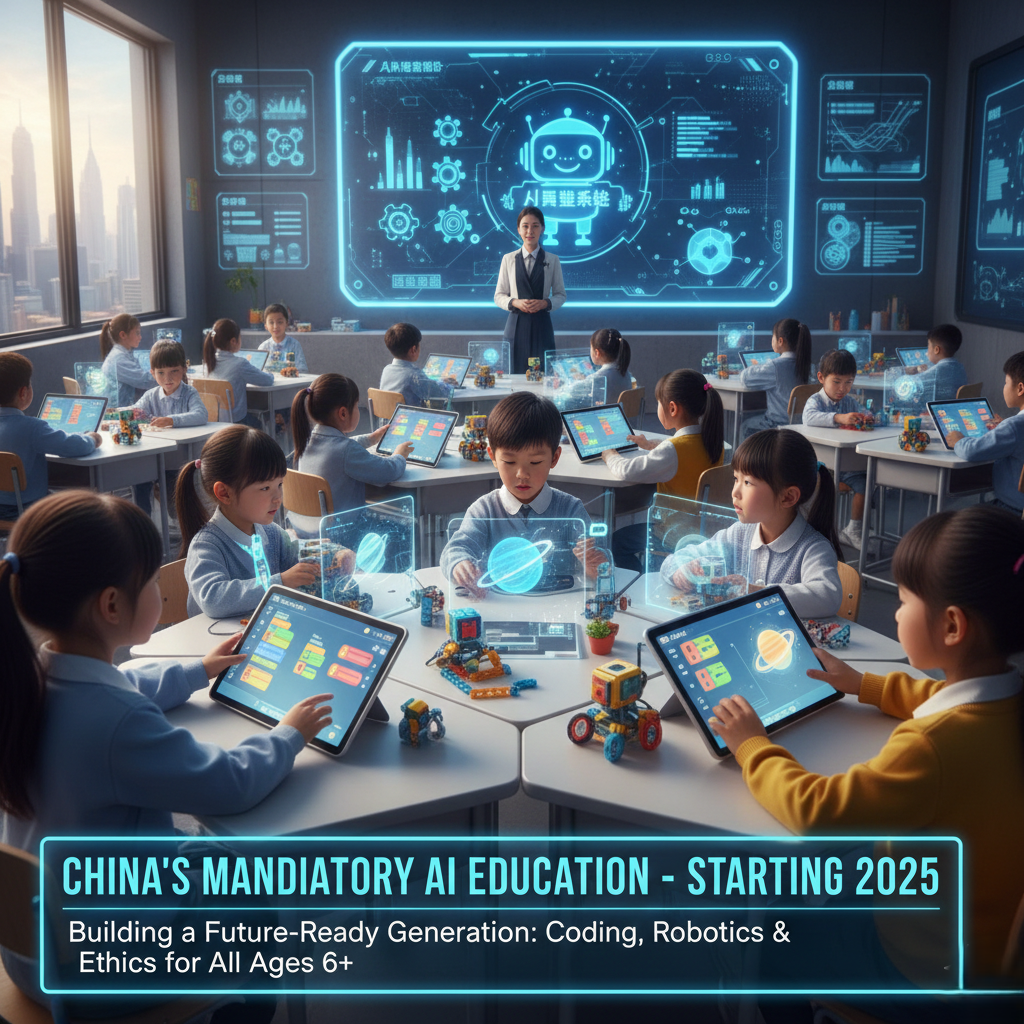
Starting in September 2025, China plans to make artificial intelligence education compulsory for all students aged six and older.
The move marks one of the most ambitious national efforts yet to prepare an entire generation for an AI-driven future.
From early primary school to high school, students will gradually learn how intelligent systems work and how to use them responsibly.
What China’s AI Curriculum Will Include
From Coding Basics to Machine Learning
The new national curriculum is designed to scale with age and cognitive ability.
Students will be introduced to:
- Coding fundamentals
- Robotics and automation concepts
- Machine learning basics
- Data science principles
- Digital ethics and AI responsibility
Complexity will increase each year, ensuring continuity rather than one-time exposure.
Building an AI-Literate Society From the Ground Up
Education as Long-Term Strategy
China’s goal goes beyond teaching children how to code.
The initiative aims to build technical literacy at a societal level, ensuring future workers understand how AI systems function, interact, and influence decision-making.
By embedding AI education early, students grow up seeing intelligent systems as tools not black boxes.
Why This Matters for Global Competition
A Potential Strategic Advantage
Technology analysts believe the scale and timing of this initiative could give China a long-term edge.
Early AI education may strengthen China’s position in:
- Software engineering
- Automation and robotics
- Advanced scientific research
- AI-driven manufacturing
Starting at age six allows skills to compound over time, something many countries currently lack.
Pressure on Other Education Systems
Will Other Nations Follow?
China’s move may force other governments to reconsider their education priorities.
Many countries still treat AI as an optional or university-level topic.
Without similar reforms, they risk producing workforces that consume AI tools rather than create them.
Redefining What “Core Subjects” Mean
Should AI Join Math and Science?
The policy raises deeper questions about the future of education itself.
If AI shapes every industry, should it become a core subject alongside math, science, and language?
Early AI literacy could reshape how students:
- Approach problem-solving
- Think about creativity
- Understand ethical responsibility
- Collaborate with intelligent systems
Ethical Education at the Center
Teaching Responsibility, Not Just Technology
Notably, the curriculum includes digital ethics, signaling awareness of AI’s social impact.
Teaching ethics early may help students:
- Understand algorithmic bias
- Respect data privacy
- Use AI tools responsibly
This balance could be critical as AI becomes more embedded in daily life.
Frequently Asked Questions (FAQs)
When will AI education become mandatory in China?
The program is scheduled to begin in September 2025.
At what age will students start learning AI?
Children aged six and older will be included.
Is this the first program of its kind?
While other countries teach coding, China’s plan is one of the most comprehensive AI-first national curricula to date.
Final Thoughts
China’s decision to make AI education compulsory reflects a belief that artificial intelligence literacy is no longer optional.
By treating AI as foundational knowledge, China is preparing students not just to use future technology but to shape it.
Whether other nations respond with similar initiatives may determine who leads the next era of global innovation.
