


Introduction
Space missions often bring surprises. However, this one feels almost surreal.
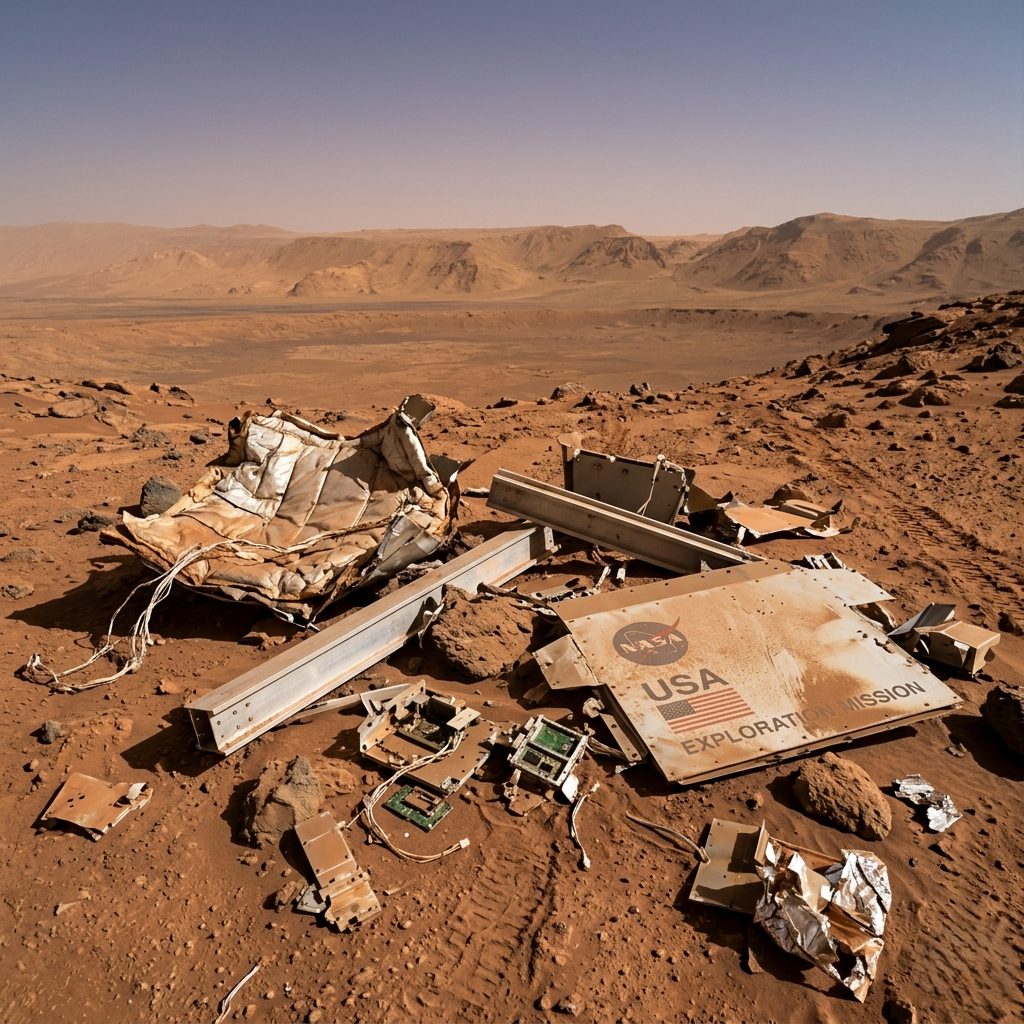
NASA recently confirmed that its rover found a piece of its own spacecraft on Mars. Even more surprising, it was discovered far from where it should be.
So, how did it get there? That question is now puzzling scientists.
What Did NASA Actually Find?
While exploring the surface of Mars, the Perseverance rover spotted something unusual.
It wasn’t a rock or dust formation. Instead, it was a shiny piece of material stuck between Martian rocks.
After careful analysis, NASA confirmed it was part of a thermal blanket. This material came from the rover’s landing system.
Where Did the Debris Come From?
The fragment belongs to the rover’s descent stage. This system worked like a jet-powered backpack that safely lowered the rover onto Mars in 2021.
Once its job was complete, the descent stage crashed intentionally at a safe distance.
However, here’s the mystery:
The debris was found over a mile away from that crash site.
Why This Discovery Is So Confusing
Scientists expected all debris to stay near the crash location. Yet this piece somehow traveled much farther.
Now, researchers are considering two main possibilities:
1. Impact Scattering
The crash may have thrown debris across a wide area. Because of the force, parts could have landed far from the main site.
2. Martian Winds
Mars is known for strong winds and dust storms. Over time, these winds might have carried lightweight material across the surface.
Although both ideas are possible, neither fully explains the situation yet.
A Growing Field: Spacecraft Archaeology
This discovery is not the first of its kind. In fact, scientists are now studying leftover mission parts on Mars.
Earlier, the Ingenuity helicopter captured images of a parachute and backshell used during landing.
These findings help researchers understand how spacecraft behave during entry and landing.
Why It Matters
- Improves future landing designs
- Helps engineers fix weaknesses
- Provides real-world data from Mars
- Increases mission safety
As a result, every piece of debris becomes valuable.
A Reminder of Human Presence Beyond Earth
This discovery also raises a deeper thought. Humans are slowly leaving traces beyond Earth.
For the first time, our machines are becoming part of another planet’s landscape.
Although unintentional, these artifacts tell a story of exploration and progress.
Real-World Insight
Think of it like finding an old airplane part miles away from a crash site on Earth. It would raise similar questions.
In the same way, Mars now holds clues about how technology behaves in extreme conditions.
Therefore, even small discoveries can lead to big insights.
FAQs
What did NASA find on Mars?
NASA found a piece of thermal blanket from its own spacecraft, discovered by the Perseverance rover.
Why is this discovery important?
It helps scientists understand spacecraft landings and improve future Mars missions.
How far was the debris from the crash site?
The fragment was found more than a mile away from where the descent stage crashed.
Can Mars winds really move debris?
Yes, Mars has strong winds that can carry lightweight materials over long distances.
What is spacecraft archaeology?
It is the study of leftover spacecraft parts on planets to learn more about missions and environments.
Final Thoughts
This unusual discovery shows that space exploration is full of surprises. While the mission was carefully planned, Mars still managed to add its own twist.
At the same time, findings like this help improve future missions and deepen our understanding of other planets.
👉 As exploration continues, one thing is clear: even lost pieces of technology can tell powerful stories.
