


Introduction
What if one global decision could actually heal the planet?
It may sound unlikely. However, the recovery of the ozone layer proves it’s possible.
Once under serious threat, this invisible shield is now slowly repairing itself thanks to worldwide action and science-backed policies.
Let’s explore how this happened and why it matters for all of us.
What Is the Ozone Layer and Why It Matters
The ozone layer sits high in the atmosphere, about 15 to 35 kilometers above Earth.
Even though it’s thin, it plays a huge role in protecting life.
Why it’s important:
- Absorbs harmful ultraviolet (UV) radiation
- Reduces risk of skin cancer and eye damage
- Protects plants, animals, and ecosystems
Without it, life on Earth would face serious health and environmental risks.
What Caused the Ozone Layer Depletion
In the late 20th century, scientists noticed something alarming.
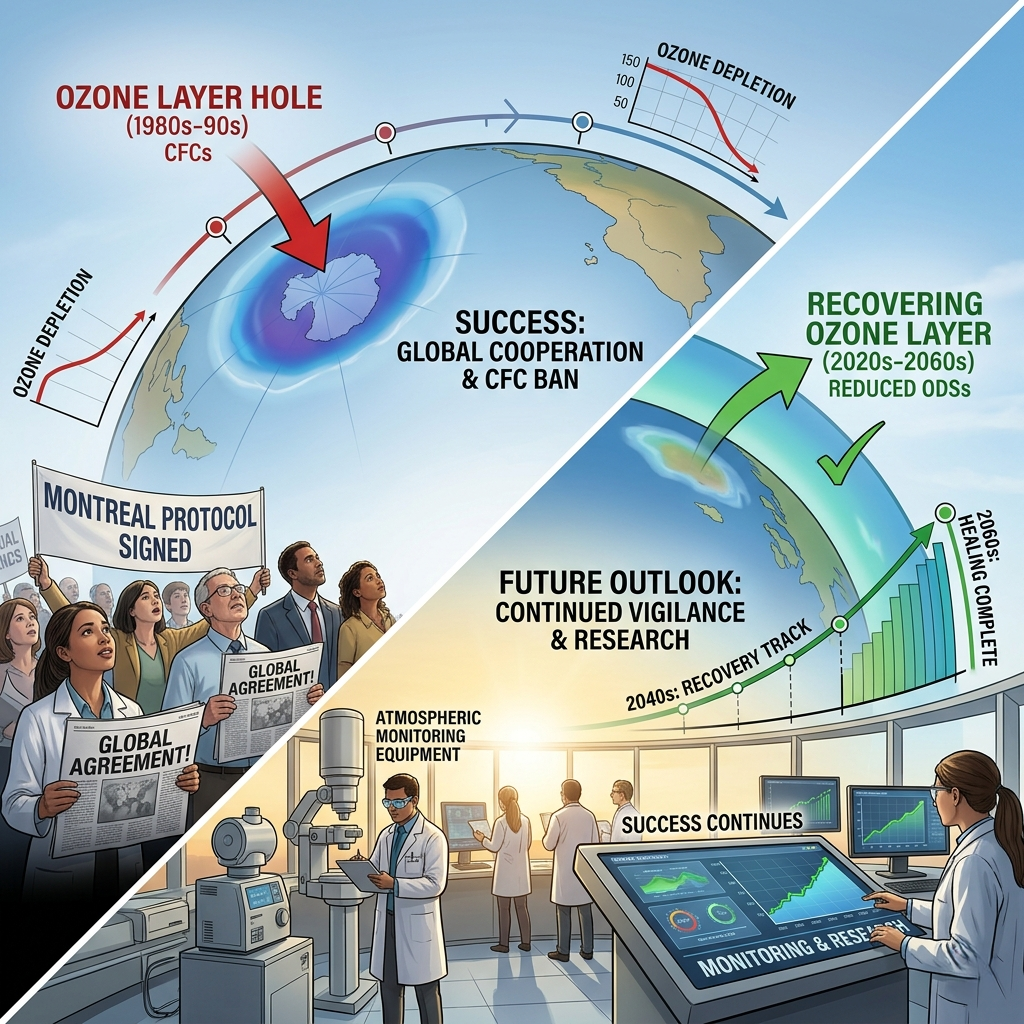
The ozone layer was thinning, especially over Antarctica, creating what we now call the “ozone hole.”
Main cause:
- Chlorofluorocarbons (CFCs)
These chemicals were widely used in:
- Refrigerators
- Air conditioners
- Aerosol sprays
- Industrial processes
Once released, CFCs rose into the atmosphere and broke down ozone molecules.
The Turning Point: The Montreal Protocol
In 1987, the world came together to solve this problem.
The result was the Montreal Protocol, one of the most successful environmental agreements ever.
What it did:
- Phased out ozone-depleting substances
- Reduced global production of harmful chemicals
- Encouraged safer alternatives
Because of strong global cooperation, countries followed through on their commitments.
Is the Ozone Layer Recovering?
Yes, and that’s the good news.
Recent reports from the World Meteorological Organization and United Nations Environment Programme confirm steady recovery.
Expected recovery timeline:
- Mid-latitudes (most regions): around 2040
- Arctic: around 2045
- Antarctica: around 2060
So, while recovery takes time, progress is clearly visible.
What Would Have Happened Without Action
Scientists believe the situation could have been much worse.
Without the Montreal Protocol:
- Skin cancer rates would rise sharply
- Cataracts would become more common
- Ecosystems would face serious damage
In short, global health and the environment would be at major risk.
Challenges That Still Remain
Even though progress is strong, the work isn’t over.
Some replacement chemicals, like hydrofluorocarbons (HFCs), don’t harm ozone, but they do affect climate change.
That’s why new efforts, like the Kigali Amendment, aim to reduce their use.
Ongoing priorities:
- Continuous monitoring
- Strong global cooperation
- Climate-friendly alternatives
Real-World Lesson: When the World Works Together
The ozone story shows something powerful.
When countries listen to science and act together, real change happens.
This success gives hope for tackling other global issues, especially climate change.
FAQs
1. What is the ozone layer?
It’s a layer in the upper atmosphere that protects Earth by blocking harmful UV radiation.
2. What caused the ozone hole?
Mainly human-made chemicals like CFCs used in cooling and aerosol products.
3. Is the ozone layer fully recovered?
Not yet, but it is steadily improving and expected to recover by 2040–2060.
4. Why is the Montreal Protocol important?
It helped reduce harmful chemicals globally and played a key role in ozone recovery.
Final Thoughts
The recovery of the ozone layer is one of the greatest environmental success stories in history.
It shows that damage can be reversed but only with awareness, responsibility, and global action.
