


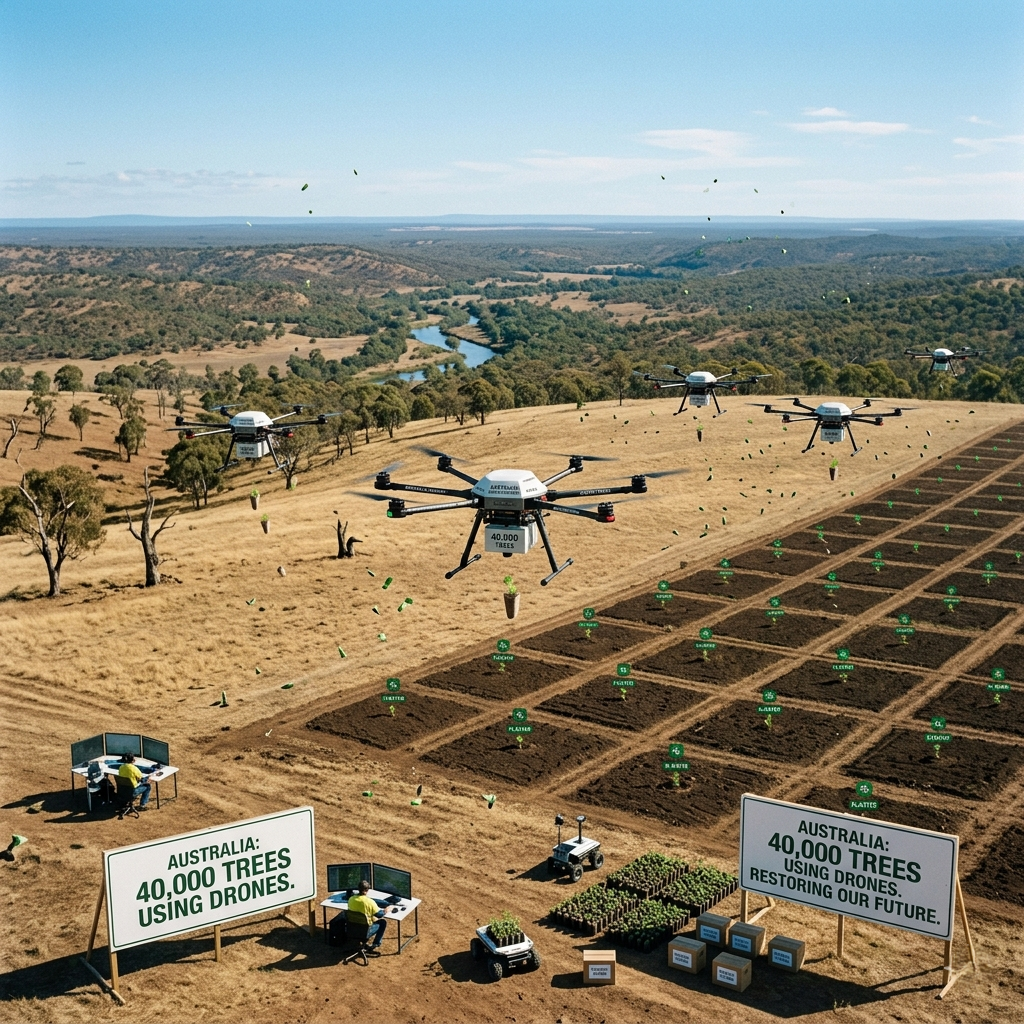
Introduction: A Smarter Way to Rebuild Forests
After devastating wildfires, restoring forests often takes years. However, Australia is changing that with a powerful new approach: drones that plant thousands of trees every single day.
This isn’t just innovation. Instead, it’s a faster, smarter way to heal damaged land and fight climate change at scale.
So, how do these drones actually work and why are they so effective? Let’s explore.
Why Tree Planting Needs a New Approach
Traditionally, planting trees is slow and labor-intensive. Workers must travel across rough land, dig holes, and plant seeds by hand.
Because of this, large-scale reforestation can take years.
However, after major bushfires, time becomes critical. Forests need quick recovery to protect wildlife, soil, and air quality.
That’s exactly where drones come in.
How Drone Tree Planting Works
Instead of relying on human labor alone, drones handle the process from above.
Here’s how it happens:
- First, drones scan the land and map the best planting zones
- Then, they fire seed pods directly into the soil
- Finally, they track growth using sensors and data
As a result, the entire process becomes faster, safer, and more precise.
Planting 40,000 Trees a Day: How Is It Possible?
This technology stands out because of its speed and efficiency.
Key Capabilities
- Plants up to 40,000 seeds per day
- Covers large, hard-to-reach areas
- Works even in dangerous or burnt landscapes
Because drones don’t need rest, they can operate continuously. Therefore, what once took months can now be done in days.
Real-World Impact in Fire-Affected Areas
Australia has faced some of the worst bushfires in recent history. These fires destroyed millions of hectares of forest and wildlife habitats.
However, drone technology is helping reverse that damage.
Key Benefits
- Faster forest recovery
- Reduced soil erosion
- Improved wildlife habitats
- Lower planting costs
In other words, drones don’t just plant trees; they rebuild entire ecosystems.
Case Study: Post-Bushfire Recovery
After major fires, certain regions struggled to regrow naturally. Traditional planting teams couldn’t cover enough ground quickly.
However, once drones were deployed, thousands of seeds were planted in just days.
Because of this rapid response, vegetation began returning much sooner than expected.
Drones vs Traditional Tree Planting
Let’s compare both methods clearly:
Traditional Planting
- Slow and labor-heavy
- Limited coverage
- Expensive over time
Drone Planting
- Fast and scalable
- Reaches remote areas easily
- Cost-effective and efficient
As a result, drones are becoming the preferred choice for large-scale reforestation.
Challenges and Limitations
Even though the technology is impressive, it’s not perfect.
Some challenges include:
- Not all seeds successfully grow
- Requires accurate data and planning
- Initial setup costs can be high
Still, improvements in AI and data tracking are solving these issues quickly.
What This Means for the Future
Clearly, drone planting is more than a trend; it’s the future of reforestation.
As technology improves, we can expect:
- Even higher planting success rates
- Smarter environmental monitoring
- Global adoption in fire-prone regions
Therefore, countries around the world may soon follow Australia’s lead.
FAQs
1. How do drones plant trees?
They shoot seed pods into the ground after scanning the land for the best planting spots.
2. Why use drones instead of humans?
Drones are faster, cheaper, and can reach dangerous or remote areas easily.
3. Do all seeds grow into trees?
Not all, but advanced techniques are improving survival rates.
4. Is this method used outside Australia?
Yes, several countries are starting to adopt drone-based reforestation.
Conclusion: Technology Meets Nature
Australia’s use of drones to plant 40,000 trees a day shows how technology can solve real-world problems.
Not only does this method save time and money, but it also helps restore nature faster than ever before.
