


For years, parents were told that screens were ruining their children’s eyesight.
Phones. Tablets. Video games.
But new research from the SUNY College of Optometry suggests the real problem may not be screens alone.
It’s the combination of prolonged close-up focus and dim indoor lighting.
And the solution might be surprisingly simple.
What the New Study Found
According to findings published in Cell Reports (February 19, 2026), reduced light exposure plays a major role in the development of childhood myopia.
Researchers found that:
- Close-up work strains developing eyes
- Dim indoor lighting limits light reaching the retina
- Bright outdoor light helps regulate healthy eye growth
In short, it’s not just screen time.
It’s the lighting environment.
Why Light Matters for Eye Development
The retina needs adequate light exposure to support proper growth.
When children spend most of their time indoors:
- Light intensity is significantly lower than outdoors
- The retina receives less stimulation
- Eye growth patterns may shift toward nearsightedness
Outdoor light is much brighter—even on cloudy days—than typical indoor lighting.
That difference appears to protect vision.
Is Screen Time Still a Problem?
Screens themselves are not completely innocent.
Long periods of close-up focus—whether reading a book or using a tablet—can increase eye strain.
But the study suggests the bigger issue is
- Continuous near work
- Limited breaks
- Lack of bright light exposure
Reducing screens alone may not solve the problem if children remain indoors.
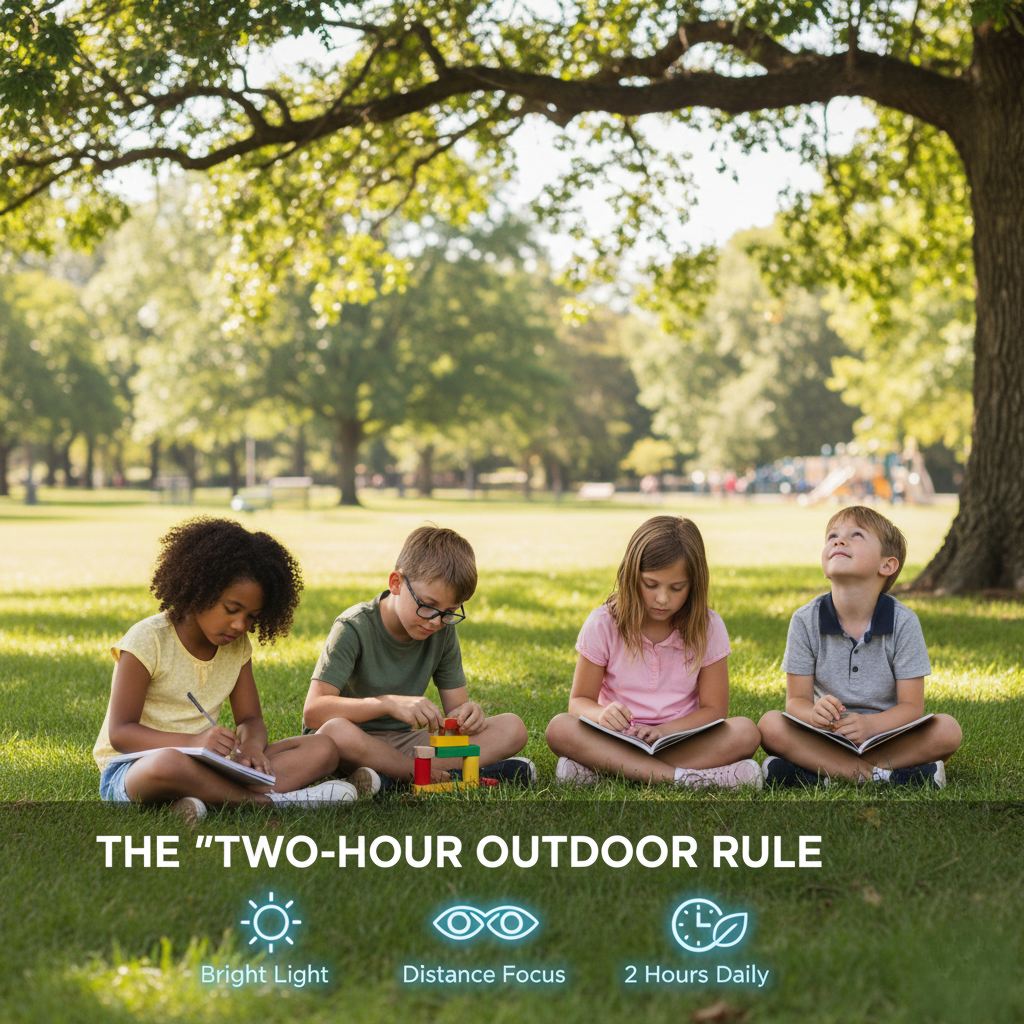
The “Two-Hour Outdoor Rule”
Experts now suggest a simple strategy for childhood myopia prevention:
Encourage children to spend about two hours outside daily.
This does not require intense exercise.
It can include:
- Playing in the yard
- Walking to school
- Outdoor sports
- Reading outside in daylight
The goal is consistent exposure to natural light.
Real-World Comparison: Indoor vs Outdoor Light
Let’s keep it simple.
Typical Indoor Lighting
- Around 300–500 lux
- Limited natural spectrum
- Constant near-focus activities
Outdoor Daylight
- Often 10,000 lux or more
- Full natural light spectrum
- Encourages distance viewing
The difference is dramatic.
Even shaded outdoor areas provide far more light than most classrooms or homes.
Why Myopia Is Rising Globally
Childhood myopia rates have increased worldwide over the past few decades.
Possible reasons include:
- More indoor lifestyles
- Increased academic pressure
- Less outdoor playtime
- Urban living environments
This study shifts the focus from blaming devices to understanding environmental habits.
Practical Tips for Parents
If you want to support your child’s eye health:
- Encourage outdoor play daily
- Use the 20-20-20 rule (every 20 minutes, look 20 feet away for 20 seconds)
- Improve indoor lighting when possible
- Balance screen time with outdoor time
Small daily changes may protect vision long-term.
FAQs
Does screen time cause myopia?
Screen time alone may not be the main cause. Prolonged close-up focus combined with dim lighting appears to play a larger role.
How much outdoor time helps prevent myopia?
Experts suggest about two hours of outdoor light exposure daily.
Why is outdoor light protective?
Bright natural light supports healthy retinal signaling and eye growth regulation.
Is reading indoors harmful?
Reading itself isn’t harmful, but long periods of close-up work without breaks and adequate lighting may increase risk.
Can myopia be reversed?
Myopia cannot usually be reversed naturally, but progression can sometimes be slowed with proper care and monitoring.
Final Thoughts
The message from this new research is clear.
It’s not just about limiting screens.
It’s about increasing light.
Encouraging children to spend more time outdoors may be one of the simplest and most powerful steps for protecting vision.
Sometimes the best prescription isn’t found in a clinic.
It’s found outside, in the daylight.
