


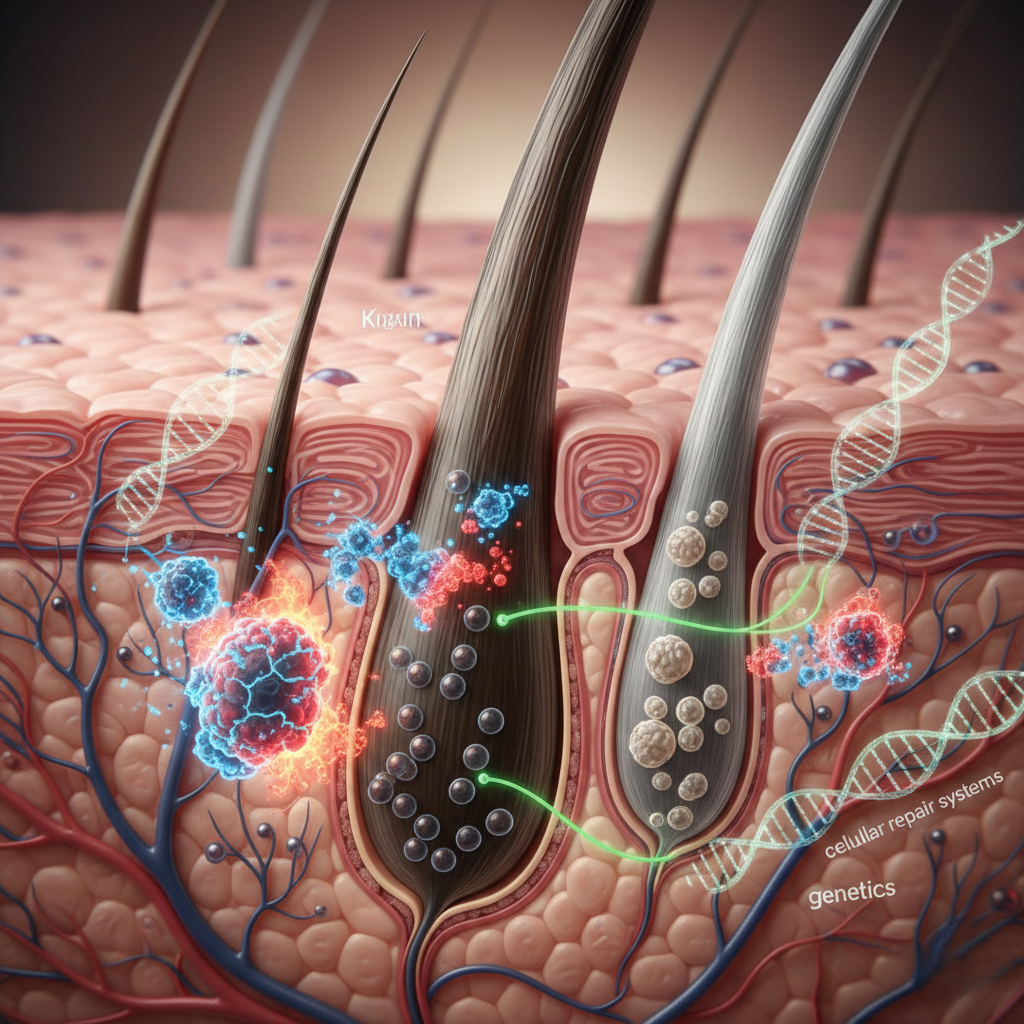
Introduction: Is Grey Hair Really Just About Age?
Most people think grey hair simply means getting older.
But science tells a more interesting story.
Grey strands appear when pigment-producing cells inside hair follicles slow down or stop working properly.
It’s less about birthdays.
And more about biology.
Let’s explore what’s really happening beneath the surface.
What Causes Hair to Turn Grey?
Hair color comes from a pigment called melanin.
Melanin is produced by specialized cells known as melanocytes.
These cells live inside each hair follicle.
When melanocytes slow down or lose function, new hair grows without pigment.
That’s when it appears grey or white.
So grey hair isn’t caused directly by aging.
It’s caused by pigment cell slowdown.
The Role of Melanocytes in Hair Color
Melanocytes are responsible for creating melanin.
Melanin determines whether your hair is:
- Black
- Brown
- Blonde
- Red
Over time, these cells may:
- Produce less pigment
- Become damaged
- Lose their ability to regenerate
When pigment production drops, color fades.
Eventually, strands grow in fully grey or white.
Oxidative Stress and Cellular Exhaustion
One major factor researchers point to is oxidative stress.
Oxidative stress happens when harmful molecules build up in the body.
These molecules can damage cells, including melanocytes.
As repair systems weaken with time, pigment cells may struggle to recover.
Think of it like a factory losing power.
Production slows down. Output drops.
In this case, pigment production declines.
Can Stress Really Cause Grey Hair?
Stress is often blamed for sudden greying.
There is some scientific support for this idea.
Severe stress may temporarily disrupt pigment production.
However, permanent grey hair usually involves deeper biological changes.
Genetics also plays a major role.
If your parents went grey early, you might too.
Stress can influence the process.
But it’s rarely the only cause.
Genetics and Medical Factors
Your DNA strongly affects when and how you go grey.
Some people notice strands in their twenties.
Others maintain natural color into their fifties.
Certain medical conditions may also impact pigment cells.
For example:
- Autoimmune disorders
- Vitamin deficiencies
- Thyroid imbalances
That’s why grey hair can sometimes reflect underlying health changes.
But often, it’s simply natural biology at work.
Is Grey Hair a Sign of Poor Health?
Not necessarily.
Grey hair is not a disease.
It’s a biological shift in pigment production.
However, scientists are studying what it reveals about cellular aging.
Melanocytes are sensitive cells.
When they weaken, it may reflect broader changes happening inside the body.
That’s why researchers are interested in pigment cells.
They may offer clues about regeneration and aging.
Can Grey Hair Be Reversed?
Currently, there’s no guaranteed way to permanently reverse grey hair naturally.
Some studies are exploring whether improving cellular health could support pigment cell function.
Researchers are investigating:
- Antioxidant support
- Cellular repair pathways
- Stem cell behavior
- Stress regulation
But for now, grey hair remains mostly irreversible once pigment cells stop functioning.
Real-World Perspective: What Grey Hair Really Means
A grey strand doesn’t mean your body is failing.
It doesn’t mean you’re unhealthy.
It means pigment cells have changed.
That change might involve:
- Genetics
- Stress exposure
- Natural cellular aging
- Environmental factors
In many ways, grey hair tells a story about your biology.
Not just your age.
FAQs About Why Hair Turns Grey
At what age does hair usually turn grey?
It varies. Some people notice grey hair in their twenties, while others maintain color much longer. Genetics plays a big role.
Can stress permanently turn hair grey?
Severe stress may influence pigment cells, but permanent greying usually involves deeper biological changes.
Does plucking grey hair cause more grey hair?
No. Removing one grey hair does not affect neighboring follicles.
Is grey hair linked to health problems?
Not usually. However, sudden or unusual changes should be discussed with a healthcare professional.
The Bigger Question: What Does Grey Hair Say About Aging?
Grey hair shows that aging isn’t just surface-level.
It reflects cellular behavior.
When pigment cells slow down, visible changes follow.
Understanding this process helps scientists explore bigger questions:
- How do cells regenerate?
- Why do some cells decline faster than others?
- Can we support cellular resilience?
Grey hair may be small.
But it opens the door to major biological research.
Final Thoughts: More Than Just a Color Change
Grey hair isn’t simply about getting older.
It’s about pigment cells adjusting over time.
Oxidative stress, genetics, and cellular health all play roles.
Instead of seeing grey strands as decline, we can view them as signals of how complex our biology really is.
Your hair carries a story.
And science is still learning how to read it.
