


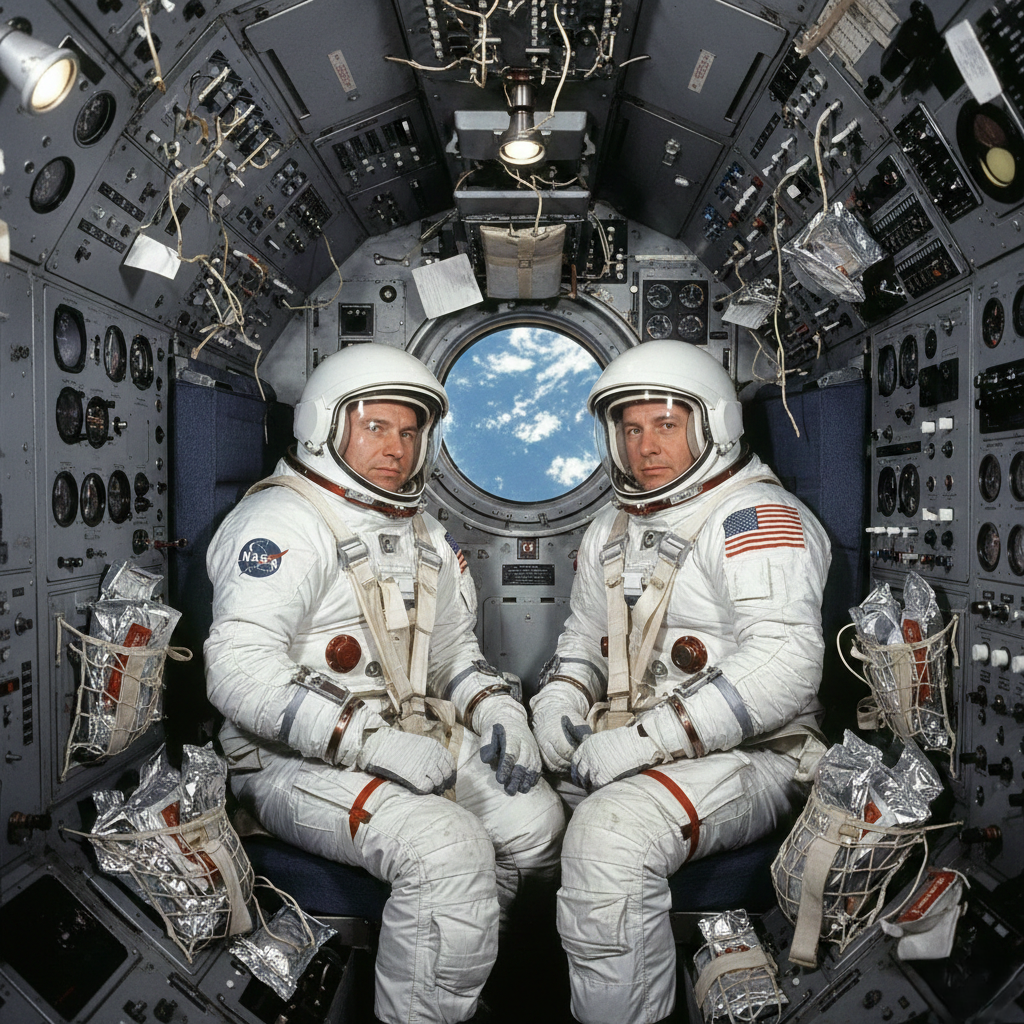
In December 1965, NASA carried out one of the hardest human endurance missions in space history.
Gemini VII wasn’t about speed or distance. It was about seeing how long humans could survive in space under extreme conditions.
A Mission With One Simple but Brutal Goal
Astronauts Frank Borman and James Lovell launched on December 4, 1965.
Two Weeks Inside a Tiny Capsule
Their task was clear:
- Stay in orbit for 14 straight days
- Live inside a spacecraft barely larger than a closet
- Collect data on human health and endurance
At the time, no one had ever tried anything like it.
Life Inside a Space the Size of a Car Seat
The Gemini VII capsule had only 55 cubic feet of living space.
Almost No Room to Move
That’s roughly the size of:
- The front seat area of a compact car
The astronauts:
- Could not stand up
- Could not stretch properly
- Spent nearly all their time strapped into seats
Comfort was not part of the design.
Daily Struggles in Orbit
Living conditions grew worse as the days passed.
Heat, Air, and Hygiene Challenges
Inside the capsule:
- Air became stale
- Hygiene options were extremely limited
- Waste had to be stored onboard
Smells and discomfort became constant companions.
The Physical and Mental Toll
The mission tested more than just the body.
Endurance Under Pressure
Borman and Lovell faced:
- Muscle stiffness
- Ongoing fatigue
- Mental stress from confinement
Despite this, they stayed focused and completed their tasks.
Why Gemini VII Was So Important
The discomfort served a larger purpose.
A Key Step Toward the Moon
Gemini VII proved that:
- Humans could survive long periods in microgravity
- Extended missions were medically possible
- Future Moon missions could be planned safely
This data directly supported the Apollo program.
A Legacy That Reached Beyond Gemini
The mission’s lessons didn’t stop with Apollo.
Impact on Future Space Stations
Findings from Gemini VII helped shape:
- Apollo Moon landings
- Skylab missions
- Long-duration space station stays
Modern astronauts still benefit from this early research.
More Than Metal and Machines
Gemini VII showed that space exploration is deeply human.
Courage Inside a Tiny Box
What looked like a small metal capsule became a powerful test of resilience.
The mission proved that:
- Spaceflight challenges the mind as much as technology
- Human determination is central to exploration
Without missions like Gemini VII, deep space travel wouldn’t be possible.
FAQs About Gemini VII
How long did Gemini VII last?
The mission lasted 14 days, a record at the time.
How small was the capsule?
It had about 55 cubic feet of living space.
Why was the mission important?
It proved humans could survive long space missions.
Final Thoughts: Endurance That Shaped Space History
Gemini VII may not be as famous as the Moon landings, but its impact was just as important.
By enduring extreme discomfort, two astronauts helped unlock the future of human spaceflight.
