


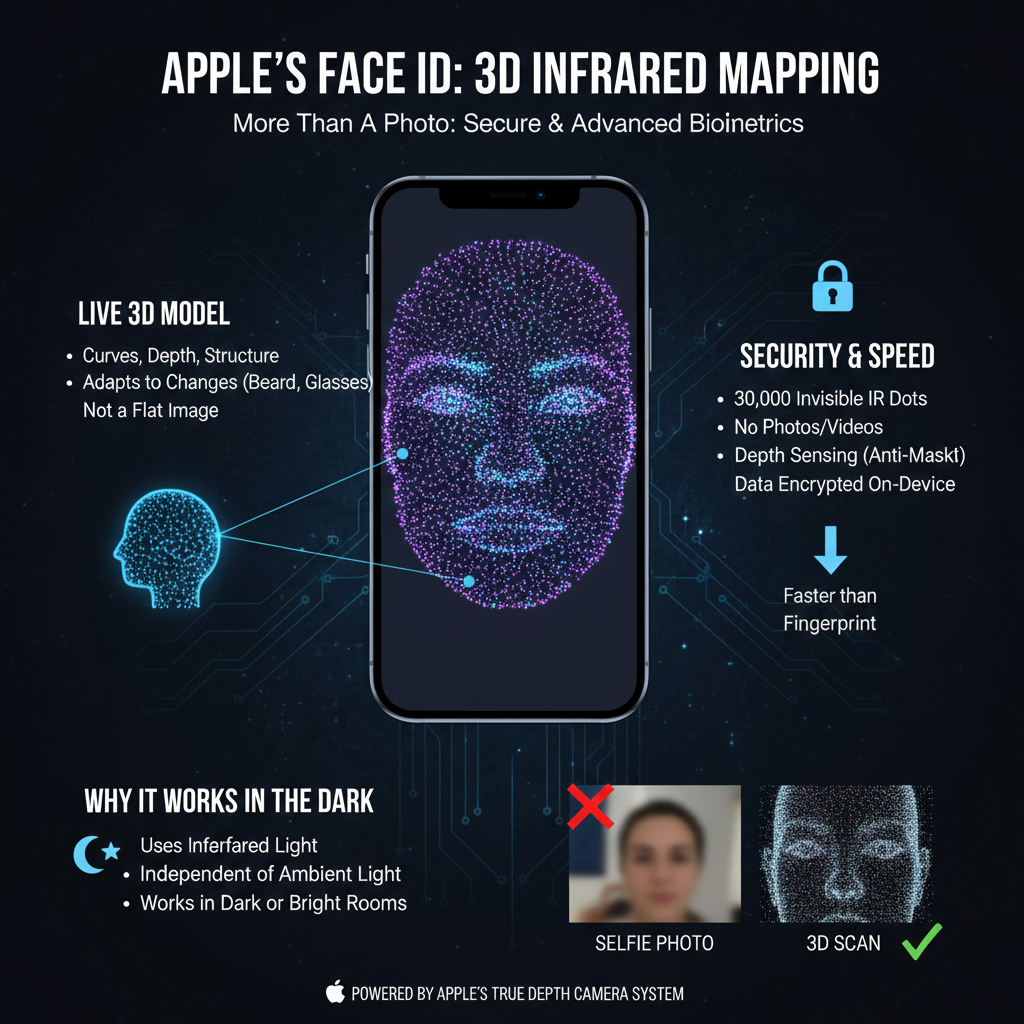
Many people think Apple’s Face ID works by snapping a photo of your face. That sounds simple but it’s completely wrong. Face ID is far more advanced and secure than that.
Instead of using a picture, Apple uses invisible infrared technology to map your face in 3D.
Face ID Uses 30,000 Invisible Infrared Dots
When you look at your iPhone or iPad, the device projects around 30,000 tiny infrared dots onto your face. You can’t see them, but the sensors can.
These dots carefully measure:
- The curves of your face
- The depth of your eyes, nose, and mouth
- The overall shape of your facial structure
This data is used to create a highly detailed facial map.
A Live 3D Model, Not a Flat Image
Face ID doesn’t store a photo. Instead, it builds a live three-dimensional model of your face.
This model updates over time, which helps Face ID recognize you even if:
- You grow a beard
- Wear glasses or makeup
- Change hairstyles
Because it understands depth, Face ID knows the difference between a real face and a flat image.
Why Face ID Works in the Dark
Since Face ID uses infrared light, it doesn’t depend on normal lighting. That’s why it works perfectly in:
- Bright sunlight
- Dim rooms
- Complete darkness
Your phone can “see” your face even when you can’t see anything around you.
What Makes Face ID So Secure
Face ID focuses on shape and depth, not color or texture. This makes it very hard to fool.
Key security advantages include:
- Can’t be unlocked with photos or videos
- Depth sensing blocks masks and prints
- Data is stored securely on the device
This is why Apple uses Face ID for payments, passwords, and app security.
Real-World Comparison
A normal camera sees your face like a selfie. Face ID sees your face like a 3D scan.
That difference is what makes Face ID:
- Faster than fingerprint scanning
- More accurate in different conditions
- Stronger against hacking attempts
Why Apple Chose This Approach
Apple designed Face ID to be simple for users but extremely complex behind the scenes. The goal was clear—make security strong without making life harder.
And that’s exactly what Face ID delivers.
FAQs
Q: Can Face ID be fooled by a photo?
No. Photos are flat, and Face ID requires depth data.
Q: Does Face ID store my face online?
No. All facial data stays encrypted on your device.
Q: Does Face ID work with glasses or hats?
Yes. It adapts to small changes over time.
Final Thoughts
Face ID is not just a camera—it’s a powerful 3D mapping system. By using thousands of invisible infrared points, Apple created a fast, secure, and reliable way to unlock devices in any lighting condition.
Understanding how it works shows why Face ID remains one of the most advanced biometric systems in consumer technology.
