


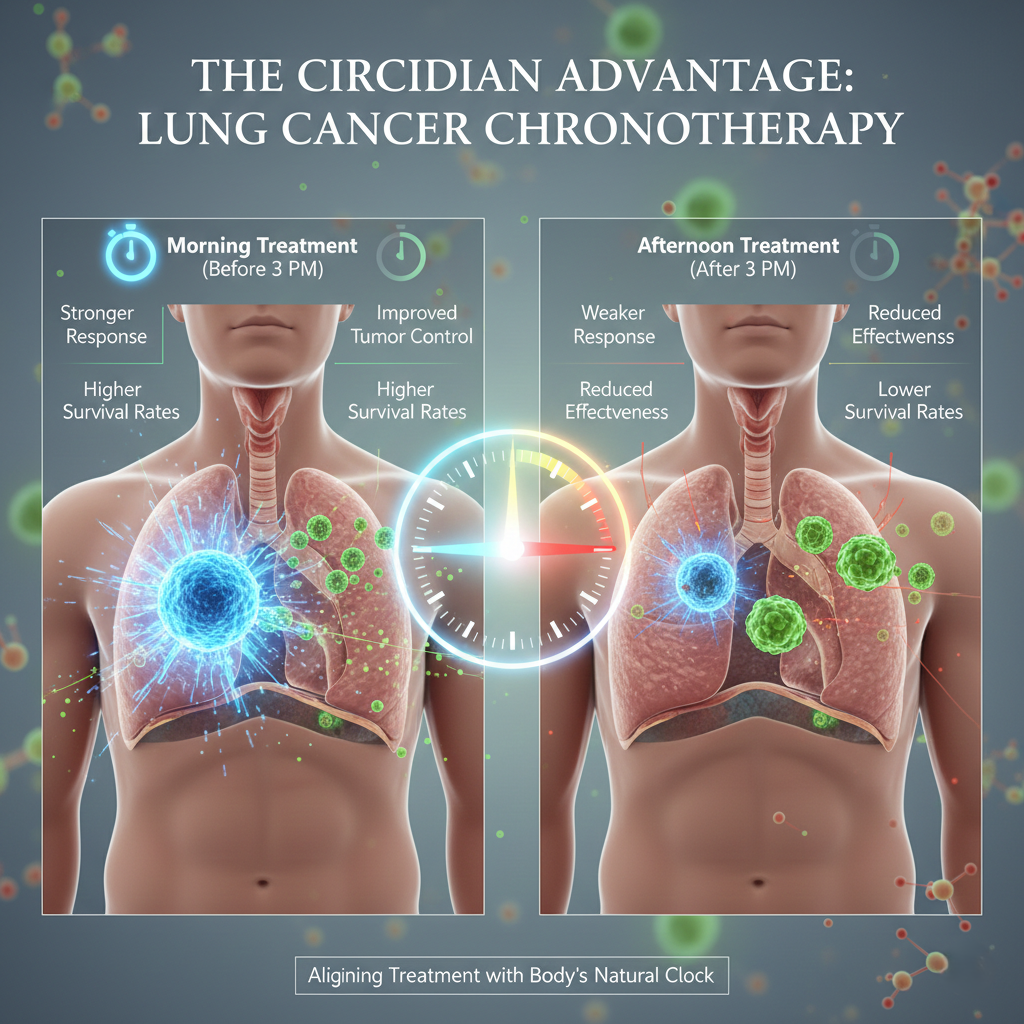
Timing might be the missing piece in cancer care. New research suggests lung cancer treatment works better when given earlier in the day.
Doctors have noticed a clear pattern. Patients treated before 3:00 p.m. often survive longer than those treated later.
This discovery could change how cancer treatment is planned in the future.
The Surprising Link Between Time and Cancer Treatment
For years, cancer care focused on drugs, doses, and genetics. Now, scientists are looking at time of day.
This idea comes from circadian rhythms, the body’s natural 24-hour clock.
These rhythms control many vital processes, including
- Immune system strength
- Hormone release
- Cell repair
- Inflammation levels
When treatment matches these cycles, the body may respond better.
What the New Lung Cancer Study Found
A major study published in The Lancet Oncology looked at lung cancer patients receiving immunotherapy.
Researchers compared patients treated:
- Before 3:00 p.m.
- After 3:00 p.m.
The results were striking.
Patients treated earlier in the day showed better survival rates and stronger treatment responses.
Why the 3 PM Cutoff Matters
The hours before mid-afternoon appear to be a biological sweet spot.
During this time:
- Immune cells are more active
- Inflammation is better controlled
- The body handles stress more efficiently
After 3 p.m., these protective effects may start to fade.
This could reduce how well treatments like immunotherapy work.
How Circadian Rhythms Boost Cancer Therapy
Circadian rhythms act like an internal manager, telling the body when to fight and when to rest.
When cancer treatment aligns with this system:
- Drugs may attack cancer cells more effectively
- Healthy cells may suffer less damage
- Side effects may be milder
This explains why timing could matter as much as the treatment itself.
Real-World Example: Immunotherapy Timing
Immune checkpoint inhibitors rely on a strong immune response.
If given when immune activity is high, the therapy may:
- Activate more cancer-fighting cells
- Improve tumor control
- Extend survival
Morning or early afternoon infusions seem to support this process better.
Will Hospitals Change Treatment Schedules Soon?
Not yet—but change may be coming.
Doctors agree that more large-scale trials are needed before official guidelines are updated.
Still, this research opens the door to time-based precision medicine.
In the future, cancer care may be tailored to:
- The patient
- The cancer type
- The time of day
FAQs
Does treatment timing affect all lung cancer patients?
Not necessarily. The strongest evidence is for patients receiving immunotherapy, especially in advanced lung cancer.
Why does the immune system work better earlier in the day?
Immune activity follows circadian rhythms and is often stronger during daytime hours.
Should patients ask for morning treatment now?
Patients should talk to their oncologist. Treatment timing depends on many medical factors.
Is this idea used in other diseases?
Yes. Time-based treatment, called chronotherapy, is already used in some heart and blood pressure conditions.
Final Thoughts
This research highlights a powerful idea: when treatment happens may matter as much as what treatment is used.
As science advances, the clock could become a key tool in cancer care.
If future studies confirm these findings, lung cancer treatment may soon be scheduled not just by availability but by biology.
The future of cancer care may be timed to the body itself.
