


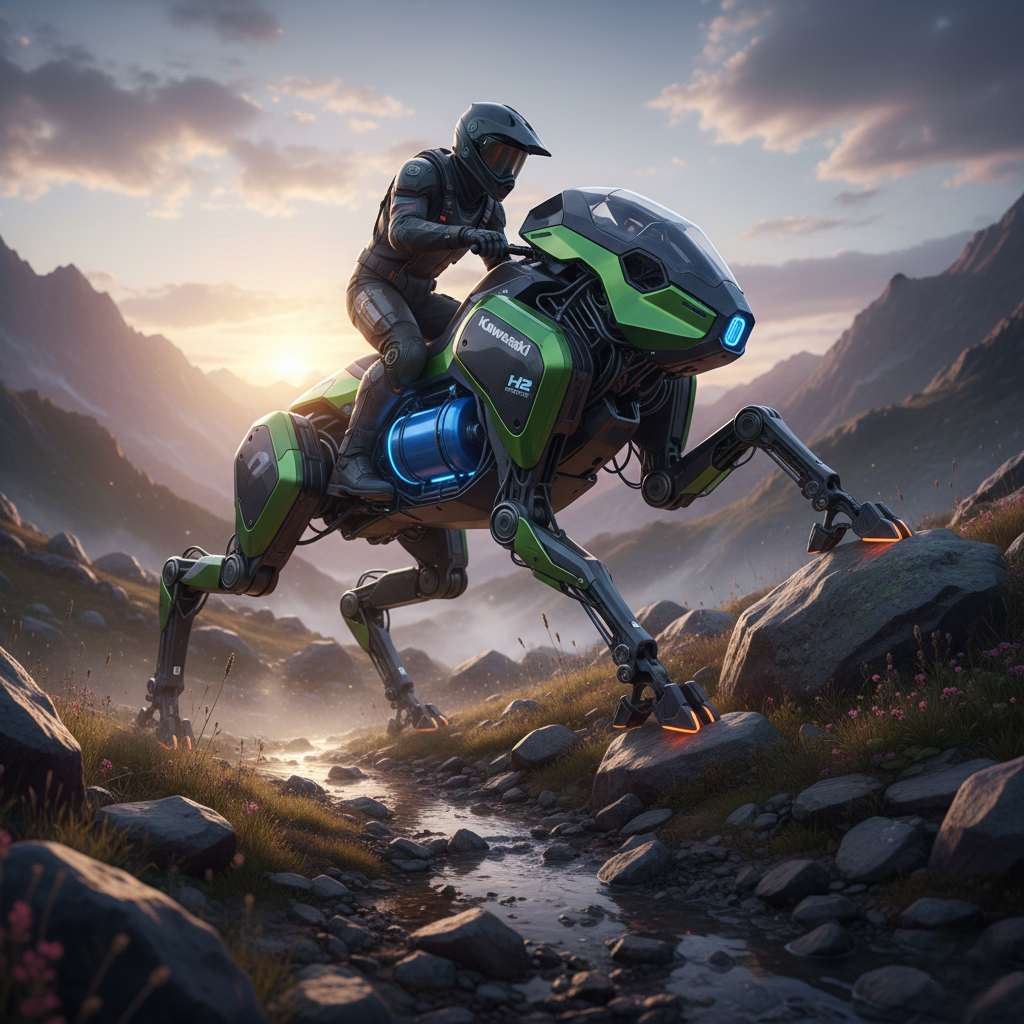
The Future of Off-Road Travel Has Legs
Imagine riding a machine that doesn’t need roads.
No wheels. No tracks. Just four powerful robotic legs adapting to rocks, mud, and steep hills in real time.
That’s exactly what Kawasaki Corleo promises—a hydrogen-powered robotic mount designed to walk across terrain where traditional vehicles fail.
It’s not just another futuristic concept. It’s a bold rethink of how personal transportation could work in extreme environments.
What Is Kawasaki Corleo?
Kawasaki Corleo is a quadruped robotic vehicle powered by hydrogen.
Instead of wheels, it uses four advanced robotic legs that move independently.
The idea is simple:
Let the machine adapt to the land—instead of forcing the land to fit the machine.
This approach blends:
- Robotics
- Clean hydrogen energy
- AI balance systems
- Bio-inspired mobility
It feels less like riding a motorcycle and more like riding a living creature.
How Kawasaki Corleo Is Powered
A 150cc Hydrogen Engine That Generates Electricity
At the core of Corleo is a 150cc hydrogen engine.
But it doesn’t directly move the legs.
Instead:
- The hydrogen engine generates electricity.
- That electricity powers motors and actuators in each leg.
- The robotic system controls movement using AI software.
Why Hydrogen?
Kawasaki chose hydrogen for practical reasons:
- Produces only water vapor (zero carbon emissions at use point)
- Higher energy density than traditional batteries
- Faster refueling compared to electric charging
- Lightweight compared to large battery packs
For long off-road missions, fast refueling can be a game changer.
How Corleo Walks on Any Terrain
A Quadruped Robotic Platform
Corleo uses four robotic legs, each with:
- Multiple mechanical joints
- Integrated motion sensors
- Real-time balance software
- Independent motor control
Each leg adjusts separately, helping the vehicle stay stable on uneven ground.
Split Rubber Hooves Inspired by Mountain Goats
At the bottom of each leg are split rubber hooves.
These are designed to:
- Grip loose gravel
- Stabilize on rocks
- Absorb shock
- Climb steep slopes
- Handle mud and soft soil
Think of how a mountain goat climbs steep cliffs. Corleone uses similar principles.
Where motorcycles spin out, Corleo steps forward.
How You Control Kawasaki Corleo
There are no handlebars. No throttle. No traditional controls.
Corleo responds to your body movements.
- Lean forward → speed up
- Shift weight left or right → turn
- Adjust posture → stabilize on rough terrain
An AI system constantly monitors:
- Terrain changes
- Rider balance
- Leg positioning
- Surface grip
It makes tiny corrections in milliseconds.
The result feels more natural than mechanical.
Real-World Applications of Corleo
Kawasaki didn’t design Corleo just for fun. It targets places where roads don’t exist.
1. Mountain Rescue & Disaster Response
In earthquake zones or landslides, wheeled vehicles struggle.
A walking machine could navigate debris more safely.
2. Military & Remote Patrol
Border patrol or rough terrain missions often require off-road mobility.
Corleo could reduce dependency on traditional vehicles.
3. Scientific Research
Fragile ecosystems, glaciers, and mountain environments need low-impact transport.
Walking machines may cause less surface disruption.
4. Adventure Tourism
Extreme exploration markets are growing.
Imagine guided robotic mount tours in deserts or mountain trails.
5. Rural and Off-Grid Transport
In remote villages without proper roads, walking mobility could offer a new solution.
Corleo vs Traditional Off-Road Vehicles
| Feature | Motorcycle | ATV | Kawasaki Corleo |
|---|---|---|---|
| Works on steep rocks | Limited | Moderate | Excellent |
| Mud traction | Low | Medium | High |
| Zero emissions | No | No | Yes (hydrogen) |
| Adapts to terrain | No | No | Yes |
| Fast refueling | Yes | Yes | Yes (hydrogen) |
Corleo isn’t replacing motorcycles.
It’s redefining mobility in extreme terrain.
Timeline: When Will Corleo Be Available?
- Expo 2025 (Osaka) → Public concept showcase
- Expo 2030 (Riyadh) → Planned demonstration rides
- Around 2035 → Target for commercial release
However, several challenges remain.
Challenges Kawasaki Must Solve
1. Hydrogen Storage Safety
Hydrogen requires secure, high-pressure storage systems.
2. Joint Durability
Robotic legs must survive dust, water, impact, and heavy loads.
3. High Production Costs
Advanced robotics and hydrogen systems are expensive.
4. Regulation
How will governments classify it?
Vehicle? Robot? Something new?
These questions must be answered before mass production.
Why Kawasaki Corleo Matters
Corleo represents something bigger than a new vehicle.
It signals a shift toward bio-inspired mobility.
Just as drones changed air access, walking machines could reshape land access.
If scalable, this technology could:
- Expand transportation in remote areas
- Reduce environmental damage
- Enable safer disaster response
- Open new exploration possibilities
This isn’t just innovation. It’s evolution.
Frequently Asked Questions (FAQs)
Is Kawasaki Corleo fully electric?
It runs on electricity, but that electricity comes from a hydrogen-powered engine.
Does it produce emissions?
At the point of use, it emits only water vapor.
Is it available for purchase?
Not yet. Commercial release is expected around 2035.
Is it safer than a motorcycle?
Potentially on rough terrain, thanks to AI balance systems. But real-world testing will determine that.
Conclusion: A Glimpse Into Terrain-Free Transportation
Kawasaki Corleo shows us a future where roads are optional.
Instead of building infrastructure to fit vehicles, vehicles may adapt to nature.
If hydrogen infrastructure expands and robotic systems become more affordable, Corleo could become the foundation of a new mobility category.
The question is no longer if machines can walk.
It’s whether we’re ready to ride them.
