


Introduction
Most people have never heard of phonons. Yet, they quietly control how modern technology works.
From overheating laptops to advanced quantum devices, the real story often comes down to tiny vibrations inside materials.
These vibrations may seem invisible. However, they are becoming one of the most important tools in modern science.
So, what exactly are phonons, and why should you care?
What Are Phonons (In Simple Terms)
Let’s keep it easy.
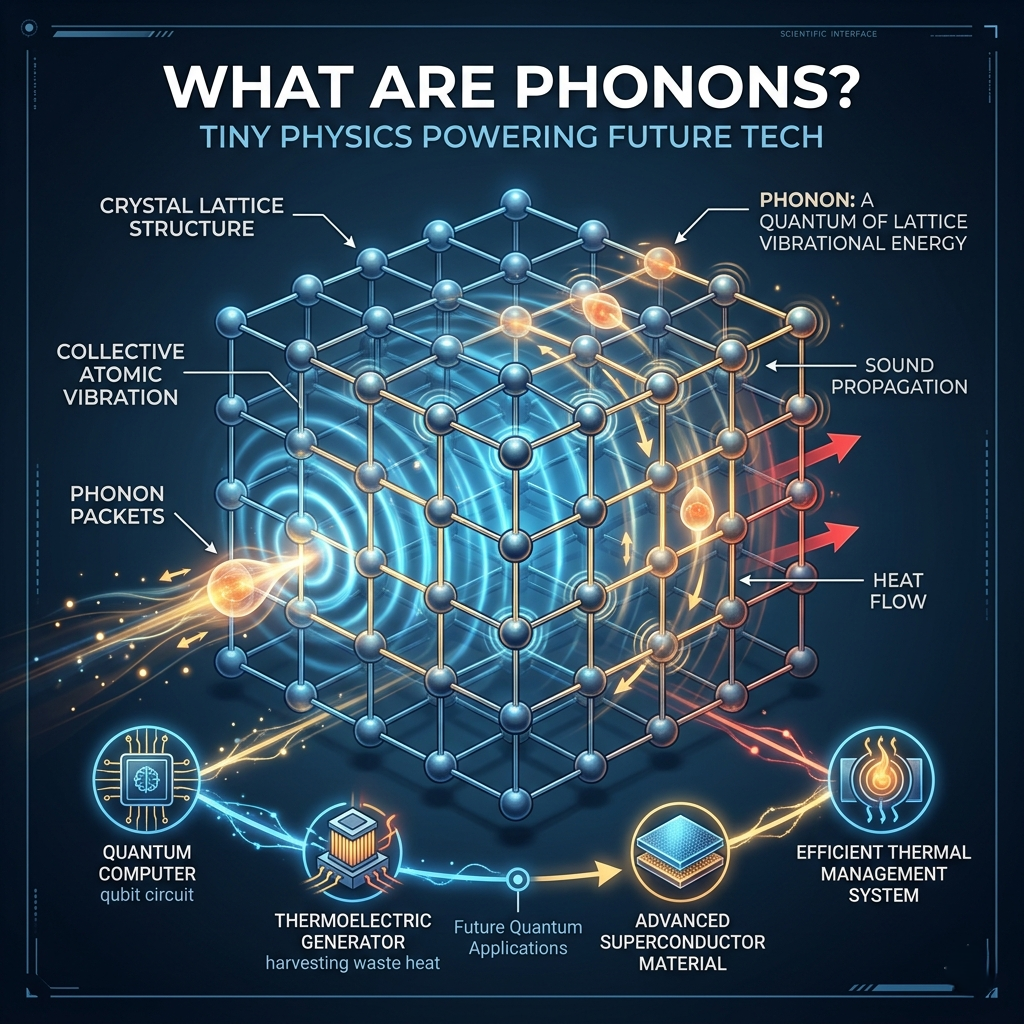
A phonon is a tiny unit of vibration moving through a solid material. In physics, this is called a
quantized vibration
Think of it like this:
👉 Imagine a wave moving through a stadium crowd.
Now replace people with atoms whose moving wave is similar to a phonon.
Instead of tracking every single atom, scientists describe the motion as one “particle-like” unit. That’s the phonon.
Why Phonons Matter More Than You Think
At first, this might sound like a classroom concept. However, phonons directly affect real-world technology.
They control key material properties.
- How heat moves through a material
- How sound travels
- How energy is lost or conserved
Because of this, phonons play a huge role in how efficient devices become.
How Phonons Affect Everyday Technology
Now let’s connect this to things you actually use.
1. Overheating in Devices
Laptops and smartphones often slow down due to heat.
Phonons control how that heat spreads. So, better phonon control means cooler devices.
2. Computer Chips
Modern chips generate a lot of heat.
If engineers manage phonons better, chips can run faster without overheating.
3. Data Centers
Huge data centers consume massive energy.
By reducing wasted heat through phonon control, companies can cut costs and improve efficiency.
The Role of Phonons in Advanced Technologies
This is where things get even more exciting.
Thermoelectric Materials
These materials convert heat into electricity.
Better phonon control reduces energy loss, making them more efficient.
Quantum Devices
In quantum computing, even tiny vibrations matter.
Phonons can either help or disrupt quantum systems. So, controlling them is critical.
Next-Gen Materials
Scientists are designing materials at the atomic level.
By managing phonons, they can create:
- Stronger materials
- More efficient electronics
- Better energy systems
Why 2026 Materials Science Is So Exciting
Here’s the interesting part.
Big technological breakthroughs are no longer just about bigger machines. Instead, they depend on tiny, invisible changes.
Phonons are a perfect example.
Although you can’t see them, they influence how materials behave from the inside out. Because of this, researchers are focusing more on controlling vibrations than ever before.
Real-World Example
Consider a high-performance laptop.
If engineers improve phonon behavior:
- Heat spreads more efficiently
- The system stays cooler
- Performance improves without extra energy
So, something as small as atomic vibrations can directly improve everyday devices.
Common Misunderstandings
Let’s clear up a few things.
Phonons are NOT:
- Physical particles like electrons
- Something you can see or touch
- Only theoretical concepts
Instead, they are a practical way to describe how atoms move together in solids.
FAQs
1. What is a phonon in simple words?
It’s a tiny vibration moving through a solid, treated like a particle in physics.
2. Why are phonons important?
They control heat, sound, and energy flow in materials.
3. Can phonons improve technology?
Yes, better phonon control can make devices faster, cooler, and more efficient.
4. Are phonons used in real-world applications?
Absolutely. They are important in electronics, energy systems, and quantum devices.
5. Can we control phonons?
Scientists are actively working on ways to control them in advanced materials.
Final Thoughts
Phonons may sound obscure, but they are quietly shaping the future of technology.
From reducing overheating to improving energy efficiency, these tiny vibrations are becoming a powerful tool for engineers and scientists.
As research advances, controlling phonons could unlock faster computers, better materials, and smarter energy systems.
