

Science Fiction Is Knocking on the Classroom Door
What if learning a new language didn’t take years?
What if your brain could absorb information faster—not by downloading knowledge, but by working more efficiently?
That idea used to belong in sci-fi movies. Now, advances in neurotechnology suggest it may be possible.
Researchers are testing wearable brain interfaces that could boost natural learning speed. And the results are raising big questions about the future of education.
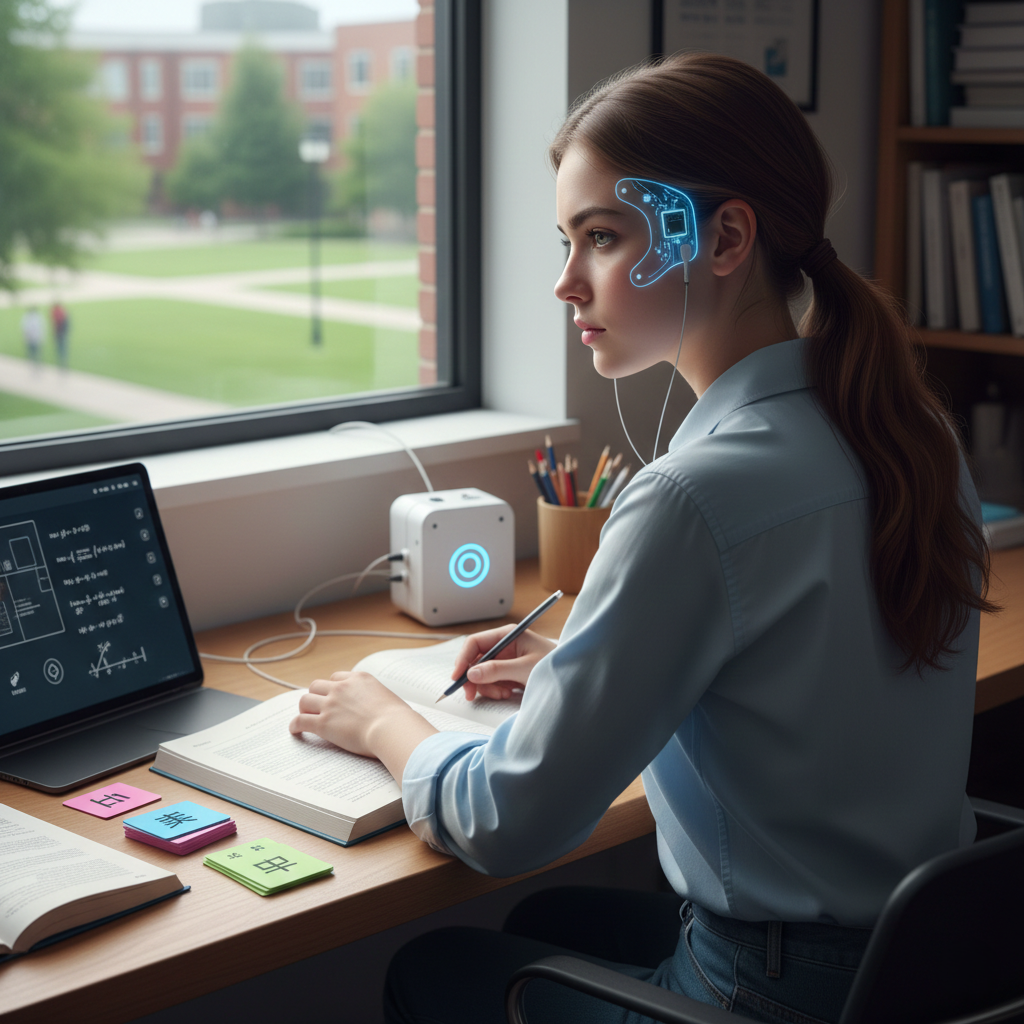
What Is a Neural Learning Patch?
Some researchers compare it to a “neural lace,” but it’s much simpler than that.
It’s a non-invasive wearable patch placed on the head. It doesn’t insert anything into the brain. There’s no surgery.
Instead, it uses gentle electrical or magnetic stimulation to support brain activity during learning.
Important:
It does not upload information into your brain.
It simply helps neurons communicate more efficiently while you study.
How the Brain Interface Works
Targeting Key Learning Areas
The patch focuses on brain regions linked to:
- Language processing
- Memory formation
- Sound recognition
- Attention control
When you combine stimulation with normal practice—reading, speaking, listening—the brain enters an “optimized” learning state.
Think of it like improving Wi-Fi speed.
The internet (your brain) is the same. The connection just runs smoother.
Does It Actually Improve Learning Speed?
Early controlled studies using similar brain stimulation methods show promising results.
Participants using stimulation during language training:
- Learned vocabulary faster
- Improved pronunciation more quickly
- Understood grammar sooner
- Reached basic conversation skills in days instead of months
The key point?
The brain still does the work.
The technology simply creates better conditions for learning.
It’s acceleration—not automation.
Real-World Example: Language Learning Trials
In experimental training programs, volunteers were split into two groups:
- Traditional study only
- Study combined with non-invasive brain stimulation
The second group consistently showed faster improvement.
For example:
- Better recall of new words
- Higher listening accuracy
- Faster response times in speaking tasks
This suggests enhanced neuroplasticity—the brain’s ability to reorganize and form new connections.
Beyond Language: Where This Technology Could Be Used
The impact may stretch far beyond classrooms.
1. Stroke Rehabilitation
Stroke patients often need to relearn speech.
Boosting neural communication during therapy could speed recovery.
2. Learning Difficulties
Students with dyslexia or processing disorders might benefit from targeted stimulation during practice.
3. Professional Training
Pilots, surgeons, or emergency responders require rapid skill development.
Optimized learning states could reduce training time while maintaining quality.
4. Memory Support in Aging
As people age, memory naturally slows.
Gentle stimulation may help maintain cognitive flexibility.
The Science Behind It: Brain Plasticity
The human brain is more adaptable than we once believed.
This adaptability is called neuroplasticity.
When we learn something new, neurons form stronger connections.
Stimulation techniques appear to enhance this process by:
- Increasing neural responsiveness
- Improving signal timing
- Strengthening connection efficiency
It’s like giving your brain a small performance boost during training sessions.
Ethical and Safety Considerations
Researchers are clear about one thing:
This technology must be handled responsibly.
Key concerns include:
- Long-term safety
- Informed consent
- Fair access
- Overuse risks
- Cognitive inequality
Before widespread adoption, strong regulation and clinical validation are essential.
Enhancing learning should never come at the cost of safety.
Is This the Future of Education?
We are not talking about instant downloads like in movies.
We’re talking about improving natural learning systems.
If proven safe and effective, neural stimulation tools could:
- Shorten training timelines
- Support medical rehabilitation
- Help struggling learners
- Improve cognitive therapy
Education may shift from “how long it takes” to “how efficiently the brain adapts.”
That’s a major change.
Frequently Asked Questions (FAQs)
Does this device upload knowledge into the brain?
No. It only enhances natural neural communication during learning.
Is it invasive?
Current research focuses on non-invasive stimulation. No surgery is required.
Is it available to the public?
Not yet. It’s still in controlled research and testing phases.
Is it safe?
Early studies suggest short-term safety, but long-term effects still require more research.
Why This Matters
For decades, we assumed learning speed had hard biological limits.
Now, neuroscience suggests those limits may be more flexible than we thought.
If we can safely improve how neurons connect during training, we may unlock faster recovery, stronger education systems, and better human performance.
This isn’t about replacing teachers.
It’s about unlocking the brain’s full potential.
