


Most people think a baby’s health depends mainly on the mother.
But new research suggests fathers play a deeper role than we once believed.
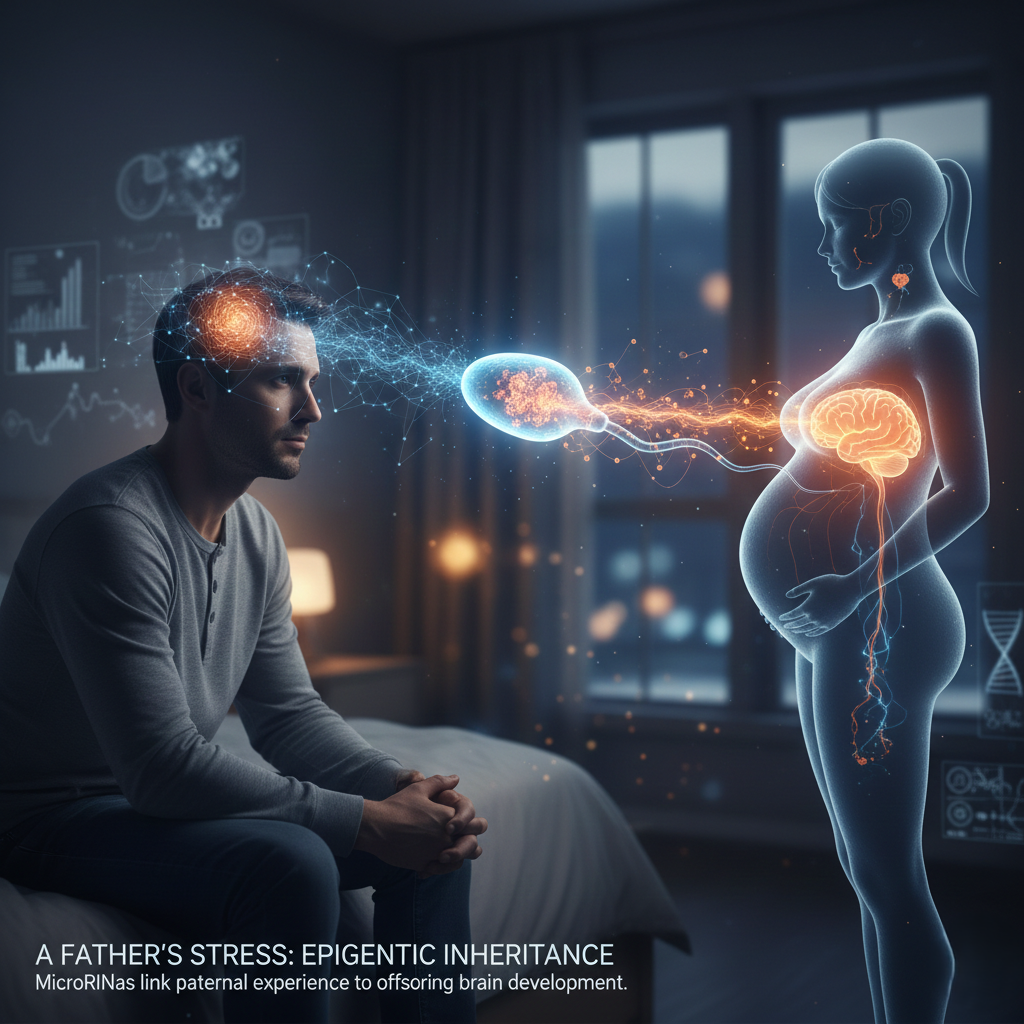
Scientists now say a father’s chronic stress may influence his child’s brain development—even before pregnancy begins.
This discovery is changing how experts think about mental health and parenthood.
How Can Stress Be Passed to the Next Generation?
The answer lies in something very small.
Inside sperm cells are tiny molecules called microRNAs. These molecules help control how genes turn on and off.
When a father experiences long-term stress, these microRNAs can change.
Those changes may then affect how a baby’s brain develops after conception.
What Are MicroRNAs, and Why Do They Matter?
MicroRNAs act like tiny switches for genes.
They don’t change DNA itself. Instead, they influence how genes behave.
This process is known as epigenetics—changes in gene activity without altering genetic code.
Research from institutions like the University of Pennsylvania, along with findings published in Nature Neuroscience, suggests stress can modify these gene regulators.
That modification may shape brain and hormone development in children.
What Did the Studies Find?
In controlled experiments, researchers observed children of stressed fathers.
They noticed differences in:
- Stress hormone regulation
- Brain response to challenges
- Emotional resilience
- Anxiety-related behaviors
In simple terms, these children processed stress differently.
Some showed lower resilience when facing difficult situations.
Why Stress Hormones Matter
Our bodies rely on hormones like cortisol to manage stress.
When this system works properly, we adapt and recover from pressure.
But if stress regulation is altered early in development, it may affect:
- Emotional balance
- Mental health
- Risk of anxiety disorders
- Ability to cope with challenges
Brain development is highly sensitive during early stages.
Even small biological shifts can have long-term effects.
Real-World Example
Imagine two children facing a stressful exam.
One remains calm and focused. The other becomes overwhelmed and anxious.
While many factors influence behavior, researchers believe inherited stress patterns may partly explain such differences.
It doesn’t mean destiny is fixed.
But it suggests biology may shape stress responses before birth.
Does This Mean Stress Guarantees Problems?
No.
This research does not suggest that every stressed father will have children with emotional difficulties.
Human development depends on many factors, including:
- Environment
- Parenting style
- Nutrition
- Social support
- Genetics
Stress-related changes simply add another layer to the picture.
The key message is awareness, not fear.
Why This Research Is Important
For years, conversations about preconception health focused mostly on mothers.
Now, scientists are expanding that view.
This research highlights that a father’s mental well-being before conception may also matter.
It strengthens the idea that preparing for parenthood includes emotional health for both parents.
What Experts Recommend
While research continues, experts suggest practical steps for men planning families:
- Manage chronic stress early
- Seek support for anxiety or depression
- Exercise regularly
- Maintain healthy sleep habits
- Build strong social connections
Simple lifestyle changes may support both personal well-being and future family health.
Frequently Asked Questions (FAQs)
1. Can a father’s stress really affect a baby before pregnancy?
Yes. Research suggests chronic stress can alter sperm microRNAs, which may influence gene regulation after conception.
2. Does this change a child’s DNA?
No. It does not alter DNA itself. It affects how genes are expressed.
3. Are these effects permanent?
Not necessarily. Environment and upbringing still play major roles in shaping development.
4. Should men delay having children if stressed?
Not automatically. But improving mental health before conception is beneficial for overall well-being.
5. Is this research fully proven?
Studies are growing, but scientists are still exploring the exact biological mechanisms.
Final Thoughts
The idea that a father’s stress could shape a child’s brain might sound surprising.
But science continues to show how connected our bodies truly are.
Mental health is not just personal. It may influence future generations in ways we are only beginning to understand.
