

Close Menu
Innovate And ExploreInnovate And Explore

    Subscribe to Updates

    Get the latest creative news from FooBar about art, design and business.

    What's Hot

    Top WordPress Plugins for SEO: Boost Your Rankings Easily

    April 25, 2026

    Best Laptops for Students in 2026: Smart Picks for Every Budget

    April 25, 2026

    AI Fooled by a Fake Disease: What the Bixonimania Experiment Reveals

    April 25, 2026
    Facebook Instagram
    Facebook Instagram YouTube TikTok
    Innovate And ExploreInnovate And Explore
    • Artificial Intelligence
    • Medical Research
    • Technology News
    • Science News
    • VR Headset
    • Palantir
    Innovate And ExploreInnovate And Explore
    Home » UK Patient Calls Neuralink Brain Chip “Magical” After Implant
    Technology News

    UK Patient Calls Neuralink Brain Chip “Magical” After Implant

    alfredBy alfredFebruary 12, 2026No Comments4 Mins Read
    Facebook Twitter Pinterest LinkedIn Tumblr WhatsApp Email
    Share
    Facebook Twitter LinkedIn WhatsApp Pinterest Email

    Imagine controlling a computer using only your thoughts.

    For one patient in the UK, that idea is no longer science fiction.

    Sebastian Gomez Pena, who was paralyzed from the neck down after an accident during medical school, has become one of the first people in the country to receive Elon Musk’s Neuralink brain chip.

    He described the experience as “magical.”

    What Is the Neuralink N1 Implant?

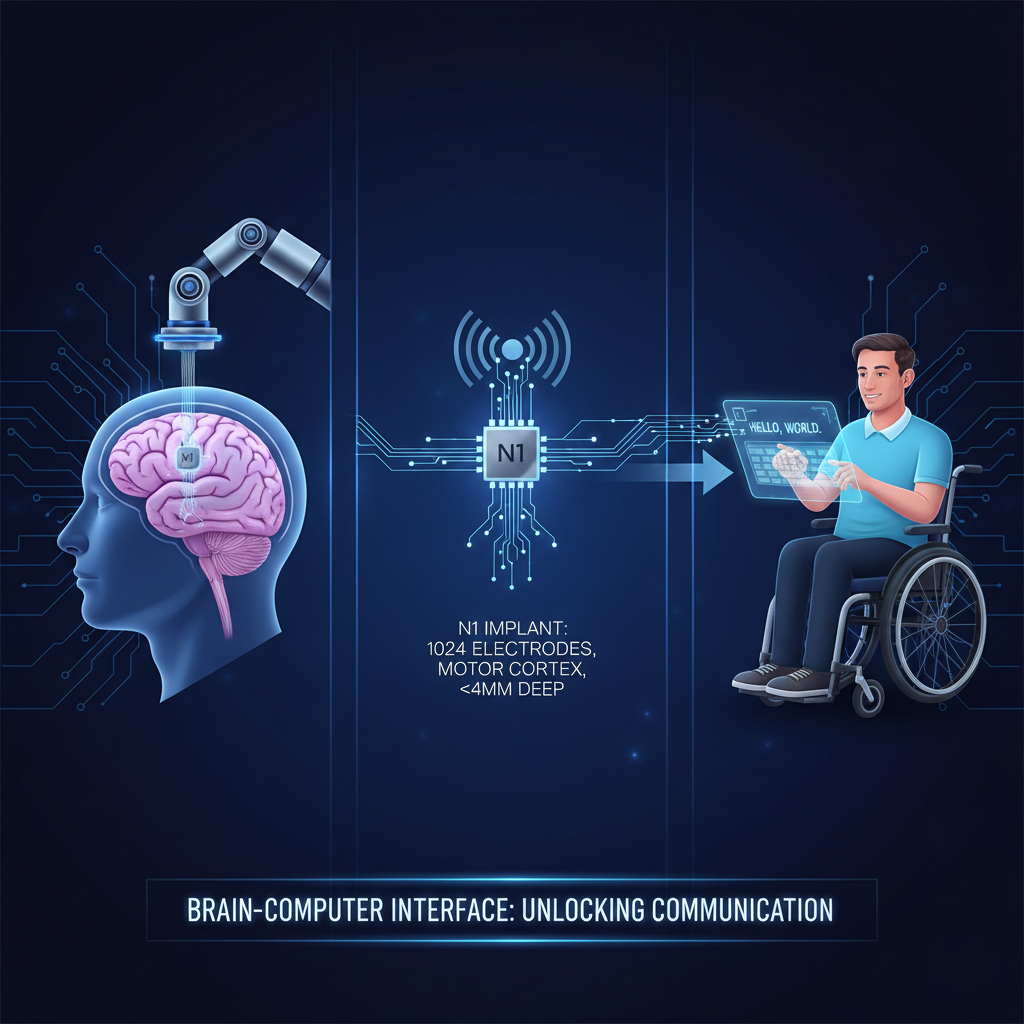
    The device, called the N1 implant, is part of Neuralink’s brain-computer interface system.

    It is designed to connect the human brain directly to digital devices.

    The implant was placed at University College London Hospital as part of the GB PRIME clinical trial, an early study focused on safety and performance.

    Sebastian is one of seven participants in the UK taking part in the trial.

    How the Brain Chip Works

    The N1 implant uses advanced technology to link brain signals to a small device.

    Here’s how it works:

    • 1,024 tiny electrodes are inserted into the brain
    • The electrodes go about four millimeters deep
    • They are placed in the motor cortex, which controls movement
    • Ultra-thin threads connect brain cells to the implant

    These threads are thinner than a human hair.

    Because the procedure is so delicate, Neuralink uses a special surgical robot called R1 to place them with high precision.

    What Can the Chip Do?

    The goal is simple but powerful.

    The chip aims to allow people with severe paralysis to:

    • Control a computer cursor
    • Type using thoughts
    • Communicate digitally
    • Operate devices without physical movement

    Early findings suggest the system may help users send commands to digital devices directly from brain signals.

    For someone unable to move their body, this could be life-changing.

    Why This Trial Matters

    Spinal cord injuries often cut off communication between the brain and muscles.

    Even though the brain still sends signals, the body cannot respond.

    Neuralink’s technology attempts to capture those signals directly from the brain and convert them into digital actions.

    If successful, it could:

    • Restore communication abilities
    • Increase independence
    • Improve quality of life

    However, researchers stress that the study is still in early stages.

    Safety and long-term effects are still being carefully monitored.

    Real-World Impact

    For Sebastian, the experience has already felt transformative.

    Calling the chip “magical” reflects the emotional impact of regaining some form of control.

    For people living with paralysis, even small improvements can mean greater freedom.

    This technology does not cure paralysis.

    But it may offer new tools to bridge the gap between brain and machine.

    Questions and Ethical Considerations

    While the innovation is exciting, experts are also discussing:

    • Long-term safety
    • Data privacy
    • Brain signal security
    • Ethical use of neural technology

    Brain-computer interfaces raise important questions about how far technology should integrate with the human body.

    These conversations will likely grow as the technology develops.

    Frequently Asked Questions (FAQs)

    1. Is the Neuralink brain chip approved for public use?

    No. It is currently being tested in clinical trials to evaluate safety and performance.

    2. Does the implant cure paralysis?

    No. It does not restore movement yet. It aims to help users control devices using brain signals.

    3. Is the surgery risky?

    Like all brain procedures, it carries risks. That is why early trials focus heavily on safety.

    4. How many people have received the implant?

    In the UK trial, seven participants are currently involved.

    5. Could this technology help other conditions?

    In the future, brain-computer interfaces may be studied for other neurological conditions, but research is still ongoing.

    Final Thoughts

    Neuralink’s UK trial marks an important step in brain-computer interface technology.

    For patients like Sebastian Gomez Pena, the implant represents hope—not just technology.

    While it’s still early, the possibility of controlling devices with thought alone could reshape how we support people with severe paralysis.

    The road ahead will require careful testing, ethical oversight, and transparency.

    advanced encryption standard ai chatgpt ai science news artificial general intelligence california science center hologram museum medical research palantir quantum physics science center science fair board science museum scientific method tech news virtual reality headset
    Share. Facebook Twitter Pinterest LinkedIn Tumblr WhatsApp Email
    alfred

    Related Posts

    Top WordPress Plugins for SEO: Boost Your Rankings Easily

    April 25, 2026

    Best Laptops for Students in 2026: Smart Picks for Every Budget

    April 25, 2026

    AI Fooled by a Fake Disease: What the Bixonimania Experiment Reveals

    April 25, 2026

    Top Website Builders for Small Businesses (Easy & Affordable)

    April 24, 2026

    Benefits of Intermittent Fasting: A Simple Guide That Works

    April 24, 2026

    Best Budget Smartphones 2026: Top Picks That Truly Deliver

    April 24, 2026
    Add A Comment
    Leave A Reply Cancel Reply

    Don't Miss

    Top WordPress Plugins for SEO: Boost Your Rankings Easily

    By alfredApril 25, 2026

    Introduction: Why SEO Plugins Matter More Than Ever If you run a WordPress site, SEO…

    Best Laptops for Students in 2026: Smart Picks for Every Budget

    April 25, 2026

    AI Fooled by a Fake Disease: What the Bixonimania Experiment Reveals

    April 25, 2026

    Top Website Builders for Small Businesses (Easy & Affordable)

    April 24, 2026
    Stay In Touch
    • Facebook
    • Twitter
    • Pinterest
    • Instagram
    • YouTube
    • Vimeo
    Our Picks

    Top WordPress Plugins for SEO: Boost Your Rankings Easily

    April 25, 2026

    Best Laptops for Students in 2026: Smart Picks for Every Budget

    April 25, 2026

    AI Fooled by a Fake Disease: What the Bixonimania Experiment Reveals

    April 25, 2026

    Top Website Builders for Small Businesses (Easy & Affordable)

    April 24, 2026

    Subscribe to Updates

    Get the latest creative news from SmartMag about art & design.

    Techlo Inno
    Innovate And Explore
    Facebook Instagram YouTube TikTok
    • About Us
    • Cookies Policy
    • Editorial Policy
    • Terms & Conditions
    © 2026 Innovate and Explore. Designed by Techlo Inno.

    Type above and press Enter to search. Press Esc to cancel.

    Powered by
    ►
    Necessary cookies enable essential site features like secure log-ins and consent preference adjustments. They do not store personal data.
    None
    ►
    Functional cookies support features like content sharing on social media, collecting feedback, and enabling third-party tools.
    None
    ►
    Analytical cookies track visitor interactions, providing insights on metrics like visitor count, bounce rate, and traffic sources.
    None
    ►
    Advertisement cookies deliver personalized ads based on your previous visits and analyze the effectiveness of ad campaigns.
    None
    ►
    Unclassified cookies are cookies that we are in the process of classifying, together with the providers of individual cookies.
    None
    Powered by