
Close Menu
Innovate And ExploreInnovate And Explore

    Subscribe to Updates

    Get the latest creative news from FooBar about art, design and business.

    What's Hot

    What Are Phonons? The Tiny Physics Behind Future Technology

    April 23, 2026

    Vitamin K Shot Refusal Raises Serious Risks for Newborns

    April 23, 2026

    Top AI Tools for Remote Work to Boost Productivity in 2026

    April 23, 2026
    Facebook Instagram
    Facebook Instagram YouTube TikTok
    Innovate And ExploreInnovate And Explore
    • Artificial Intelligence
    • Medical Research
    • Technology News
    • Science News
    • VR Headset
    • Palantir
    Innovate And ExploreInnovate And Explore
    Home » Isaac Newton’s 2060 Prediction: What Did He Really Mean?
    Science News

    Isaac Newton’s 2060 Prediction: What Did He Really Mean?

    alfredBy alfredFebruary 12, 2026No Comments3 Mins Read
    Facebook Twitter Pinterest LinkedIn Tumblr WhatsApp Email
    Share
    Facebook Twitter LinkedIn WhatsApp Pinterest Email

    When we think of Isaac Newton, we picture gravity, motion, and calculus.

    But there was another side to him.

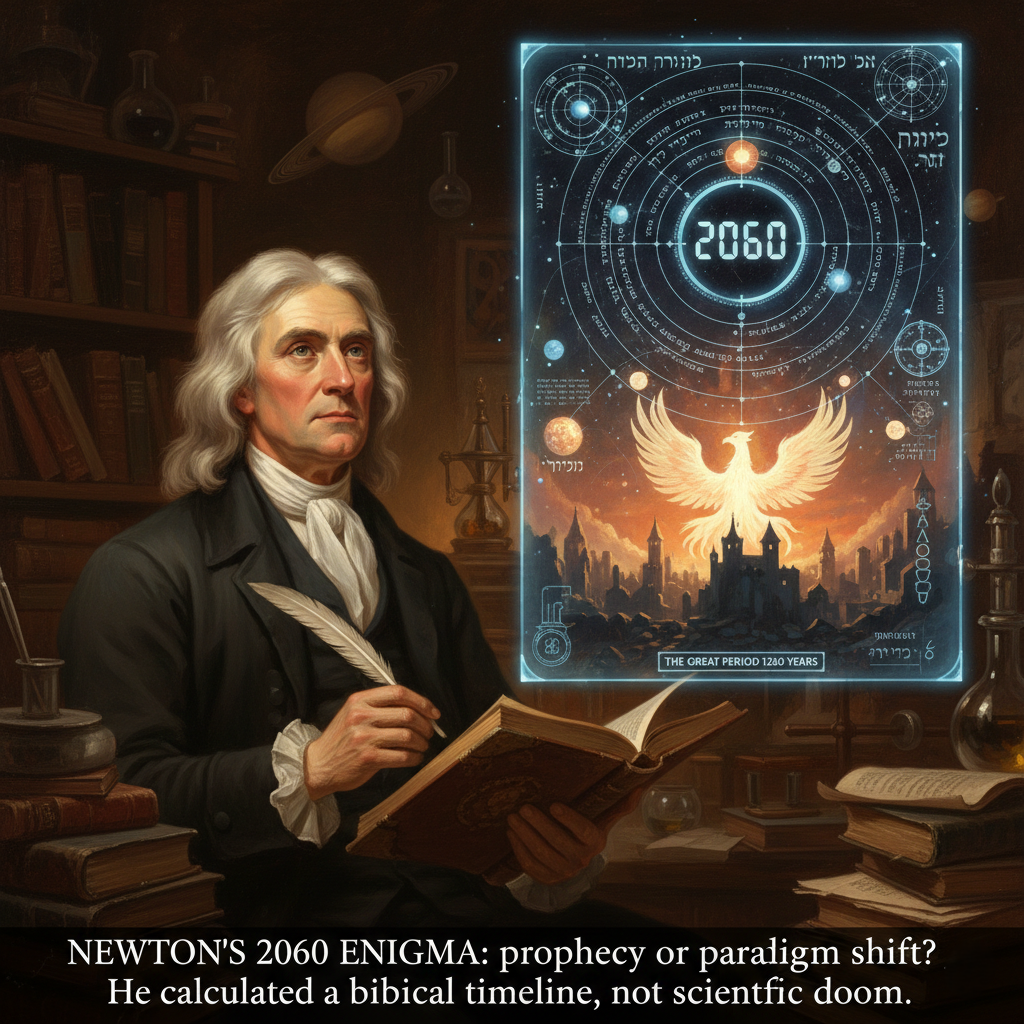
    Hidden in his private writings was a prediction that the year 2060 could mark the “end of the world.”

    Before you imagine fire falling from the sky, the story is far more complex—and surprisingly thoughtful.

    Newton’s Lesser-Known Interest: Biblical Prophecy

    Newton was not only a scientist.

    He spent years studying biblical texts, especially:

    • The Book of Daniel
    • The Book of Revelation

    He carefully examined timelines and symbolic numbers mentioned in scripture.

    For Newton, mathematics and faith were not separate. He believed both followed logical patterns.

    The 1,260-Year Calculation

    In his notes, Newton focused on a 1,260-year period mentioned in the Bible.

    He linked this timeline to the rise of the Holy Roman Empire in 800 CE.

    Here’s how his reasoning worked:

    1. Start with the year 800 CE
    2. Add 1,260 years
    3. Arrive at the year 2060

    That year, he believed, could mark a major shift in human history.

    Was Newton Predicting Total Destruction?

    Not exactly.

    Newton did not describe a fiery apocalypse or the end of humanity.

    Instead, he believed 2060 could represent:

    • The fall of corrupt institutions
    • A spiritual transformation
    • A new era of peace
    • A major political shift

    His view leaned more toward renewal than destruction.

    It was about change, not chaos.

    Why He Kept It Private

    Newton was cautious.

    In his writings, he warned that dramatic predictions could harm religious belief.

    He believed extreme claims often weakened faith instead of strengthening it.

    For him, these calculations were careful interpretations—not sensational headlines.

    That’s likely why he never loudly announced the 2060 date during his lifetime.

    Why This Matters Today

    As 2060 slowly approaches, many people rediscover this prediction online.

    But it’s important to understand context.

    Newton’s 2060 calculation was:

    • A theological interpretation
    • Not a scientific forecast
    • Not based on physics or astronomy
    • Not a guaranteed event

    It shows how even one of history’s greatest scientists wrestled with big spiritual questions.

    The Bigger Picture: Science and Faith

    Newton lived in a time when science and religion were closely connected.

    He believed the universe operated under divine order.

    To him, studying scripture was another way of understanding truth.

    This makes his 2060 prediction less about doom—and more about his attempt to connect logic with belief.

    Frequently Asked Questions (FAQs)

    1. Did Isaac Newton really predict the world would end in 2060?

    He calculated 2060 as a possible turning point, but not necessarily total destruction.

    2. Was this prediction based on science?

    No. It was based on biblical interpretation, not physics or the mathematics of nature.

    3. Did Newton publicly announce this prediction?

    No. These writings were found after his death.

    4. Did he describe an apocalypse?

    Not in a dramatic sense. He expected transformation, not fiery destruction.

    5. Should we take the 2060 prediction seriously?

    It’s best viewed as a historical curiosity rather than a factual forecast.

    Final Thoughts

    Isaac Newton changed science forever.

    But he was also human—curious about faith, prophecy, and the future.

    His 2060 prediction was not a warning of doom.

    It was an attempt to understand history through scripture and numbers.

    Today, it serves as a fascinating reminder that even brilliant scientific minds explore big spiritual questions.

    As 2060 approaches, the real lesson may not be about the end of the world.

    It may be about the endless human desire to understand it.

    advanced encryption standard ai chatgpt ai science news artificial general intelligence california science center hologram museum medical research palantir quantum physics science center science fair board science museum scientific method tech news virtual reality headset
    Share. Facebook Twitter Pinterest LinkedIn Tumblr WhatsApp Email
    alfred

    Related Posts

    What Are Phonons? The Tiny Physics Behind Future Technology

    April 23, 2026

    Vitamin K Shot Refusal Raises Serious Risks for Newborns

    April 23, 2026

    Top AI Tools for Remote Work to Boost Productivity in 2026

    April 23, 2026

    Earth’s CO₂ Levels Hit 430 ppm: A Serious Climate Warning

    April 22, 2026

    AI Cameras in Factories: What’s Really Happening Behind Viral Videos?

    April 22, 2026

    Top AI Tools for Startups to Grow Faster in 2026

    April 22, 2026
    Add A Comment
    Leave A Reply Cancel Reply

    Don't Miss

    What Are Phonons? The Tiny Physics Behind Future Technology

    By alfredApril 23, 2026

    Introduction Most people have never heard of phonons. Yet, they quietly control how modern technology…

    Vitamin K Shot Refusal Raises Serious Risks for Newborns

    April 23, 2026

    Top AI Tools for Remote Work to Boost Productivity in 2026

    April 23, 2026

    Earth’s CO₂ Levels Hit 430 ppm: A Serious Climate Warning

    April 22, 2026
    Stay In Touch
    • Facebook
    • Twitter
    • Pinterest
    • Instagram
    • YouTube
    • Vimeo
    Our Picks

    What Are Phonons? The Tiny Physics Behind Future Technology

    April 23, 2026

    Vitamin K Shot Refusal Raises Serious Risks for Newborns

    April 23, 2026

    Top AI Tools for Remote Work to Boost Productivity in 2026

    April 23, 2026

    Earth’s CO₂ Levels Hit 430 ppm: A Serious Climate Warning

    April 22, 2026

    Subscribe to Updates

    Get the latest creative news from SmartMag about art & design.

    Techlo Inno
    Innovate And Explore
    Facebook Instagram YouTube TikTok
    • About Us
    • Cookies Policy
    • Editorial Policy
    • Terms & Conditions
    © 2026 Innovate and Explore. Designed by Techlo Inno.

    Type above and press Enter to search. Press Esc to cancel.

    Powered by
    ►
    Necessary cookies enable essential site features like secure log-ins and consent preference adjustments. They do not store personal data.
    None
    ►
    Functional cookies support features like content sharing on social media, collecting feedback, and enabling third-party tools.
    None
    ►
    Analytical cookies track visitor interactions, providing insights on metrics like visitor count, bounce rate, and traffic sources.
    None
    ►
    Advertisement cookies deliver personalized ads based on your previous visits and analyze the effectiveness of ad campaigns.
    None
    ►
    Unclassified cookies are cookies that we are in the process of classifying, together with the providers of individual cookies.
    None
    Powered by