


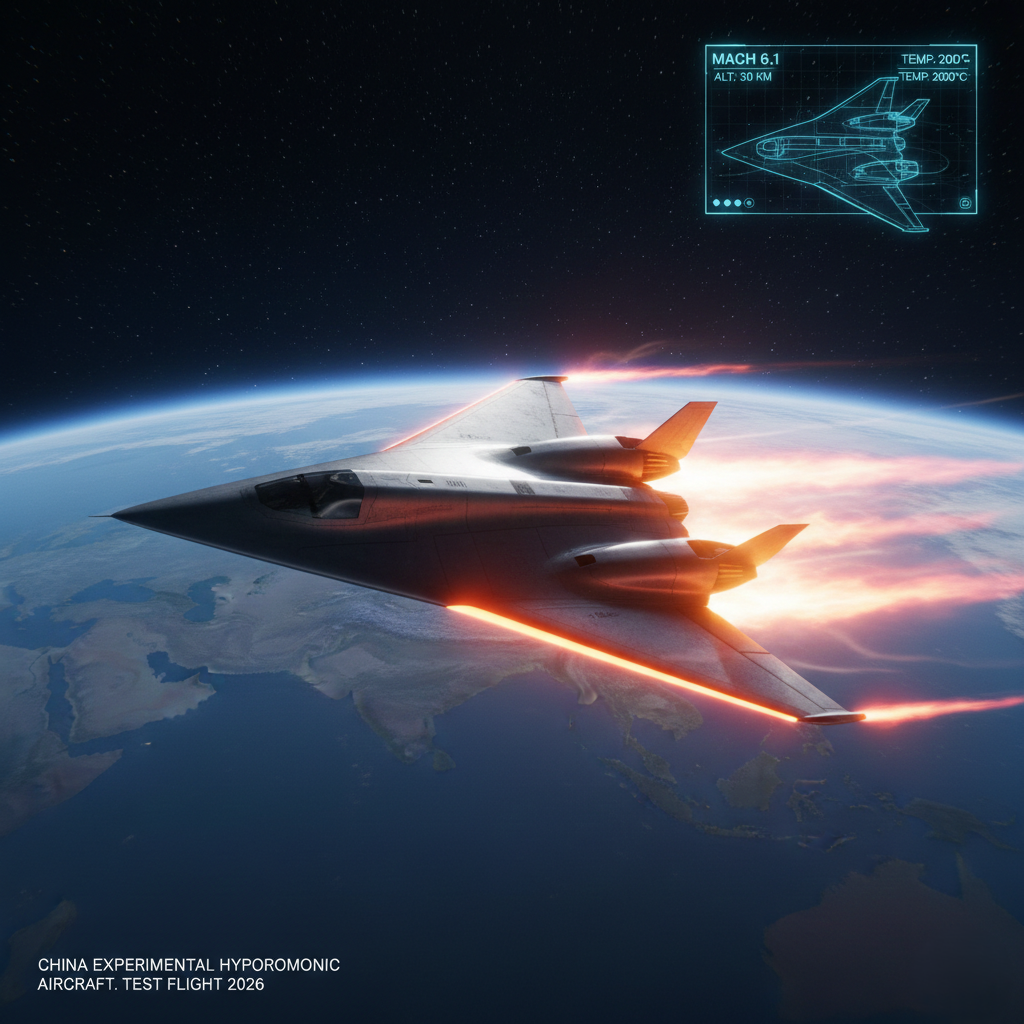
China has reportedly tested an experimental hypersonic aircraft that may reach speeds close to Mach 6.
That’s around 8,100 kilometers per hour.
To put it simply, that’s six times the speed of sound.
And once you cross Mach 5, you enter what scientists call hypersonic speed.
What Is Hypersonic Flight?
Hypersonic vehicles travel faster than Mach 5.
At these speeds:
- Air pressure becomes extreme
- Surface temperatures skyrocket
- Control becomes much more complex
Traditional aircraft design no longer works the same way.
This is why hypersonic research is considered one of the most advanced fields in aerospace engineering.
Why Mach 6 Is a Big Deal
Mach 6 is not just “very fast.”
At that speed:
- Detection becomes harder
- Interception becomes more difficult
- Reaction time shrinks dramatically
That’s why defense analysts worldwide are closely watching these developments.
Hypersonic systems are already reshaping global security planning.
Who Is Behind the Research?
Reports link the work to researchers associated with the Chinese Academy of Sciences.
But China is not alone.
Countries including the United States and Russia are also investing heavily in hypersonic systems.
The race is global.
The Engineering Challenge of Mach 6
Flying at Mach 6 creates serious technical problems.
The biggest challenge? Heat.
At hypersonic speeds, air friction can generate temperatures high enough to damage standard aircraft materials.
To survive those conditions, engineers rely on:
- Heat-resistant composite materials
- Advanced thermal protection systems
- Specialized wind tunnel testing
- High-temperature simulations
These systems are designed specifically for extreme aerodynamic stress.
Potential Uses of Hypersonic Aircraft
Hypersonic technology has major implications.
Possible applications include:
1. Military Deployment
Rapid troop or equipment movement across long distances.
2. Advanced Missile Systems
Hypersonic glide vehicles are harder to intercept than traditional ballistic missiles.
3. Future Passenger Travel
In the long term, this could lead to ultra-fast global travel.
Imagine flying between continents in a fraction of today’s flight time.
However, civilian use remains far in the future.
How Hypersonic Development Affects Global Security
Defense analysts say hypersonic progress is changing strategic planning.
Why?
Because current missile defense systems were not built to handle sustained hypersonic maneuvering.
This has triggered:
- Increased aerospace funding
- New defense policies
- Expanded research collaborations
It’s not just about speed.
It’s about strategic balance.
Comparison: Hypersonic vs Traditional Aircraft
| Feature | Commercial Jet | Hypersonic Vehicle |
|---|---|---|
| Speed | ~Mach 0.85 | Mach 5+ |
| Heat Exposure | Low | Extreme |
| Detection Difficulty | Moderate | High |
| Engineering Complexity | Advanced | Extremely advanced |
The gap is enormous.
Could This Change the Future of Travel?
In theory, yes.
If hypersonic systems mature safely, they could reduce global travel time dramatically.
But there are major hurdles:
- Safety certification
- Cost of materials
- Environmental impact
- Noise and sonic boom issues
For now, most hypersonic efforts remain focused on defense research.
FAQs
What does Mach 6 mean?
Mach 6 means six times the speed of sound, roughly 8,100 kilometers per hour.
Is China the only country developing hypersonic aircraft?
No. Several nations, including the U.S. and Russia, are actively investing in hypersonic research.
Why are hypersonic vehicles hard to intercept?
Their extreme speed and maneuverability reduce response time for current defense systems.
Can hypersonic technology be used for passenger travel?
Possibly in the future, but major technical and safety challenges remain.
Why does hypersonic flight create so much heat?
Air friction at those speeds generates intense thermal energy that can damage standard materials.
Final Thoughts
China’s reported Mach 6 hypersonic aircraft test highlights how fast aerospace technology is evolving.
This isn’t just about breaking speed records.
It’s about reshaping defense systems, aerospace engineering, and possibly the future of global travel.
As hypersonic research advances worldwide, the next decade could redefine what high-speed flight really means.
