


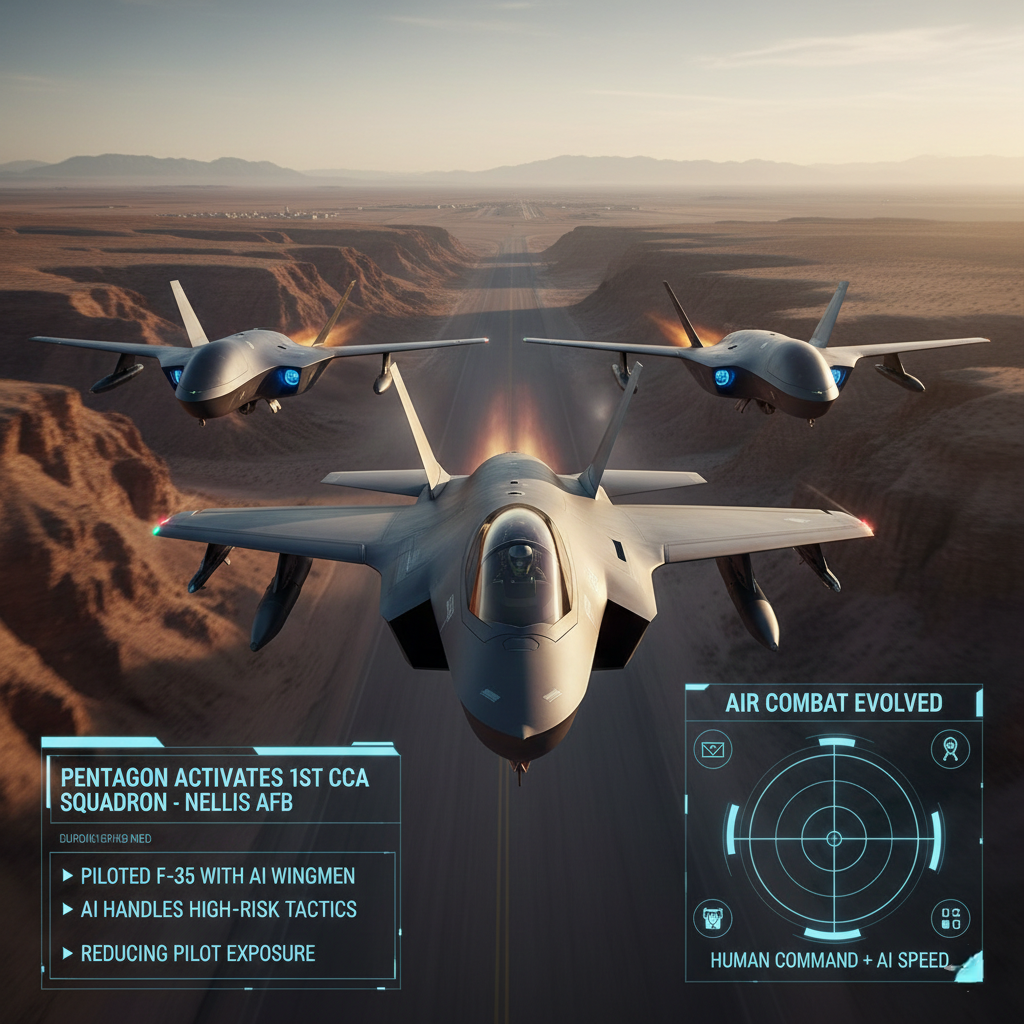
Air combat just entered a new era.
The Pentagon has officially activated the first Collaborative Combat Aircraft squadron at Nellis Air Force Base.
These aircraft don’t carry human pilots.
Instead, they are AI-controlled jets designed to fly alongside manned fighter aircraft as “loyal wingmen.”
And that changes everything.
What Are Collaborative Combat Aircraft?
Collaborative Combat Aircraft (CCA) are advanced, semi-autonomous military aircraft.
They are built to support human pilots in combat missions.
Think of them as smart robotic teammates in the sky.
They fly with piloted jets and assist in high-risk operations.
What Can These AI Jets Do?
These aircraft are not just surveillance drones.
They are designed for active combat roles.
Capabilities reportedly include:
- Engaging in aerial dogfights
- Jamming enemy radar systems
- Gathering intelligence
- Acting as decoys
- Absorbing enemy fire to protect human pilots
In simple terms, some of the most dangerous tasks in the sky can now be handled by machines.
Why Nellis Air Force Base?
The United States Air Force selected Nellis because it serves as a key hub for advanced air combat training and testing.
The base is known for:
- High-level tactical exercises
- Red Flag training missions
- Cutting-edge military aviation programs
Launching the first squadron here signals that this is not just an experiment—it’s operational.
How AI Is Changing Air Combat
For decades, fighter pilots carried all the risk.
Now, artificial intelligence can:
- Process battlefield data faster than humans
- React in milliseconds
- Operate in high-threat zones
- Reduce pilot exposure to danger
Human pilots remain in control of mission decisions.
But AI systems handle rapid tactical tasks.
It’s teamwork between human judgment and machine speed.
Strategic Impact on Modern Warfare
This development signals a major shift in military planning.
Autonomous support aircraft could:
- Increase mission flexibility
- Lower casualty risk
- Expand force projection
- Improve real-time battlefield awareness
Defense analysts say this could reshape aerial warfare doctrine over the next decade.
Are These Fully Autonomous?
Not exactly.
While highly advanced, these aircraft are designed to operate under human oversight.
The goal is collaboration, not full replacement.
The human pilot remains the decision-maker.
The AI acts as a force multiplier.
What This Means for the Future
The activation of this squadron suggests:
- AI integration in defense is accelerating
- Autonomous systems will play larger roles in combat
- Future air battles may involve mixed human-AI formations
This could also influence global military competition, as other nations invest in similar technologies.
FAQs
What are Collaborative Combat Aircraft?
They are AI-assisted military jets designed to fly alongside human pilots and support combat missions.
Are these aircraft fully autonomous?
They operate with high levels of automation but remain under human supervision.
Why is this important?
It reduces risks for human pilots and increases mission flexibility.
Where was the first squadron activated?
At Nellis Air Force Base in Nevada.
Could this replace human fighter pilots?
The current strategy focuses on partnership, not replacement.
Final Thoughts
The activation of the first Collaborative Combat Aircraft squadron marks a turning point in military aviation.
Artificial intelligence is no longer just assisting from the ground.
It is now flying in formation.
As AI continues to merge with aerospace technology, the future of air combat will look very different from the past.
