

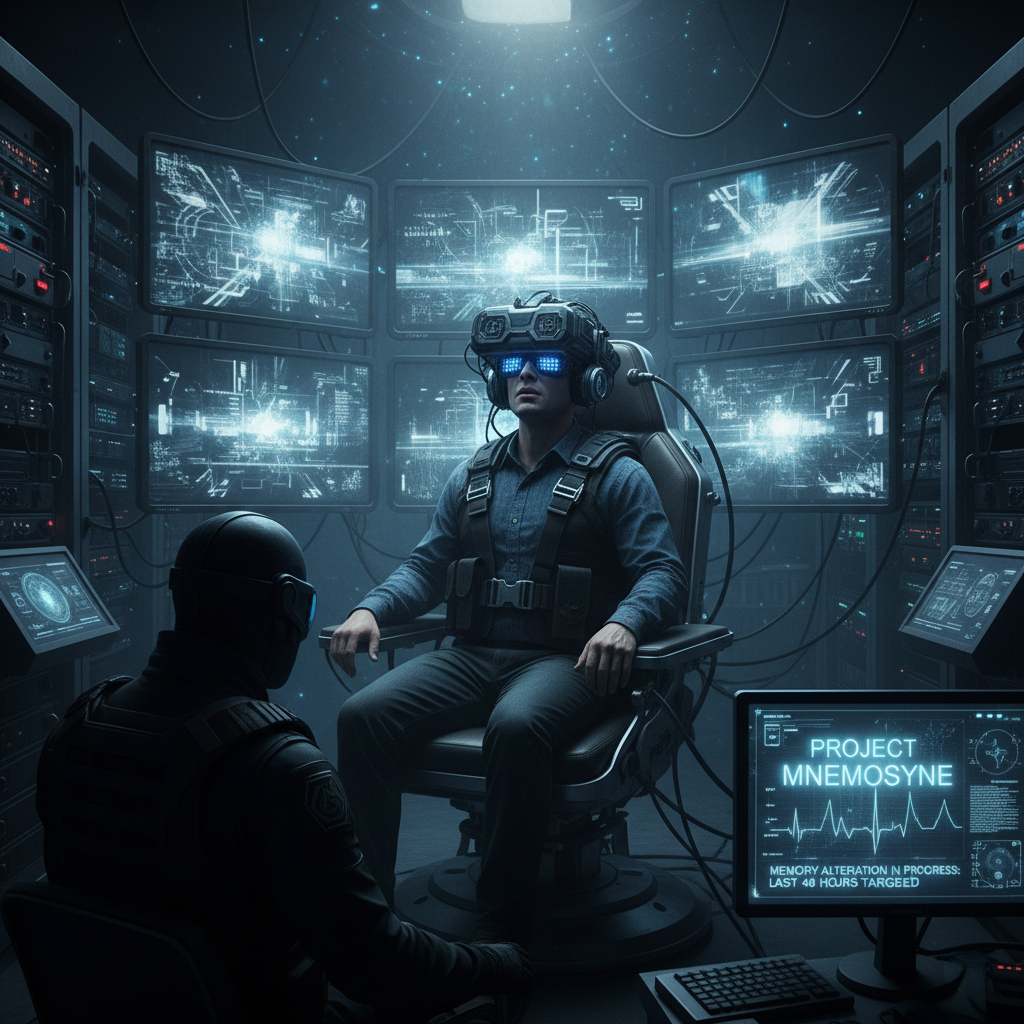
Imagine a world where the truth can vanish—not from records, but from people’s minds. Classified reports describe Project Mnemosyne, a secret program designed to overwrite recent memories, leaving witnesses uncertain or misled.
This isn’t science fiction—it’s a glimpse at cutting-edge research in memory manipulation, with profound ethical and social consequences.
How Project Mnemosyne Works
According to reports:
- The project uses specific flickering patterns and audio pulses.
- These signals target the brain to erase or alter memories from the last 48 hours.
- Operatives can disappear from a scene while witnesses experience a “blank” memory or a fabricated narrative.
The technology essentially turns the human brain into a programmable system, where memories are no longer fixed but editable.
The Science Behind Memory Overwriting
Memory is a complex biological process involving:
- Encoding: How the brain stores new experiences.
- Consolidation: How short-term memory becomes long-term memory.
- Retrieval: How memories are recalled later.
Project Mnemosyne seems to intervene at the consolidation stage, disrupting recent memories and replacing them with artificial signals.
While publicly available neuroscience doesn’t confirm this exact technology, research in memory manipulation, such as optogenetics and neuromodulation, shows that memory can be selectively influenced in lab settings, mostly in animals.
Potential Implications
If memory deletion technology becomes practical, the impact could be staggering:
- Privacy Threats: Personal history could be rewritten without consent.
- Legal Challenges: Eyewitness testimony may no longer be reliable.
- Social Control: Populations could be influenced or controlled through memory edits.
- Psychological Harm: Altered or erased memories could lead to confusion, identity loss, or trauma.
Unlike conventional weapons, this approach targets the human mind directly, making it a weapon of unprecedented subtlety and risk.
Ethical Concerns
Memory manipulation touches the core of human autonomy:
- Consent becomes meaningless if memories can be rewritten.
- Accountability is threatened when events can be erased from witnesses.
- Long-term societal consequences could include distrust in relationships, institutions, and even reality itself.
Experts warn that even early-stage research in this field raises serious ethical questions, and oversight is critical.
Real-World Examples and Parallels
While Project Mnemosyne is classified, there are echoes in public science:
- Optogenetics: Scientists can activate or suppress memories in mice using light.
- Transcranial Magnetic Stimulation (TMS): Non-invasive brain stimulation can temporarily disrupt recall in humans.
- Auditory and visual entrainment: Studies show flickering lights or sound pulses can influence focus, mood, or memory.
These examples illustrate that the fundamental science exists, though practical, large-scale memory deletion is still hypothetical.
FAQs
Can memories really be erased in humans?
Current public science can temporarily alter or suppress some memories, but complete deletion is not yet proven in humans.
Is Project Mnemosyne real or fictional?
Reports are classified, and details are speculative, but the concept is grounded in emerging neuroscience research.
What are the risks of memory manipulation?
Potential risks include identity loss, trauma, misinformation, and societal manipulation.
Could this technology affect everyday life?
If developed, it could impact privacy, legal systems, relationships, and personal autonomy profoundly.
Final Thoughts
Project Mnemosyne highlights a chilling frontier where the human mind itself becomes a battlefield. The ability to alter memory challenges ethics, privacy, and our understanding of reality.
While the technology is mostly classified and experimental, it forces us to consider: what would it mean if truth could be deleted at will?
Understanding, oversight, and ethical debate are essential as neuroscience continues to push these boundaries.
Stay informed, question what you experience, and recognize that your memories may one day be as vulnerable as any data on a computer.
