


Look at your hand for a moment.
Your fingers might hold clues about your earliest days—even before you were born.
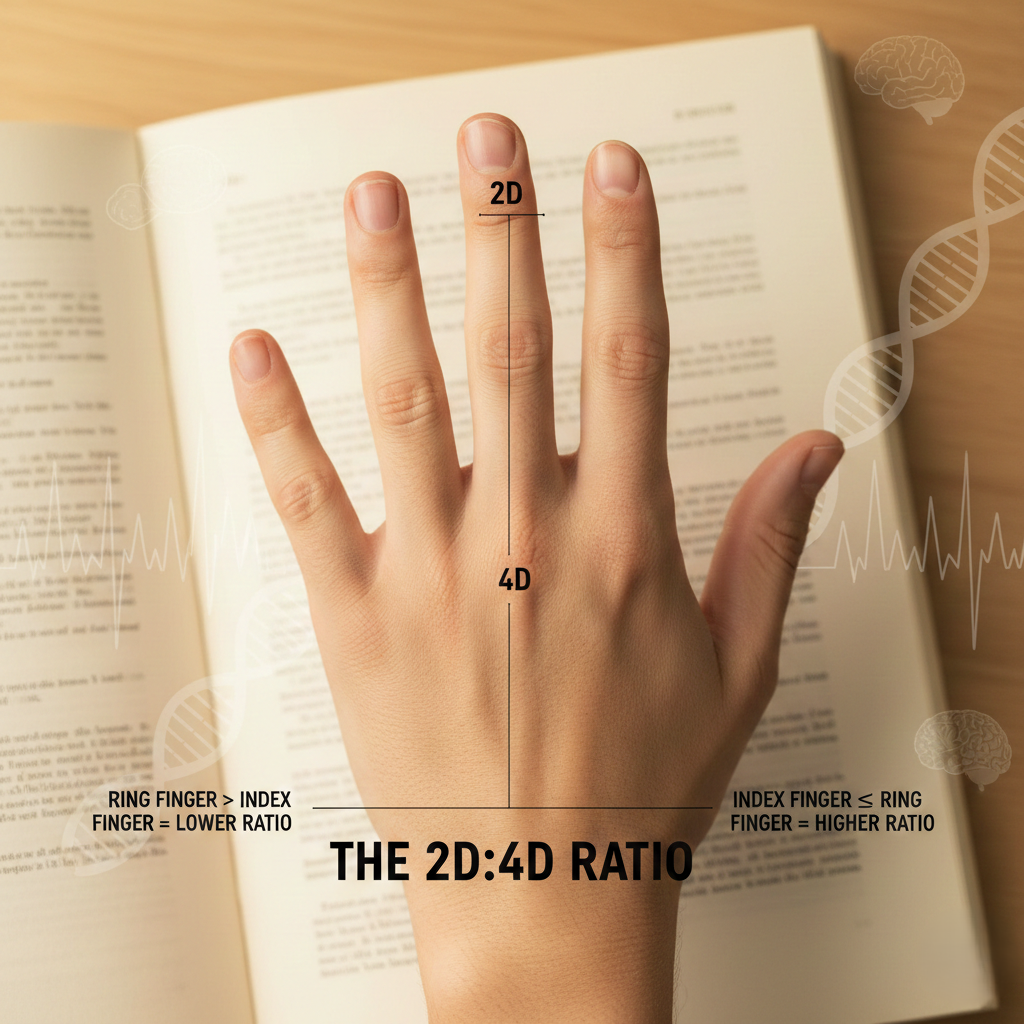
Researchers say the length difference between your index finger and ring finger could reflect hormone exposure in the womb. This tiny detail is known as the 2D:4D ratio.
Let’s break down what that really means.
What Is the 2D:4D Finger Ratio?
The 2D:4D ratio compares:
- The length of your index finger (2D)
- The length of your ring finger (4D)
If your ring finger is longer than your index finger, you likely have a lower 2D:4D ratio.
If both fingers are similar in length, or your index finger is longer, the ratio is higher.
This simple measurement has caught the attention of scientists in anthropology and biology.
How Prenatal Hormones Shape Development
During early pregnancy, a baby is exposed to varying levels of hormones like testosterone and estrogen.
These hormones don’t just shape physical traits. They also influence how parts of the brain develop.
Studies suggest that higher prenatal testosterone is often linked to a lower 2D:4D ratio.
Higher prenatal estrogen is typically linked to a higher ratio.
Researchers believe this ratio acts as a biological record of hormone balance before birth.
The Brain Connection
Research in human development has explored how the 2D:4D ratio relates to brain structure and cognitive patterns.
Some findings suggest links to:
- Spatial awareness
- Certain problem-solving styles
- Differences in brain organization
For example, spatial reasoning—the ability to rotate objects mentally or read maps—has been studied in connection with finger ratios.
However, this does not mean your fingers decide your abilities.
What the Science Really Says
It’s important to stay realistic.
The 2D:4D ratio does not predict intelligence, personality, or success.
Instead, it offers insight into how early biological factors may influence development in subtle ways.
Think of it as one small clue in a much bigger picture.
Your environment, education, culture, and experiences still shape who you become.
Real-World Example
Anthropologists often study finger ratios across different populations.
By comparing patterns, they can explore how prenatal hormone exposure may relate to broader trends in brain structure or behavior.
This helps scientists understand human evolution and development—not judge individuals.
Nature vs Nurture: The Bigger Picture
Even if prenatal hormones influence early brain formation, they don’t lock in your future.
Your development is shaped by:
- Family and upbringing
- Education and training
- Social environment
- Personal effort
- Life experiences
Biology may set the stage, but life writes the script.
Why This Research Matters
Understanding the 2D:4D ratio helps researchers explore:
- Early brain development
- Hormonal influence before birth
- Patterns in human biology
- Evolutionary anthropology
It’s mainly a scientific tool, not a personality test.
The findings are useful for research into human growth and development, not for making personal predictions.
FAQs
Can I measure my 2D:4D ratio at home?
Yes. Measure from the base crease to the tip of your index and ring finger. Divide index length by ring length to get the ratio.
Does a lower ratio mean higher intelligence?
No. There is no strong evidence linking finger ratio directly to intelligence.
Is this trait genetic?
Finger length patterns are influenced by both genetics and prenatal hormone exposure.
Can the ratio change over time?
No. Once your fingers fully develop, the ratio remains stable throughout adulthood.
Should I be concerned about my ratio?
Not at all. It’s simply a research marker used in anthropology and biology.
Final Thoughts
Your hands may carry a quiet record of your earliest development.
The 2D:4D finger ratio offers fascinating insight into how prenatal hormones might influence brain formation long before birth.
But remember—it’s just one piece of the puzzle.
Who you are today is shaped far more by your experiences, choices, and environment than by finger length.
