

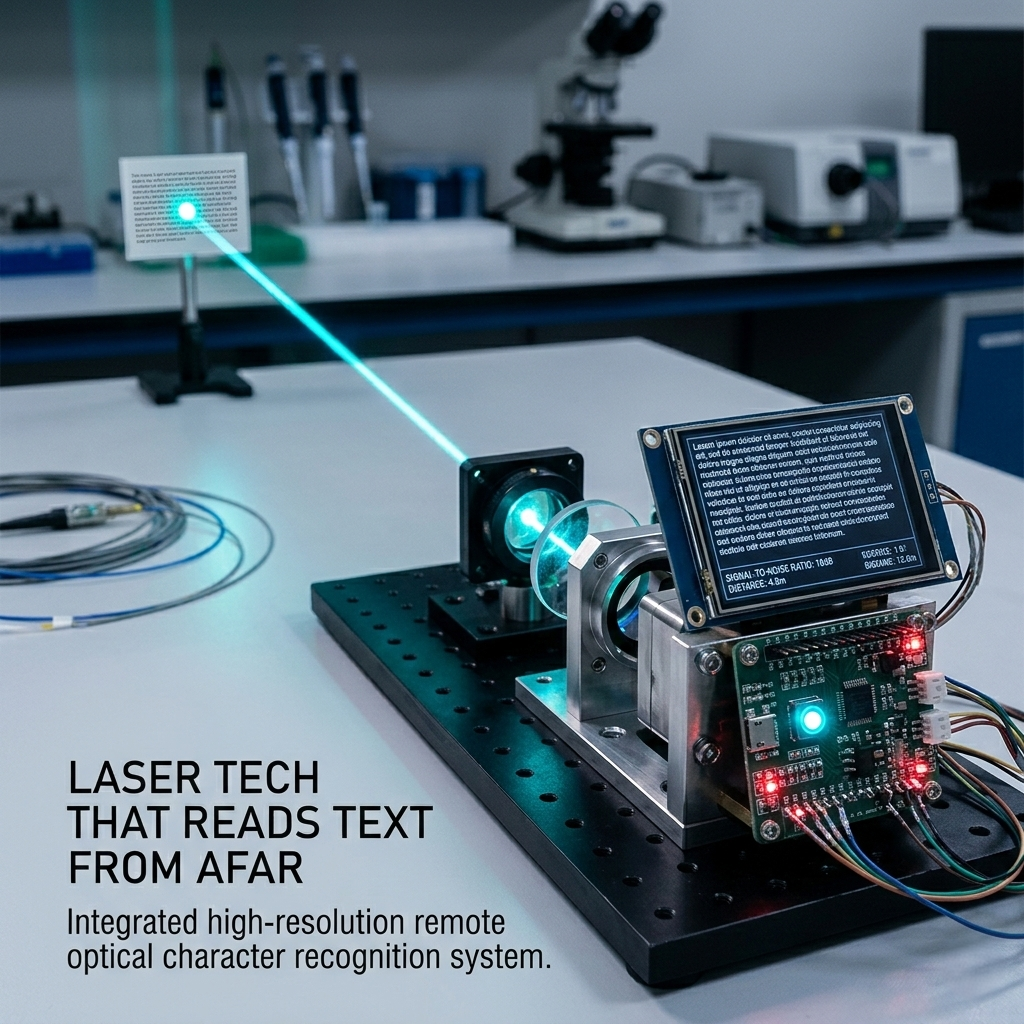
Imagine pointing a laser at a distant wall and extracting information from it.
It sounds like a spy movie scene. However, researchers have developed systems that can analyze tiny surface vibrations and reconstruct visual details — even readable text.
While the concept raises privacy concerns, the science behind it is fascinating.
Let’s break it down simply.
How the Laser Vibration System Works
The process starts with a focused laser beam.
The system sends the laser toward a distant surface, such as the following:
- A wall
- A window
- A piece of equipment
- A structural object
When sound waves or small movements cause vibrations on that surface, those vibrations slightly change how the laser light reflects back.
Although the changes are extremely small, they are measurable.
Turning Light Vibrations Into Information
Special optical sensors capture the reflected laser light.
Then, advanced signal-processing software analyzes the tiny fluctuations.
Step by step, the system:
- Detects micro-movements
- Converts light changes into electrical signals
- Processes patterns using algorithms
- Reconstructs visual or text-based information
In simple words, it studies how light “shakes” and transforms that motion into readable output.
This combination of optics and AI makes the breakthrough possible.
Why This Is Technically Impressive
Light travels incredibly fast. At the same time, vibrations can be microscopic.
So detecting usable information requires:
- Extreme measurement precision
- Stable environmental conditions
- High-speed data processing
- Advanced reconstruction algorithms
Because of this complexity, the system is far from a simple gadget.
Instead, it represents a sophisticated blend of laser physics, artificial intelligence, and signal processing.
Real-World Applications Beyond Surveillance
Headlines often focus on spying potential. However, the technology has several practical uses.
For example, remote laser sensing could help with:
1. Structural Safety Inspections
Engineers could examine buildings or bridges from a safe distance.
2. Disaster Zone Monitoring
Rescue teams could analyze unstable areas without physical contact.
3. Scientific Experiments
Researchers could measure sensitive reactions without disturbing them.
4. Industrial Equipment Checks
Factories could inspect fragile or high-risk machinery remotely.
Therefore, the technology can improve worker safety and reduce exposure to danger.
Privacy and Security Concerns
Naturally, any system capable of recovering information remotely raises ethical questions.
Critics worry that such tools could be misused for:
- Unauthorized monitoring
- Corporate espionage
- Personal privacy violations
However, it’s important to understand the limitations.
This is not a “point and instantly read” device.
It requires:
- Very stable environmental conditions
- Precise laser alignment
- Clear line of sight
- Powerful computing systems
Even small disruptions like wind, weather, or surface texture can affect performance.
So while the idea sounds powerful, real-world use remains technically demanding.
Comparing It to Existing Technologies
Similar principles already exist in laser microphones. These devices detect sound by measuring window vibrations.
However, reconstructing readable text or detailed visuals requires far more advanced processing.
Because AI models now analyze signal patterns more effectively, the accuracy continues improving.
That’s where modern computing makes the difference.
The Bigger Picture: Optics Meets Artificial Intelligence
This development highlights a broader trend.
Optical technology, AI algorithms, and advanced sensors are merging rapidly.
As a result:
- Remote sensing becomes more precise
- Data reconstruction becomes more accurate
- Non-contact analysis becomes more practical
Yet innovation always brings responsibility.
Societies must define clear legal and ethical boundaries before such systems become widespread.
FAQs
Can a laser really read text from a distance?
Under controlled conditions, laser systems can detect tiny vibrations and reconstruct certain visual details, including text patterns.
Is this technology widely available?
No. It requires specialized equipment, stable conditions, and advanced computing systems.
Does weather affect performance?
Yes. Wind, rain, obstacles, and surface material can significantly reduce accuracy.
Is this mainly for surveillance?
While surveillance gets attention, the technology also has applications in engineering, safety inspection, and scientific research.
How accurate is the reconstruction?
Accuracy depends heavily on environmental stability, sensor precision, and processing power.
Final Thoughts: Innovation Needs Boundaries
Laser vibration reconstruction technology demonstrates how powerful modern sensing systems have become.
On one hand, it offers safer inspection tools and valuable scientific applications. On the other hand, it raises important privacy questions.
As optics and AI continue evolving together, society must balance innovation with responsible oversight.
Technology moves quickly. Clear rules and transparency must move just as fast.
