


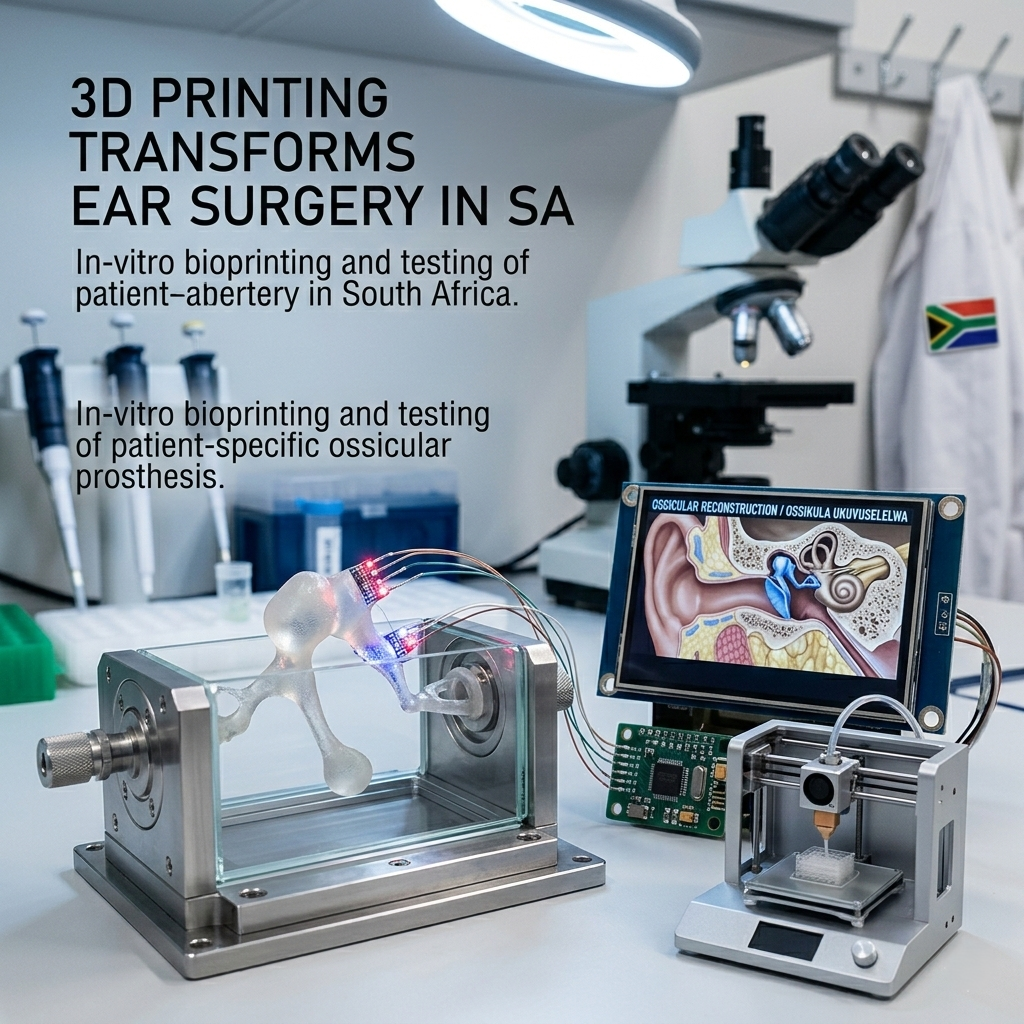
Hearing loss can quietly change a person’s life. Conversations become harder. Everyday sounds fade. Confidence often drops.
Now, surgeons in South Africa are using 3D printing to restore hearing in a more precise way than ever before.
This innovation is reshaping reconstructive ear surgery—and it’s a powerful example of personalized medicine in action.
Understanding Conductive Hearing Loss
Conductive hearing loss happens when sound cannot properly travel through the middle ear.
Inside the ear are three tiny bones called ossicles:
- Malleus
- Incus
- Stapes
These bones pass sound vibrations to the inner ear. However, infection, trauma, or congenital conditions can damage them.
As a result, sound transmission weakens.
That’s where surgery becomes necessary.
What Is Ossiculoplasty?
Ossiculoplasty is a surgical procedure that repairs or replaces damaged ossicles.
Traditionally, surgeons used prefabricated implants. While effective in many cases, those implants did not always perfectly match a patient’s anatomy.
Even small alignment differences can affect hearing outcomes.
Therefore, precision matters.
How 3D Printing Improves Ear Reconstruction
3D printing allows surgeons to design custom prosthetic implants tailored to each patient.
Here’s how the process works:
- The patient’s ear is scanned using imaging technology.
- A digital model of the middle ear is created.
- A custom implant is designed to match exact measurements.
- The prosthetic is printed using biocompatible materials.
Common materials include:
- Titanium
- Specialized medical-grade polymers
Because the implant fits precisely, alignment improves significantly.
And better alignment often leads to better sound transmission.
Clinical Results: What Do Patients Experience?
Clinical reports show promising results.
When the surgery is successful, patients often experience:
- Improved hearing thresholds
- Clearer sound perception
- Better speech recognition
However, outcomes still depend on several factors:
- Surgical precision
- The patient’s overall ear condition
- Absence of active infection
- Proper healing after surgery
Therefore, while 3D printing enhances accuracy, medical expertise remains essential.
Why Custom Implants Matter
The middle ear is extremely small and delicate. Even minor size differences can reduce performance.
With 3D printing, surgeons can:
- Adjust implant length and shape
- Improve contact with remaining ossicles
- Reduce mechanical mismatch
- Increase stability over time
Consequently, personalized implants offer advantages over standard, one-size-fits-all solutions.
This represents a major step toward patient-specific treatment.
The Bigger Impact: Personalized Medicine in Action
3D printing is not limited to ear surgery. However, its use in ossiculoplasty highlights how healthcare is evolving.
Instead of adapting patients to existing tools, medicine now adapts tools to patients.
That shift improves:
- Surgical precision
- Recovery outcomes
- Long-term effectiveness
Moreover, countries investing in medical innovation are expanding access to advanced care.
South Africa’s adoption of this technology demonstrates growing leadership in surgical advancement.
Comparing Traditional vs. 3D-Printed Ossicle Implants
Traditional Implants:
- Standardized sizes
- Limited customization
- Effective but not perfectly tailored
3D-Printed Implants:
- Fully customized design
- Improved anatomical fit
- Higher potential precision
While both approaches can restore hearing, customization increases the chance of optimal alignment.
And in middle ear surgery, millimeters make a difference.
FAQs
What causes conductive hearing loss?
It occurs when sound cannot properly pass through the middle ear due to damaged ossicles, infection, trauma, or congenital issues.
What is ossiculoplasty?
Ossiculoplasty is a surgical procedure that reconstructs or replaces the tiny bones of the middle ear to restore sound transmission.
How does 3D printing help in ear surgery?
It allows surgeons to create custom implants that perfectly match a patient’s anatomy, improving precision and alignment.
Are 3D-printed implants safe?
Yes. They are made from biocompatible materials like titanium or medical-grade polymers designed for long-term use.
Do all patients fully regain hearing?
Results vary. Success depends on surgical accuracy, healing, and the patient’s overall ear health.
Final Thoughts: A New Era in Hearing Restoration
3D printing is changing how surgeons approach delicate procedures like ossiculoplasty.
By creating implants tailored to each patient, doctors can improve alignment and increase the chances of restoring effective hearing.
Although outcomes still depend on careful surgical practice, personalized implants offer clear advantages.
This innovation shows how technology and medicine can work together to improve real lives.
