


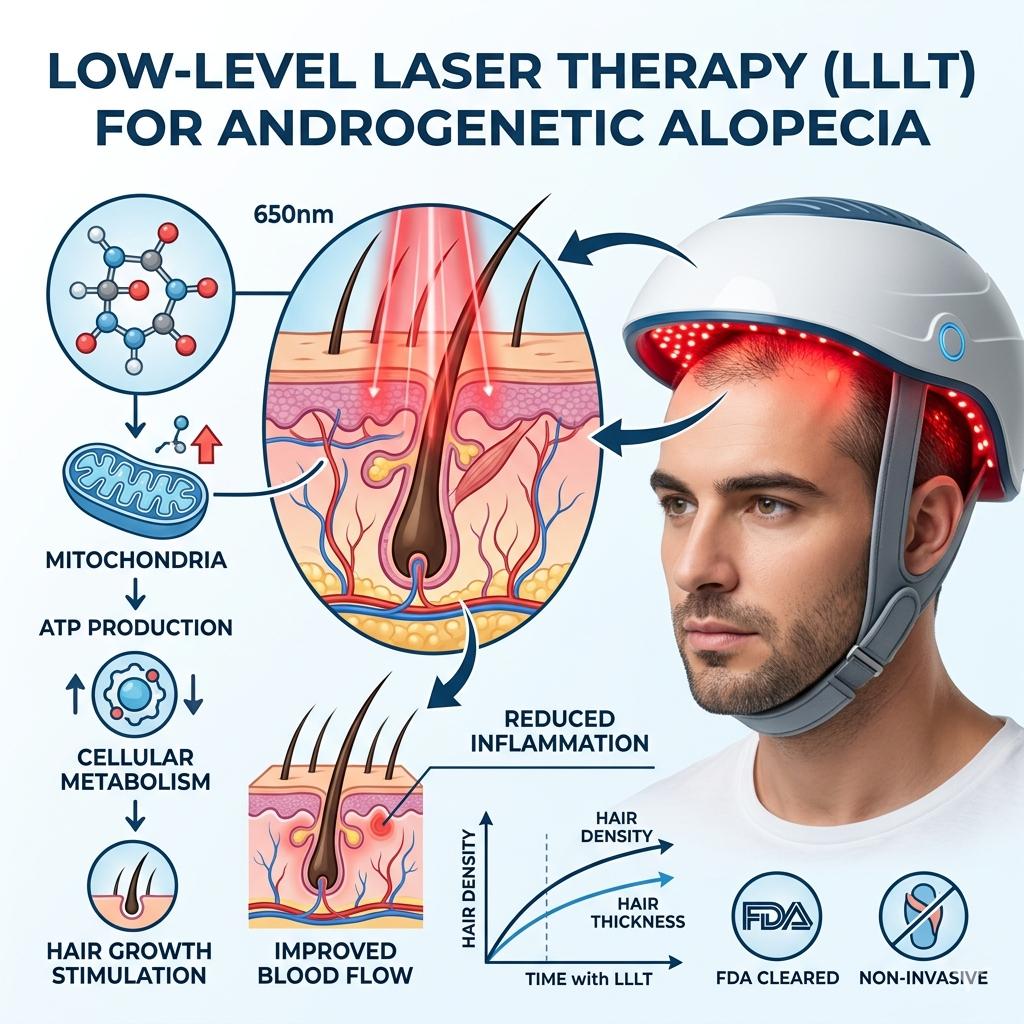
Hair loss affects millions of people worldwide. One of the most common types is androgenetic alopecia, often known as male or female pattern baldness.
In recent years, researchers have explored non-invasive treatments that may help stimulate hair growth.
One promising approach is low‑level laser therapy.
A clinical study published in the American Journal of Clinical Dermatology investigated whether this light-based therapy could improve hair density in people with pattern hair loss.
What Is Low-Level Laser Therapy (LLLT)?
Low-level laser therapy uses controlled red light to stimulate biological processes in cells.
Unlike surgical treatments, LLLT is non-invasive and painless.
The therapy works by exposing the scalp to specific wavelengths of light. In many devices, this light falls within the red spectrum around 655 nanometers.
Researchers believe this wavelength may stimulate hair follicles and improve cellular activity in the scalp.
As a result, hair growth cycles may become more active.
Overview of the Clinical Study
The study conducted by Jimenez JJ and colleagues evaluated the effectiveness of a 655-nm laser device for treating androgenetic alopecia.
Researchers designed the experiment as a controlled clinical trial.
Participants included both men and women experiencing pattern hair loss.
Key Study Details
- Participants used the device at home
- The trial lasted 26 weeks
- Two groups were created for comparison
These groups allowed researchers to measure the treatment’s real effects.
How the Study Was Conducted
Participants were divided into two groups:
- Active treatment group – used the working laser device
- Control group – used a sham device that appeared identical but did not emit therapeutic light
This method helps eliminate bias and ensures reliable results.
Researchers then measured hair growth in a defined target area of the scalp.
By focusing on a specific region, scientists could track changes in terminal hair density accurately.
Results of the Study
At the end of the 26-week period, researchers compared results between the two groups.
The findings showed that participants using the active laser device experienced statistically significant increases in terminal hair density.
In contrast, the control group using the inactive device showed smaller changes.
These results suggest that red light therapy may stimulate hair follicles and encourage thicker hair growth in some individuals.
How LLLT May Stimulate Hair Follicles
Although scientists are still studying the exact biological mechanism, several theories explain how LLLT may work.
Possible effects include:
- Increased blood circulation in the scalp
- Improved cellular energy production
- Activation of hair follicle growth phases
- Reduced inflammation around hair follicles
Together, these processes may help strengthen existing follicles and promote healthier hair growth.
Who May Benefit Most from LLLT
Research suggests that light-based therapy may work best for individuals in the early to moderate stages of androgenetic alopecia.
In these cases, hair follicles remain active but weakened.
By stimulating follicle activity, LLLT may help extend the growth phase of the hair cycle.
However, results can vary depending on factors such as:
- Age
- Genetics
- Duration of hair loss
- Consistency of treatment
Advantages of Laser Therapy for Hair Loss
One reason LLLT has gained attention is its convenience.
Unlike surgical procedures, laser therapy can often be used at home with wearable devices.
Potential Benefits
- Non-invasive treatment
- No surgical recovery time
- Minimal discomfort
- Easy home-based application
Because of these advantages, some individuals consider it a supportive option within a broader hair restoration plan.
Why Medical Guidance Is Important
Although the study results are promising, experts emphasize the importance of professional advice.
Hair loss can occur for many reasons, including hormonal changes, medical conditions, or nutritional deficiencies.
A healthcare professional can evaluate the underlying cause and recommend appropriate treatments.
In many cases, doctors may combine therapies such as the following:
- Topical medications
- Oral treatments
- Laser therapy
- Lifestyle adjustments
This comprehensive approach often produces better results.
FAQs
What is low-level laser therapy for hair loss?
Low-level laser therapy is a treatment that uses red light to stimulate hair follicles and potentially improve hair growth in people with pattern hair loss.
Does LLLT work for androgenetic alopecia?
Clinical studies suggest LLLT may increase hair density in some individuals with androgenetic alopecia, especially during early stages of the condition.
How long does laser therapy take to show results?
Some studies observed noticeable improvements after approximately 26 weeks of consistent use.
Is laser hair therapy safe?
LLLT devices are generally considered safe when used according to instructions. However, medical consultation is recommended before starting treatment.
Can laser therapy completely cure hair loss?
Laser therapy may improve hair density for some individuals, but it does not permanently cure androgenetic alopecia.
Final Thoughts
Low-level laser therapy represents a promising non-invasive approach for treating androgenetic alopecia.
Clinical research published in the American Journal of Clinical Dermatology found that a 655-nm laser device increased terminal hair density in participants after 26 weeks of consistent use.
Although results can vary, the study highlights the potential of red light therapy as a supportive option for people experiencing pattern hair loss.
As always, individuals considering treatment should consult a qualified healthcare professional to determine the most appropriate strategy for their specific condition.
