


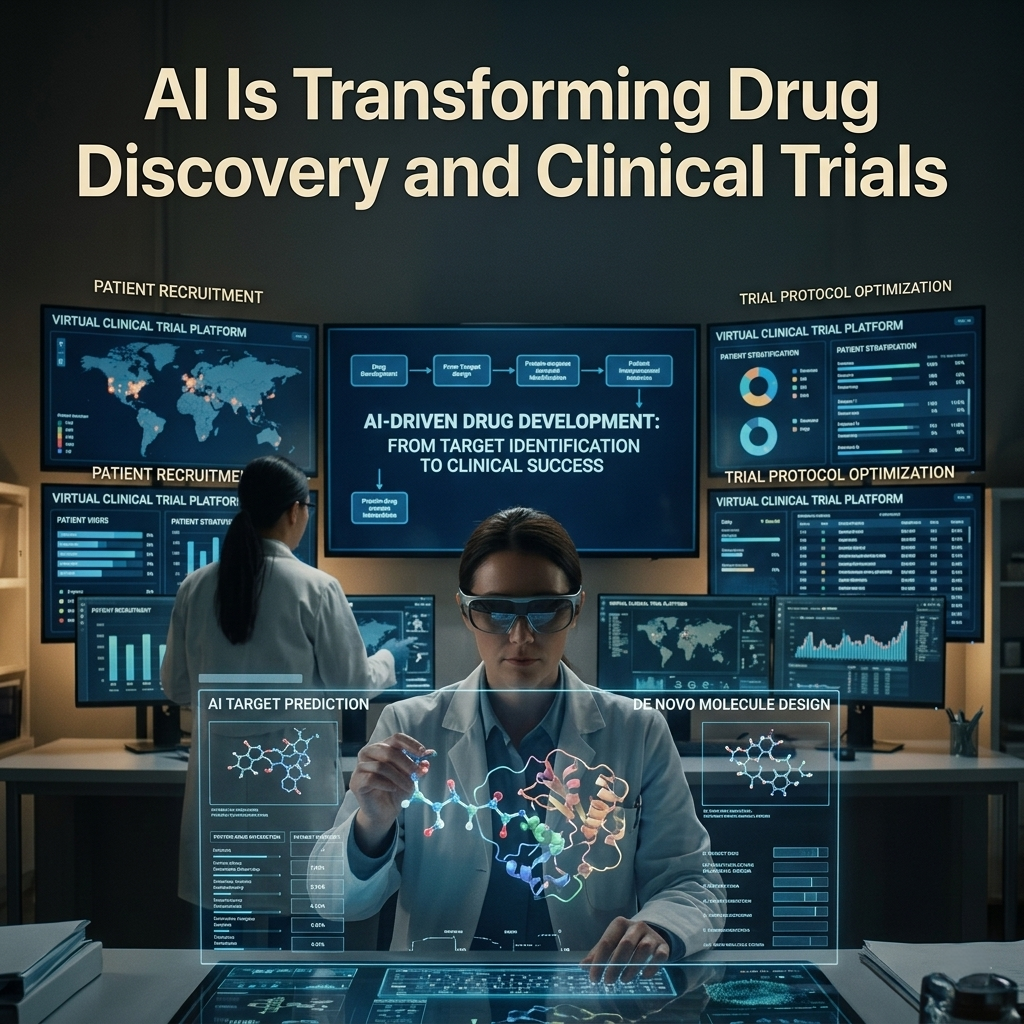
For decades, developing a new medicine has been one of the most expensive and time-consuming processes in science.
On average, creating a single drug can take 12 to 15 years and cost more than $2 billion before it reaches patients.
Today, that long process is beginning to change. Advances in artificial intelligence are helping scientists design and evaluate potential medicines much faster than before.
Many experts believe the pharmaceutical industry is entering a new era of AI-driven drug discovery.
How Drug Discovery Traditionally Worked
Traditional pharmaceutical research involves many stages:
- Identifying a biological target
- Screening thousands of chemical compounds
- Testing promising molecules in laboratories
- Running multiple phases of clinical trials
This process often requires years of laboratory experiments and high failure rates.
Only a small percentage of tested compounds eventually become approved medicines.
How Artificial Intelligence Is Changing the Process
Modern AI systems can analyze massive amounts of biological and chemical data.
These systems can:
- Design completely new drug molecules
- Predict how compounds interact with proteins
- Estimate safety risks and side effects
- Simulate possible clinical trial outcomes
Instead of testing thousands of compounds in the lab, scientists can now evaluate many possibilities through advanced computer models.
What once required years of early-stage screening may now be explored in weeks or months.
The Role of Multimodal AI
Much of this progress comes from multimodal AI, which can analyze different types of data at the same time.
These systems are trained on information such as the following:
- Genomic data
- Protein structure databases
- Medical research papers
- Electronic health records
- Historical clinical trial results
By combining these sources, AI models can find complex patterns that humans might miss.
Designing Completely New Molecules
One of the most powerful capabilities of AI is generative drug design.
Instead of searching existing chemical libraries, AI systems can create entirely new molecular structures.
These molecules may be designed to:
- Bind more precisely to disease targets
- Reduce harmful side effects
- Improve stability and effectiveness
Some discoveries are guided by protein structure predictions from tools like AlphaFold, developed by DeepMind.
These structural insights help researchers design drugs that fit biological targets with greater accuracy.
AI-Designed Drugs Entering Clinical Trials
Several pharmaceutical and biotechnology companies are already testing AI-designed drug candidates in human clinical trials.
These early trials aim to confirm whether the computer-designed molecules behave safely and effectively in real patients.
Organizations such as the U.S. Food and Drug Administration and other global regulators are also exploring how to evaluate medicines created with AI assistance.
New regulatory frameworks may eventually be needed as software becomes more deeply involved in medical discovery.
A New Race in the Pharmaceutical Industry
Both traditional pharmaceutical companies and AI-focused biotech startups are investing heavily in these technologies.
The competition is intense because faster drug discovery could lead to the following:
- Lower research costs
- Quicker development timelines
- More treatments for rare diseases
- Better personalized medicine
AI may also help identify patient subgroups that respond best to certain treatments.
This could improve clinical trial success rates and reduce wasted research efforts.
Challenges and Limitations
Despite its promise, AI drug discovery still faces several challenges.
Computer predictions must still be validated through laboratory experiments and human trials.
Researchers must also ensure that AI systems are:
- Transparent and explainable
- Free from biased medical data
- Reliable across different populations
Even with advanced algorithms, human scientists remain essential in guiding research and interpreting results.
FAQs
What is AI drug discovery?
AI drug discovery uses artificial intelligence to design new medicines, analyze biological data, and predict how drugs might work before laboratory testing.
How much faster can AI make drug development?
AI can significantly accelerate early research stages by simulating molecular behavior and screening potential compounds much faster than traditional methods.
What role does Alpha Fold play in drug research?
AlphaFold predicts the 3D structures of proteins, helping scientists design drugs that interact more precisely with disease targets.
Are AI-designed drugs already in clinical trials?
Yes. Several drug candidates designed with AI assistance are currently being tested in human clinical trials.
Will AI replace pharmaceutical scientists?
No. AI is a powerful tool, but human researchers still guide experiments, validate results, and ensure safety.
Final Thoughts
Artificial intelligence is beginning to reshape one of the most complex industries in science.
By analyzing massive biological datasets and designing new molecules digitally, AI is helping researchers explore drug possibilities faster than ever before.
Although laboratory testing and clinical trials remain essential, the early stages of drug discovery are becoming increasingly software-driven.
As AI continues to evolve, the vision of software-designed medicine is moving from theory to real-world practice—potentially bringing new treatments to patients faster than ever before.
