


Introduction
Pregnancy creates one of the most remarkable biological connections in nature.
For months, a mother’s body protects and nourishes a developing baby. However, scientists have discovered the relationship may work both ways.
Researchers found that fetal cells can travel into the mother’s body and even help repair damaged tissues. This fascinating process shows that pregnancy may involve a deeper biological partnership than previously believed.
The Hidden Cellular Exchange During Pregnancy
During pregnancy, the mother and baby remain connected through the placenta.
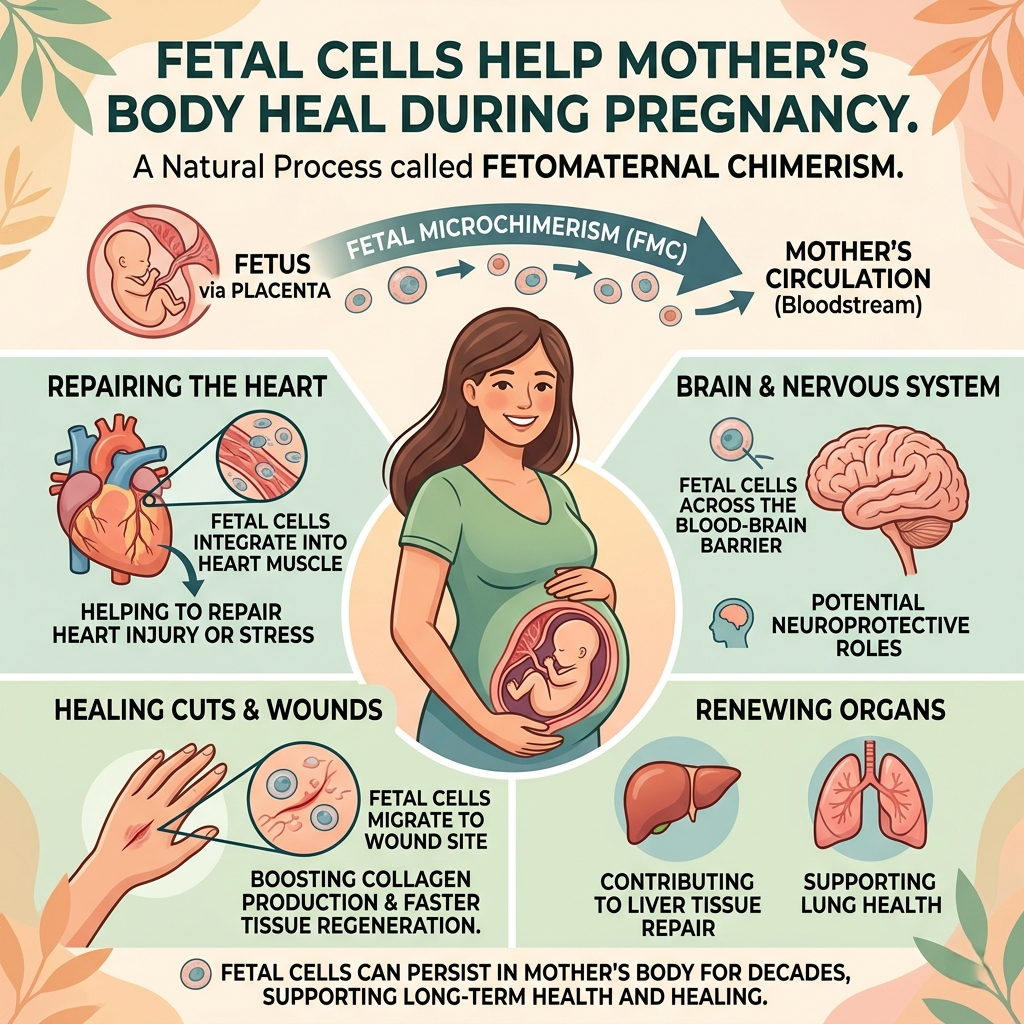
However, this connection does more than deliver nutrients and oxygen. Scientists discovered that tiny numbers of fetal cells can cross the placenta and enter the mother’s bloodstream.
These cells may remain in the mother’s body for years or even decades.
Researchers call this phenomenon fetal microchimerism.
The term describes a situation where a small number of cells from another individual live inside the body.
In this case, the baby’s cells become part of the mother’s biological system.
How Fetal Cells Travel Through the Body
Once fetal cells enter the mother’s bloodstream, they do not simply disappear.
Instead, they can move throughout the body.
Scientists observed that these cells sometimes migrate toward areas where the mother’s tissues are injured. Consequently, they may participate in repair processes.
This behavior surprised researchers because the cells appear to respond to signals from damaged tissues.
Fetal Cells May Help Repair the Mother’s Heart
One of the most interesting discoveries involves heart tissue repair.
Research has shown that fetal cells may travel to the mother’s heart when damage occurs.
In certain studies, scientists observed that some fetal cells began behaving like heart cells.
This suggests they may support the healing process in damaged areas of the heart.
Findings published in Circulation Research reported fetal stem cells present in injured maternal heart tissue.
Researchers believe these cells may contribute to tissue regeneration.
What Scientists Observed in Major Studies
Scientists from the Mount Sinai School of Medicine and other research institutions studied how fetal cells behave inside the mother’s body.
Their findings revealed several surprising possibilities.
Researchers observed that fetal cells may:
- Travel through the placenta into the mother’s bloodstream
- Move toward damaged or inflamed tissues
- Develop into specialized cells in certain conditions
- Remain inside the mother’s body long after pregnancy
These discoveries highlight a deeper biological interaction between mother and baby.
Why This Discovery Matters
This research changes how scientists understand pregnancy.
Traditionally, pregnancy was viewed as a process where the mother supports the baby’s development.
However, fetal microchimerism suggests the relationship may be more cooperative.
In some cases, the baby’s cells may contribute to the mother’s healing process.
Although scientists are still exploring this phenomenon, the discovery opens new possibilities for medical research.
For example, fetal cells may help researchers understand the following:
- Natural tissue repair mechanisms
- Stem cell behavior in the human body
- Potential regenerative therapies in the future
Therefore, this tiny cellular exchange could have big implications for medicine.
Real-World Example: Healing After Heart Injury
To understand this better, consider a real-world scenario.
If a mother experiences heart tissue damage, certain biological signals are released.
These signals may attract fetal cells circulating in the bloodstream.
Once they arrive, some of those cells may begin developing into heart-like cells and supporting the healing process.
Although this effect remains under investigation, it shows how the body may use natural biological tools for repair.
The Long-Term Presence of Fetal Cells
Another surprising finding involves how long these cells remain.
Researchers have detected fetal cells in mothers many years after pregnancy.
In some cases, these cells were found decades later in different tissues.
This means pregnancy may leave a lasting biological imprint on the mother’s body.
Scientists are still studying whether these cells mainly provide benefits or sometimes contribute to other health conditions.
Frequently Asked Questions (FAQs)
What is fetal microchimerism?
Fetal microchimerism is a process where fetal cells cross the placenta during pregnancy and remain inside the mother’s body, sometimes for many years.
Can fetal cells really help repair tissues?
Research suggests fetal stem cells may move toward damaged tissues and participate in repair processes. However, scientists are still studying how often this happens.
Do fetal cells stay in the mother’s body permanently?
In many cases, fetal cells remain in the mother’s body long after pregnancy. Some studies have detected them decades later in organs and tissues.
Why are scientists studying fetal cells?
Researchers want to understand how these cells help repair tissues. This knowledge may help develop new regenerative medical treatments in the future.
Final Thoughts
Pregnancy represents far more than the development of a new life. It may also involve a remarkable biological exchange between mother and baby.
Through fetal microchimerism, fetal cells can travel into the mother’s body, migrate toward injured tissues, and potentially support healing.
Although research continues, these discoveries highlight the extraordinary connection between mother and child at the cellular level.
As scientists learn more, this phenomenon may open new doors in regenerative medicine and deepen our understanding of how the human body repairs itself.
