

Introduction: When Silence Is No Longer the Limit
For many people with severe paralysis, silence has been one of the hardest barriers to live with.
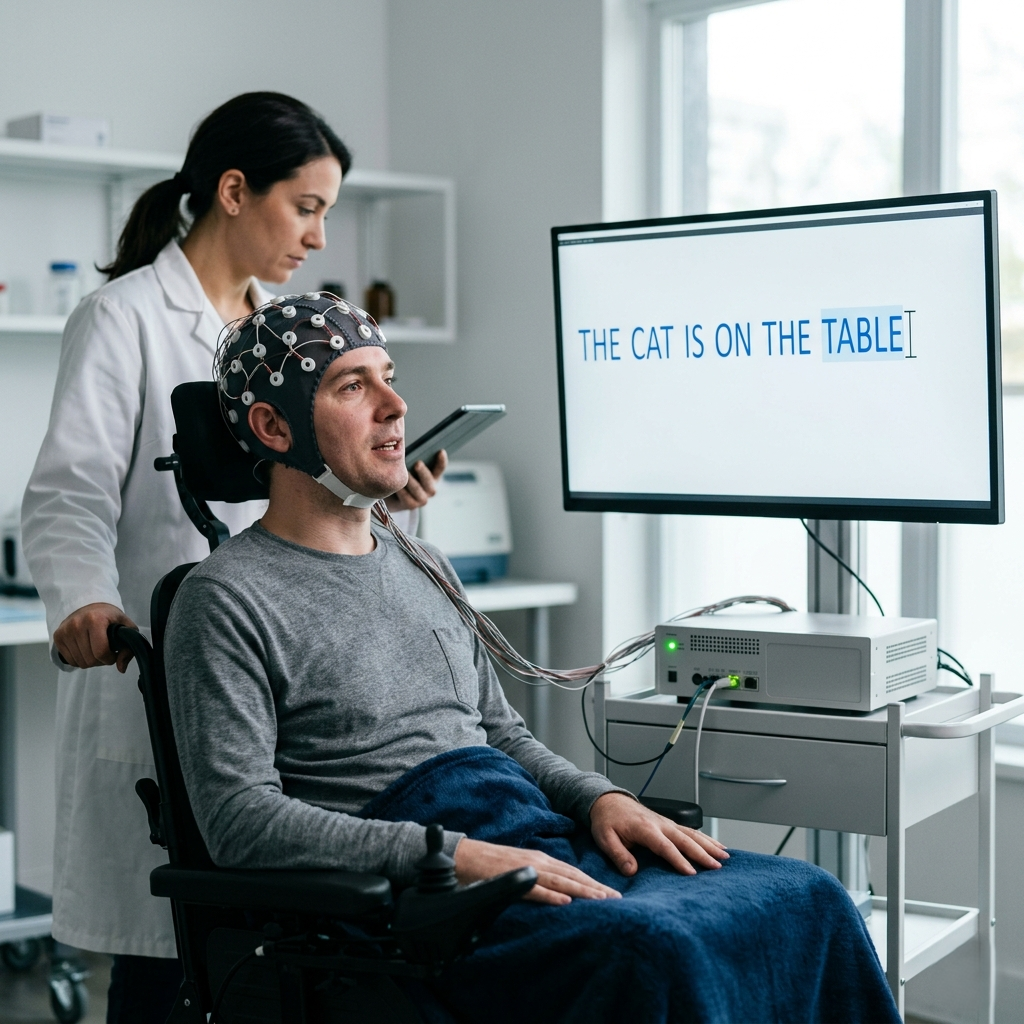
Now, that is starting to change. Scientists have developed a system that can turn brain activity into flowing text.
Instead of basic signals or slow typing, patients can now express full thoughts almost in real time.
How Brain-to-Text Technology Works
This system reads patterns directly from the brain and converts them into language.
It is based on a brain-computer interface.
Step-by-step process:
- Brain activity is recorded during thinking
- AI models analyze the signal patterns
- Patterns are matched to language structures
- Full sentences are generated as text
As a result, communication becomes smoother and more natural.
From Simple Signals to Real Conversations
Older systems were limited. They often relied on:
- Yes/no responses
- Single-word outputs
- Slow typing interfaces
However, this new approach goes much further.
What’s improved:
- Continuous sentence generation
- More natural phrasing
- Faster communication speed
Because of these changes, users can feel socially present again, not just assisted.
The Power of Personalization
One of the biggest breakthroughs is customization.
Each brain works a little differently. So, the system learns a person’s unique neural patterns over time.
Think of it like a “neural accent.”
Benefits of personalization:
- Higher accuracy
- Fewer translation errors
- More natural expression
As a result, the output better reflects what the person actually intends to say.
Real Impact: Restoring Human Connection
This technology does more than help people talk; it helps them reconnect with others.
Real-life improvements:
- Faster conversations with family
- Better participation in social settings
- Reduced frustration and isolation
For many patients, this means regaining a sense of identity and presence.
Beyond Paralysis: Wider Medical Benefits
Although the focus is on paralysis, the impact goes further.
This research also supports conditions like aphasia.
Broader applications:
- Language rehabilitation therapy
- Stroke recovery support
- Better understanding of brain-language mapping
Because of this, it could improve care for millions of people.
The Privacy Challenge: Protecting Thoughts
With great power comes serious responsibility.
Turning thoughts into text raises major privacy concerns.
Key protections being developed:
- On-device processing (no cloud exposure)
- Consent-based activation
- Secure data handling
Scientists are treating privacy as a core feature—not an afterthought.
The Big Question: Is It Truly Your Voice?
This technology raises an important issue.
If AI predicts words from brain signals, how do we ensure it reflects real intent?
The challenge:
- Avoiding AI “guessing” incorrectly
- Keeping the user’s true meaning intact
- Building trust in the system
Because of this, ethical standards are becoming just as important as technical progress.
How This Compares to Older Communication Tools
| Technology | Speed | Natural Expression |
|---|---|---|
| Eye-tracking systems | Slow | Limited |
| Basic BCIs | Moderate | Simple words |
| Brain-to-text AI | Fast | Full sentences |
Clearly, this new system is a major leap forward.
FAQs About Brain-to-Text Technology
1. Can this read minds completely?
No, it interprets patterns related to language, not all thoughts.
2. Is it available for public use?
Not yet. It is still in advanced research stages.
3. How accurate is it?
Accuracy is improving with personalization and training.
4. Is it safe?
Researchers are focusing heavily on safety and privacy protections.
Conclusion: A New Voice for the Future
This breakthrough is about more than technology; it’s about giving people their voice back.
By turning brain signals into natural language, scientists are breaking one of the hardest barriers in medicine.
