


Introduction
On April 3, 2026, a major moment in China’s private space race took an unexpected turn.
China’s company Space Pioneer attempted the first launch of its powerful Tianlong-3 rocket. Expectations were high.
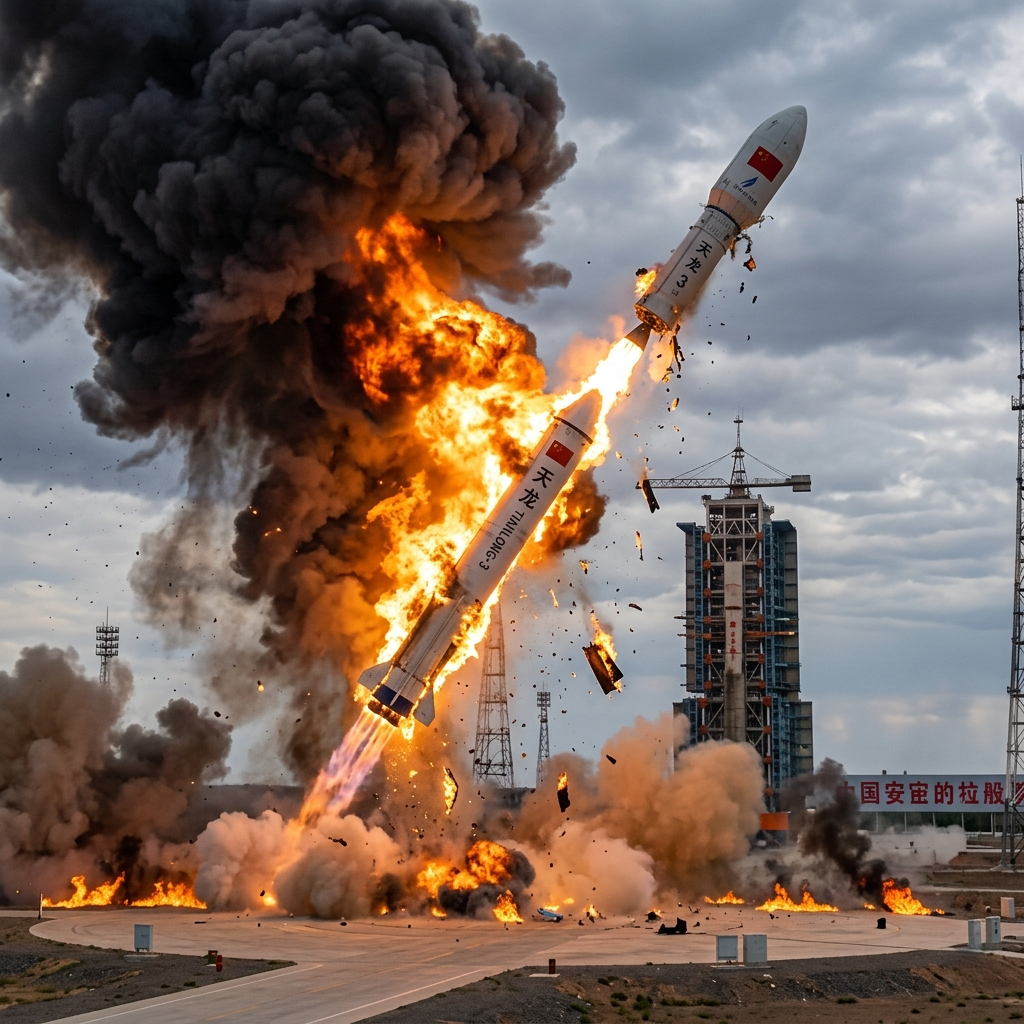
However, things didn’t go as planned. Shortly after liftoff, the rocket broke apart in mid-air and failed to reach orbit.
So, what went wrong and why does this matter so much?
What Is Tianlong-3 and Why It Matters
Tianlong-3 is designed as a reusable rocket, similar to the Falcon 9 developed by SpaceX.
The goal is simple but powerful: reduce launch costs and support frequent missions.
Specifically, Tianlong-3 aims to
- Carry heavy payloads into low Earth orbit
- Launch multiple satellites at once
- Support China’s growing space infrastructure
As a result, it plays a key role in future satellite networks.
What Happened During the Launch
The launch took place at the Jiuquan Satellite Launch Center, one of China’s main spaceports.
At first, everything looked normal. The rocket lifted off smoothly.
However, within moments:
- The rocket began losing stability
- It broke apart mid-air
- The mission failed before reaching orbit
Soon after, Space Pioneer confirmed the failure but did not share detailed reasons.
Why This Failure Is Important
Although rocket failures are not unusual, this one highlights a bigger challenge.
Reusable rockets are extremely complex. They must:
- Survive launch stress
- Deliver payloads precisely
- Return safely for reuse
Therefore, even small issues can lead to major failures.
This setback shows that building reliable reusable systems takes time, testing, and constant improvement.
A Pattern of Challenges
Interestingly, this was not the first issue with Tianlong-3.
Back in 2024, a test stage detached unexpectedly during ground testing. It even crashed nearby.
Because of that, concerns about engineering reliability have followed the project.
Still, setbacks like these are common in early-stage rocket development.
China’s Bigger Space Ambitions
Despite the failure, China’s goals remain ambitious.
Tianlong-3 is meant to support large satellite networks like the Qianfan megaconstellation.
These networks aim to:
- Provide global internet coverage
- Improve communication systems
- Compete with global projects
So, this rocket is more than just a launch vehicle; it’s part of a bigger strategy.
Competition Inside China’s Space Industry
China’s private space sector is growing fast.
For example, LandSpace is also developing reusable rockets.
Their upcoming Zhuque-3 aims to achieve similar goals.
Because of this competition, innovation is accelerating quickly.
However, success in reusable technology is still limited.
The Gap with the United States
So far, no Chinese company has successfully reused an orbital rocket stage.
In contrast, SpaceX has already mastered this with Falcon 9.
This gap highlights:
- Differences in experience
- Engineering maturity
- Testing and iteration cycles
Even so, China is catching up step by step.
Real-World Comparison
To understand the challenge, let’s compare:
Falcon 9 (SpaceX):
- Proven reusable system
- Multiple successful landings
- Lower launch costs
Tianlong-3 (China):
- Still in testing phase
- The first launch failed
- Reusability not yet proven
Clearly, China is still in the early stages of mastering this technology.
What Happens Next
Even though the failure is a setback, it’s not the end.
Typically, after such events, companies:
- Analyze flight data
- Identify technical issues
- Improve design and systems
- Prepare for the next test
So, Tianlong-3 will likely return with upgrades.
FAQs
Why did the Tianlong-3 rocket fail?
The exact reason hasn’t been shared yet. However, early signs suggest a technical issue shortly after liftoff.
Is this failure unusual in space missions?
Not at all. Many rockets fail during early testing phases before becoming reliable.
What is a reusable rocket?
A reusable rocket can be launched, recovered, and used again, reducing costs significantly.
Will China succeed in reusable rocket technology?
Most likely, yes. Although progress is slower, ongoing efforts show strong commitment and improvement.
Conclusion
The Tianlong-3 rocket failure is a setback but also a learning moment.
While China’s private space industry is growing fast, reusable rocket technology remains a major challenge.
However, with continued testing and competition, progress is inevitable.
👉 If you’re following the future of space innovation, keep an eye on Tianlong-3 because the next launch could tell a very different story.
