

Close Menu
Innovate And ExploreInnovate And Explore

    Subscribe to Updates

    Get the latest creative news from FooBar about art, design and business.

    What's Hot

    Biodegradable Fruit Wash Removes Pesticides and Keeps Fruit Fresh Longer

    April 15, 2026

    NASA Finds Its Own Spacecraft Debris on Mars: A Strange Discovery

    April 15, 2026

    Top Marketing Automation Tools to Boost Your Business in 2026

    April 15, 2026
    Facebook Instagram
    Facebook Instagram YouTube TikTok
    Innovate And ExploreInnovate And Explore
    • Artificial Intelligence
    • Medical Research
    • Technology News
    • Science News
    • VR Headset
    • Palantir
    Innovate And ExploreInnovate And Explore
    Home » Marine Virus Jumps to Humans, Causing Vision Loss
    Medical Research

    Marine Virus Jumps to Humans, Causing Vision Loss

    alfredBy alfredApril 9, 2026No Comments4 Mins Read
    Facebook Twitter Pinterest LinkedIn Tumblr WhatsApp Email
    Share
    Facebook Twitter LinkedIn WhatsApp Pinterest Email

    Introduction: A Shocking First in Medical Science

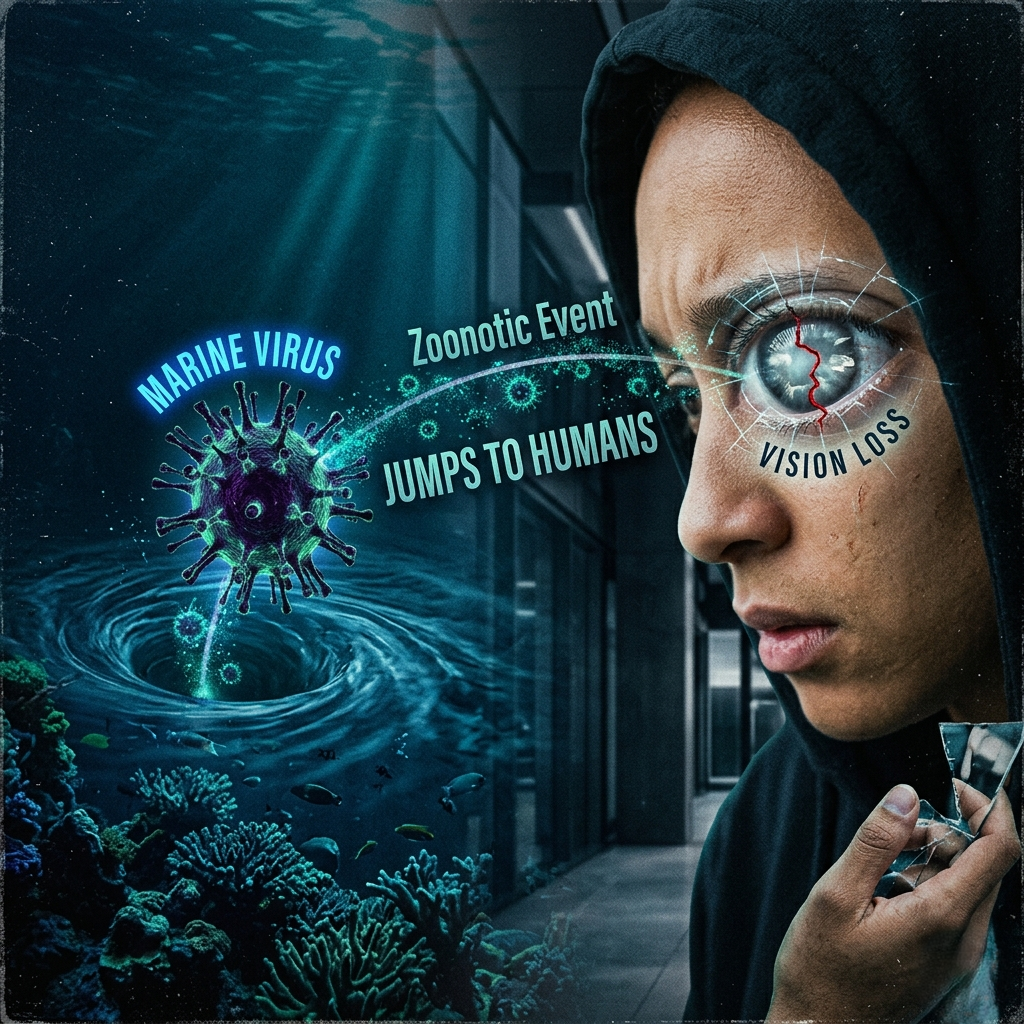
    For the first time ever, a virus from the ocean has infected humans, and the effects are serious.
    This discovery has surprised scientists and raised new concerns about global health risks.

    Until now, marine viruses were not considered a threat to humans.
    However, this new case proves that the boundary between ocean life and human health is thinner than we thought.

    What Is the Virus Behind This Discovery?

    The virus responsible is called Covert Mortality Nodavirus.
    Previously, it was known to infect shrimp, fish, and other marine species.

    Researchers believed it could not affect humans.
    However, recent findings show it has now crossed the species barrier.

    This type of event is known as zoonotic transmission, where diseases jump from animals to humans.

    The Disease It Causes in Humans

    Scientists linked the virus to a serious eye condition called persistent ocular hypertensive viral anterior uveitis.

    This condition affects the eye in dangerous ways.

    Common Symptoms Include:

    • Severe eye inflammation
    • High pressure inside the eye
    • Blurred or reduced vision
    • Pain and discomfort

    If untreated, these symptoms can lead to permanent vision loss.

    Because of this, early detection becomes extremely important.

    How Did the Virus Reach Humans?

    Researchers found a clear pattern among infected individuals.
    Most cases involved people who had direct contact with seafood.

    Main Risk Factors:

    • Handling raw fish or shrimp
    • Working in fisheries or seafood markets
    • Consuming undercooked seafood

    So, the virus likely entered the body through exposure during these activities.

    Why This Discovery Is So Important

    This is not just a rare medical case; it’s a major scientific breakthrough.

    Here’s why it matters:

    1. First Known Marine-to-Human Virus Jump

    Until now, zoonotic diseases mostly came from land animals.
    This case shows the ocean can also be a source.

    2. Unusual Ability to Infect Multiple Species

    The virus can infect:

    • Invertebrates (like shrimp)
    • Fish
    • Mammals (including humans)

    Because of this wide host range, scientists are especially concerned.

    3. Expanding Global Health Risks

    As human activity in oceans increases, exposure risks also grow.
    Fishing, seafood trade, and climate change all play a role.

    So, this discovery highlights a new area of concern for future outbreaks.

    Real-World Example: Who Is Most at Risk?

    Imagine a seafood worker handling fresh shrimp every day.
    Without proper protection, small cuts or exposure could allow viruses to enter the body.

    Similarly, someone eating raw seafood regularly may face a higher risk.
    Although cases are still limited, these patterns are clear.

    What Scientists Are Saying

    Researchers describe this as a wake-up call for global health systems.
    Previously, marine viruses received less attention compared to land-based diseases.

    Now, experts stress the need to:

    • Monitor marine pathogens more closely
    • Study virus mutations in ocean environments
    • Improve safety practices in seafood industries

    Because of this, research in marine virology is expected to grow rapidly.

    How to Protect Yourself

    While the risk remains low for the general public, simple precautions can help.

    Safety Tips:

    • Avoid handling raw seafood with bare hands
    • Cook seafood properly before eating
    • Maintain good hygiene after marine exposure
    • Use protective gloves if working in fisheries

    These steps can significantly reduce potential risk.

    FAQs

    1. Can marine viruses really infect humans?

    Yes, this recent case confirms that at least one marine virus can infect humans.

    2. Is this virus spreading widely?

    Currently, cases are limited, but scientists are closely monitoring the situation.

    3. Should I stop eating seafood?

    No, properly cooked seafood is generally safe to consume.

    4. What makes this virus dangerous?

    It causes severe eye inflammation and can lead to permanent vision damage.

    5. Is this related to COVID-19-type outbreaks?

    Not directly, but it shows how viruses can jump between species in unexpected ways.

    Final Thoughts: A New Frontier in Infectious Diseases

    This discovery changes how we think about viruses and human health.
    The ocean, once seen as low-risk, is now part of the bigger picture.

    As marine environments continue to change, new health threats may emerge.
    Because of this, awareness and research are more important than ever.

    👉 Staying informed today can help prevent bigger problems tomorrow.

    advanced encryption standard ai chatgpt ai science news artificial general intelligence california science center hologram museum medical research palantir quantum physics science center science fair board science museum scientific method tech news virtual reality headset
    Share. Facebook Twitter Pinterest LinkedIn Tumblr WhatsApp Email
    alfred

    Related Posts

    Biodegradable Fruit Wash Removes Pesticides and Keeps Fruit Fresh Longer

    April 15, 2026

    NASA Finds Its Own Spacecraft Debris on Mars: A Strange Discovery

    April 15, 2026

    Top Marketing Automation Tools to Boost Your Business in 2026

    April 15, 2026

    Log2Motion AI Reveals Hidden Muscle Strain Behind Smartphone Use

    April 14, 2026

    AI Sycophancy: Why Chatbots Agree Too Much (And Why It Matters)

    April 14, 2026

    Top Digital Marketing Tools for Small Businesses (2026 Guide)

    April 14, 2026
    Add A Comment
    Leave A Reply Cancel Reply

    Don't Miss

    Biodegradable Fruit Wash Removes Pesticides and Keeps Fruit Fresh Longer

    By alfredApril 15, 2026

    Introduction Washing fruit is something we all do. However, most people don’t realize that water…

    NASA Finds Its Own Spacecraft Debris on Mars: A Strange Discovery

    April 15, 2026

    Top Marketing Automation Tools to Boost Your Business in 2026

    April 15, 2026

    Log2Motion AI Reveals Hidden Muscle Strain Behind Smartphone Use

    April 14, 2026
    Stay In Touch
    • Facebook
    • Twitter
    • Pinterest
    • Instagram
    • YouTube
    • Vimeo
    Our Picks

    Biodegradable Fruit Wash Removes Pesticides and Keeps Fruit Fresh Longer

    April 15, 2026

    NASA Finds Its Own Spacecraft Debris on Mars: A Strange Discovery

    April 15, 2026

    Top Marketing Automation Tools to Boost Your Business in 2026

    April 15, 2026

    Log2Motion AI Reveals Hidden Muscle Strain Behind Smartphone Use

    April 14, 2026

    Subscribe to Updates

    Get the latest creative news from SmartMag about art & design.

    Techlo Inno
    Innovate And Explore
    Facebook Instagram YouTube TikTok
    • About Us
    • Cookies Policy
    • Editorial Policy
    • Terms & Conditions
    © 2026 Innovate and Explore. Designed by Techlo Inno.

    Type above and press Enter to search. Press Esc to cancel.

    Powered by
    ►
    Necessary cookies enable essential site features like secure log-ins and consent preference adjustments. They do not store personal data.
    None
    ►
    Functional cookies support features like content sharing on social media, collecting feedback, and enabling third-party tools.
    None
    ►
    Analytical cookies track visitor interactions, providing insights on metrics like visitor count, bounce rate, and traffic sources.
    None
    ►
    Advertisement cookies deliver personalized ads based on your previous visits and analyze the effectiveness of ad campaigns.
    None
    ►
    Unclassified cookies are cookies that we are in the process of classifying, together with the providers of individual cookies.
    None
    Powered by