


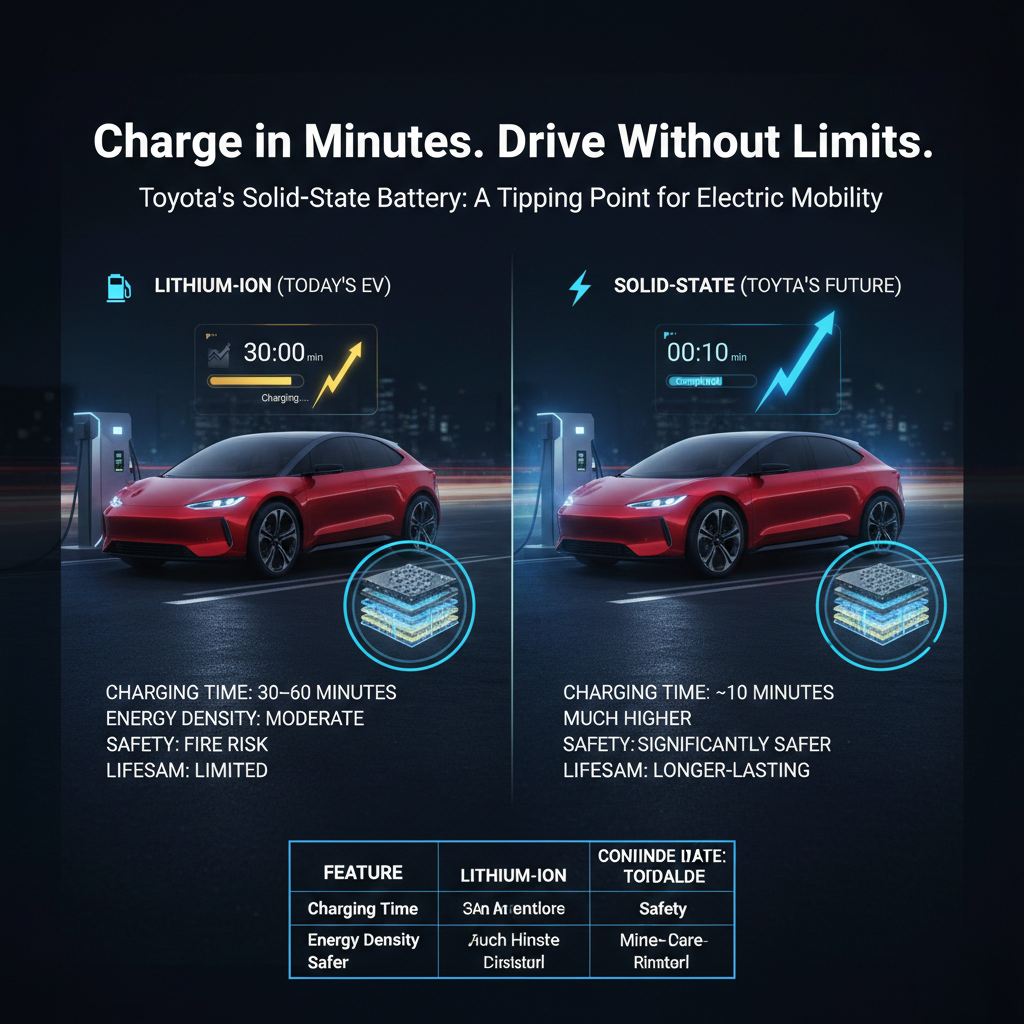
Electric vehicles have improved rapidly, but one concern still holds many drivers back: charging time. Waiting 30 minutes or longer still feels inconvenient to many.
Toyota believes it has a solution. Its progress in solid-state battery technology could dramatically change how quickly electric cars recharge.
What Makes Solid-State Batteries Different?
Most electric vehicles today rely on lithium-ion batteries filled with liquid electrolytes. These liquids help move energy but also create limitations.
Solid-state batteries replace liquid electrolytes with solid materials. That single shift unlocks major performance improvements.
Key advantages include:
- Higher energy density in the same space
- Longer battery lifespan
- Improved safety with lower fire risk
- Greater resistance to heat and degradation
This technology changes the battery from the inside out.
Toyota’s Push Toward Ultra-Fast Charging
Toyota’s engineers believe solid-state batteries could charge from near empty to full in 10 minutes or less.
That speed rivals refueling a gasoline car.
Imagine stopping for coffee and returning to a fully charged vehicle. For many drivers, that convenience would eliminate range anxiety entirely.
Why Fast Charging Could Change Everything
Range anxiety isn’t just about distance. It’s about time and uncertainty.
With ultra-fast charging:
- Long charging stops disappear
- Planning routes becomes unnecessary
- EVs feel as flexible as gas-powered cars
This psychological shift could accelerate global EV adoption almost overnight.
Beyond Cars: A Much Bigger Impact
Toyota’s solid-state battery technology could affect far more than private vehicles.
Potential applications include:
- Public transportation systems
- Delivery and logistics fleets
- Industrial energy storage
- National power grids
Faster, safer batteries improve efficiency across entire economies.
Safety and Longevity Advantages
Solid-state batteries are less prone to overheating or catching fire. This makes them safer in everyday driving and extreme conditions.
They also degrade more slowly, meaning fewer replacements over a vehicle’s lifetime.
That combination reduces costs and environmental impact.
The Challenges Still Ahead
Despite the promise, solid-state batteries aren’t ready for mass adoption yet.
Key hurdles include:
- Complex manufacturing processes
- High production costs
- Scaling technology for millions of vehicles
Toyota acknowledges these challenges but says steady progress is being made.
How This Compares to Today’s EV Batteries
| Feature | Lithium-Ion | Solid-State |
|---|---|---|
| Charging Time | 30–60 minutes | ~10 minutes |
| Energy Density | Moderate | Much higher |
| Safety | Fire risk | Significantly safer |
| Lifespan | Limited | Longer-lasting |
The differences are substantial.
When Could Solid-State EVs Hit the Road?
Toyota has indicated that commercial solid-state batteries could appear later this decade if development continues smoothly.
Early models may target premium or limited markets before wider rollout.
As costs drop, mass-market EVs would follow.
Frequently Asked Questions (FAQs)
What is Toyota’s solid-state battery?
It’s a next-generation battery using solid materials instead of liquid electrolytes to store and deliver energy.
Why is charging so much faster?
Solid electrolytes allow higher energy flow without overheating, enabling rapid charging.
Will solid-state batteries be safer?
Yes. They reduce fire risk and handle heat more effectively than lithium-ion batteries.
Are these batteries available now?
Not yet. They are still in advanced development and testing stages.
A Tipping Point for Electric Mobility
When charging becomes as quick and effortless as refueling, electric cars stop feeling like a compromise.
Toyota’s solid-state battery technology may be the breakthrough that finally removes the last major barrier to EV adoption.
If successful, this innovation won’t just improve electric cars it could redefine how the world powers transportation.
