
Imagine copying a real brain into a computer and watching it come alive.
That’s exactly what scientists have now achieved. And honestly, it’s one of the biggest breakthroughs in modern science.
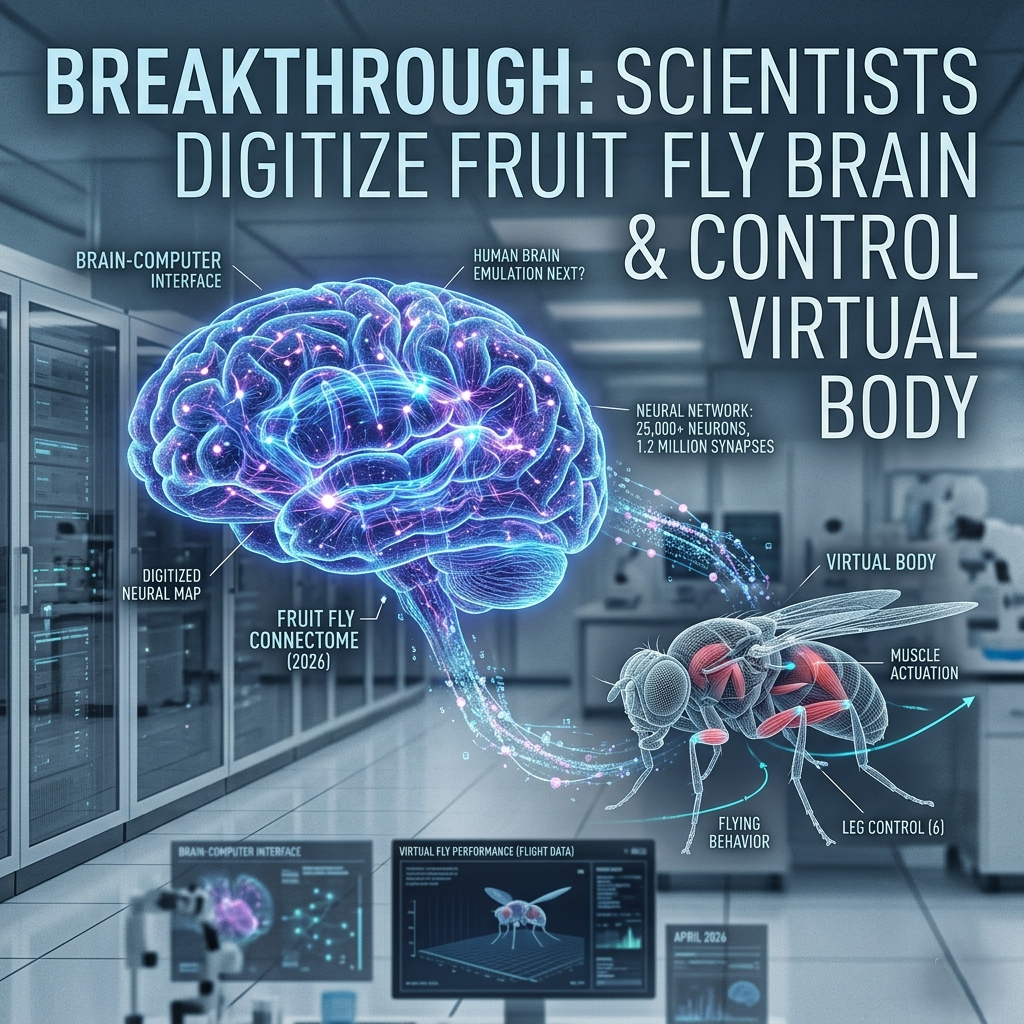
Researchers have successfully uploaded a fruit fly’s brain into a digital system. Even more impressive, the virtual brain is now controlling a simulated body with 95% behavioral accuracy.
So, what does this really mean? And why should you care? Let’s break it down in a simple way.
What Scientists Actually Did
Scientists at Eon Systems recreated the entire brain of a fruit fly inside a computer.
They didn’t just approximate it. Instead, they copied its real biological structure.
Here’s what that includes:
- Around 125,000 neurons
- About 50 million synaptic connections
- A complete neural wiring map (connectome)
Because of this, the system behaves like a real brain, not just a programmed AI.
How the Digital Brain Works
Unlike typical AI, this system doesn’t rely on trained models or guesswork.
Instead, it uses the exact wiring of a real brain.
Closed-Loop System Explained
Here’s where it gets interesting:
- The virtual body receives sensory input
- That input goes into the digital brain
- The brain processes it naturally
- Then it sends motor commands back
As a result, the digital insect reacts in real time.
It can:
- Move naturally
- Groom itself
- “Drink” in the simulation
So, it’s not just reacting; it’s behaving.
Why This Is Different from Traditional AI
Most AI systems, like chatbots or image generators, rely on training data and algorithms.
However, this approach is completely different.
Key Differences
| Traditional AI | Brain Emulation |
|---|---|
| Uses code and models | Uses real brain structure |
| Learns from data | Acts from biological wiring |
| Needs training | Works instantly |
| Simulates intelligence | Recreates it |
Because of this, scientists are not just building intelligence; they are copying it.
The Role of the Fly Connectome
This breakthrough builds on data from the FlyWire Project.
That project mapped the entire neural structure of a fruit fly.
Without this detailed map, recreating the brain would not be possible.
So, this success is actually the result of years of groundwork.
Real-World Implications
Now let’s talk about why this matters beyond the lab.
1. Understanding the Brain Better
First, scientists can study how real brains work in a controlled environment.
That means faster discoveries in neuroscience.
2. New Kind of Artificial Intelligence
Next, this could lead to AI that behaves more naturally.
Instead of training models, we may simply replicate biological systems.
3. Medical Breakthroughs
This could help in studying diseases like
- Alzheimer’s
- Parkinson’s
- Brain injuries
Because researchers can test directly on digital brains.
4. Toward Human Brain Emulation
This is the big one.
Researchers aim to scale this technology to:
- Mice
- Then humans
While that sounds futuristic, the biggest challenge now is computing power, not science.
Real Example: Why This Matters
Think about flight simulators used to train pilots.
Now imagine a “brain simulator” that behaves like a real human brain.
Doctors could test treatments before applying them in real life.
Similarly, AI systems could become more human-like without massive training datasets.
Challenges Still Ahead
Even though this is exciting, there are still limits.
Major Challenges:
- Huge computational requirements
- Ethical concerns about digital consciousness
- Scaling complexity from flies to humans
So, while progress is fast, careful steps are necessary.
FAQs
Is the fly actually alive in the computer?
No, it’s not alive. However, its brain behavior is accurately simulated using real biological data.
How accurate is the simulation?
The system shows about 95% behavioral accuracy, which is extremely high for this kind of experiment.
Can this be done for humans?
Not yet. However, scientists believe it’s possible in the future with enough computing power.
Is this the same as artificial intelligence?
No. This is brain emulation, which copies real neural structures instead of training models.
Final Thoughts
This breakthrough changes how we think about intelligence itself.
Instead of building AI from scratch, scientists are now copying nature’s design.
And step by step, the gap between biological life and digital systems is shrinking.
What should you take from this?
We are moving toward a future where minds could exist in digital form.
That may sound like science fiction, but it’s starting to become reality.
👉 Keep an eye on this space. The next big leap might be closer than anyone expects.
