


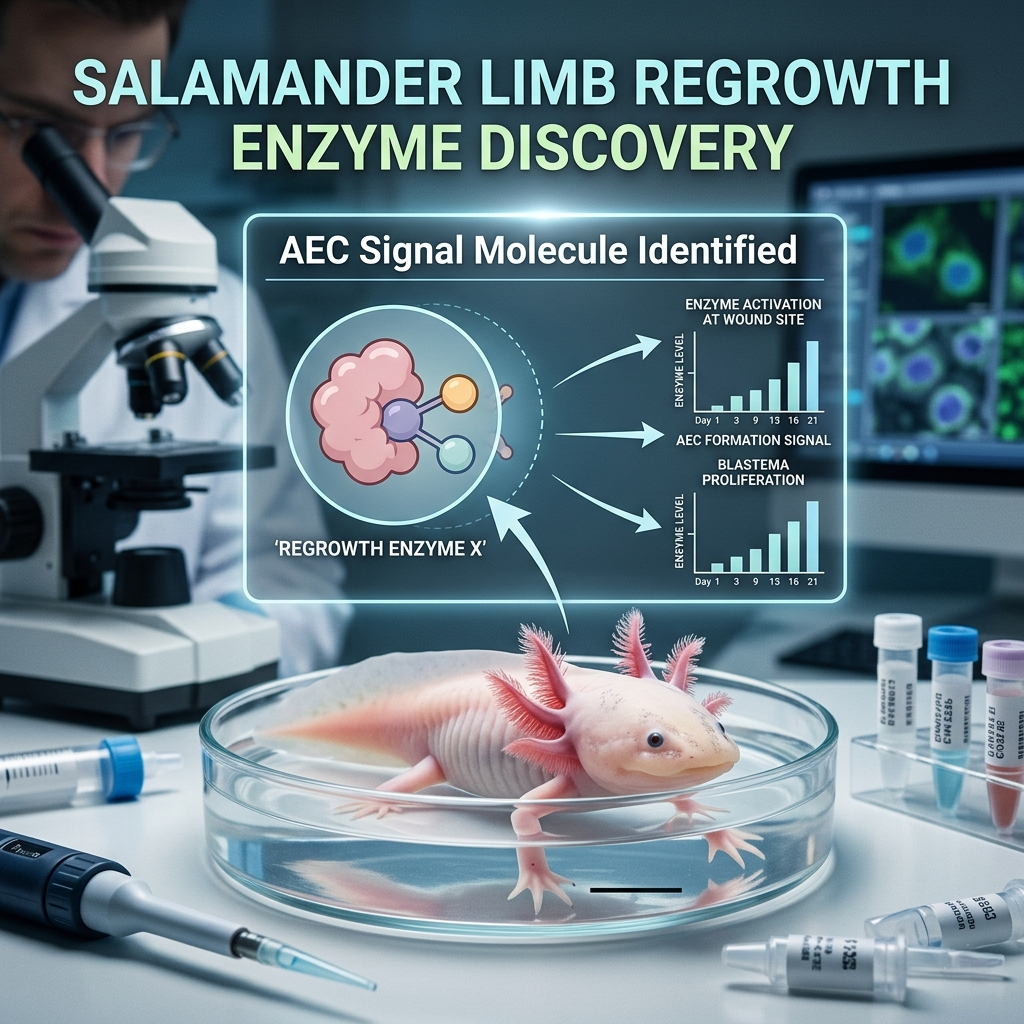
Imagine losing a limb and growing it back naturally. It sounds impossible for humans. However, for salamanders, it’s normal.
Now, scientists have taken a big step toward understanding this ability. They discovered a key enzyme that controls how these animals regrow lost limbs.
Why Salamanders Are So Special
The salamander is famous for its healing power.
It can regrow:
- Arms and legs
- Parts of the heart
- Sections of the spinal cord
Because of this, scientists have studied them for years. They want to understand how this natural process works.
The Key Discovery: A Powerful Enzyme
Researchers found that a specific enzyme plays a major role in regeneration.
This enzyme controls how cells grow, divide, and organize during healing. As a result, the body doesn’t just repair damage—it rebuilds entire structures.
That’s what makes this discovery so important.
What Is a Blastema and Why Does It Matter?
At the center of regrowth is something called a “blastema.”
A blastema is like a repair hub.
Here’s what happens:
- Cells gather at the injury site
- They multiply rapidly
- They transform into different tissue types
- A new limb starts forming
Without this structure, full regeneration wouldn’t be possible.
How the Enzyme Controls Regrowth
The enzyme helps trigger the formation of the blastema.
Because of this, it acts like a “switch” that tells the body to start rebuilding instead of just healing a wound.
In simple terms, it changes the body’s response from repair to regeneration.
What This Means for Humans
Humans can heal wounds, but we cannot regrow limbs.
However, this discovery could change that in the future. It connects directly to regenerative medicine, which focuses on repairing the body using advanced biology.
Scientists hope to:
- Activate similar processes in humans
- Improve healing after injuries
- Repair nerve damage
- Possibly regrow lost tissues
Although this will take time, the potential is huge.
Real-World Impact and Future Possibilities
If this research continues to grow, it could transform healthcare.
For example:
- Accident victims may recover faster
- Patients with severe injuries may regain function
- New treatments could replace complex surgeries
So, this is more than just a scientific discovery—it’s a glimpse into the future of medicine.
Why This Breakthrough Matters
This discovery shows that nature already has solutions we don’t fully understand yet.
By studying salamanders, scientists are learning how to unlock hidden healing abilities.
Moreover, it brings us closer to treatments once considered impossible.
FAQs
1. Can humans regrow limbs like salamanders?
No, not currently. However, research aims to make this possible in the future.
2. What does the enzyme do?
It controls cell growth and helps trigger the regeneration process.
3. What is a blastema?
It’s a group of cells that forms at an injury site and rebuilds tissues.
4. How long before this helps humans?
It may take years or even decades. The research is still in early stages.
5. Why study salamanders?
Because they naturally regenerate body parts, making them ideal for research.
Final Thoughts
The discovery of this enzyme is a major step forward in understanding regeneration.
It shows that the human body might one day heal in ways we never imagined. Moreover, it highlights how studying nature can unlock powerful medical solutions.
Stay curious—because breakthroughs like this are shaping the future of healing. 🚀
