


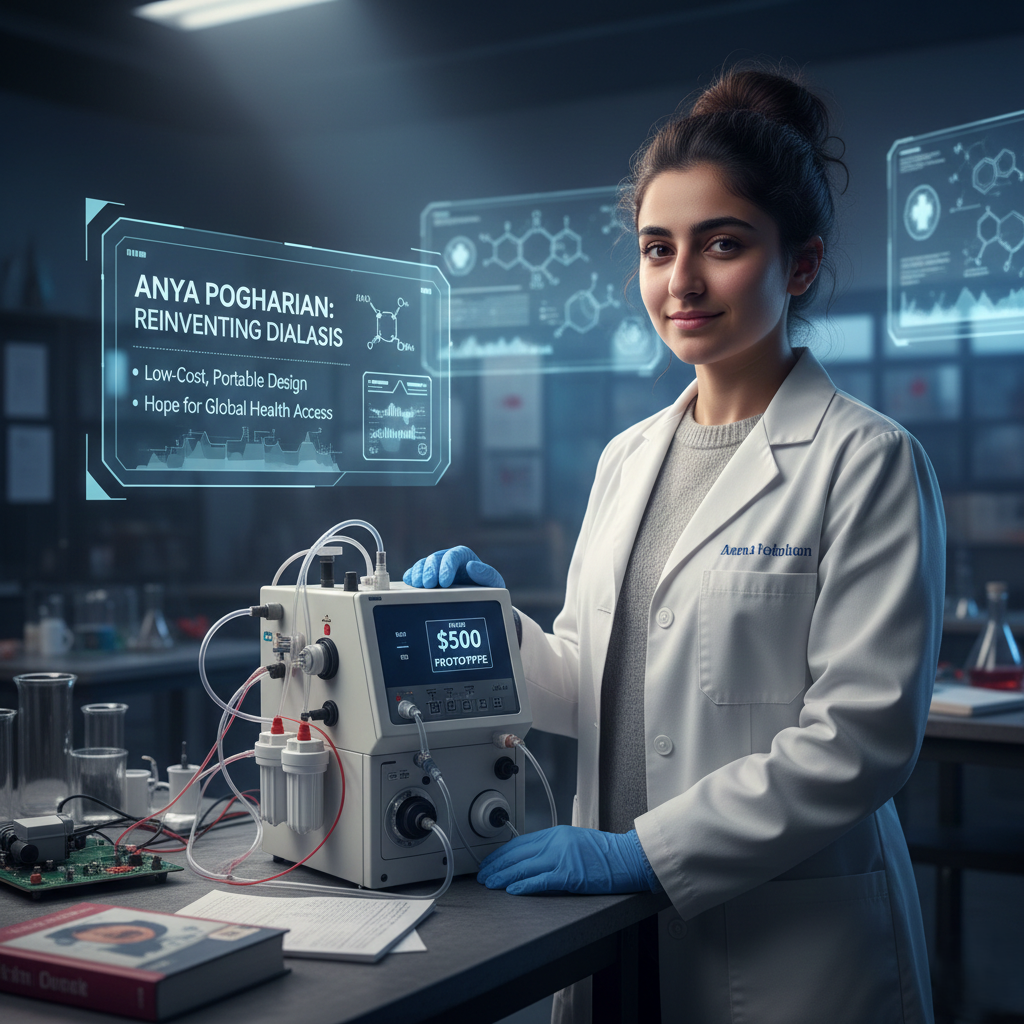
Innovation doesn’t always begin in billion-dollar labs. Sometimes, it starts in a high-school classroom driven by curiosity and compassion.
This is the remarkable story of Anya Pogharian, a Canadian teenager whose low-cost dialysis prototype sparked global attention and hope for more accessible healthcare solutions.
The Problem That Sparked an Idea
Witnessing the Reality of Kidney Failure
Anya’s journey began while volunteering in a hospital dialysis unit.
There, she saw patients endure not only physical strain but overwhelming emotional and financial stress.
She learned a hard truth:
- Standard dialysis machines can cost over $30,000
- Millions worldwide lack access to life-saving treatment
- Cost alone can determine survival in low-income regions
That realization became the turning point.
Turning Curiosity Into Engineering Action
Learning Beyond the Classroom
Motivated by a passion for engineering, Anya set out to understand how dialysis machines work on her own.
She studied:
- Technical medical manuals
- Scientific research papers
- Engineering design resources
Without formal training, she broke down a complex medical system into something she could redesign from scratch.
A $500 Dialysis Machine Prototype
Rethinking Cost Without Sacrificing Purpose
Using commonly available, low-cost components, Anya developed a functional dialysis machine prototype for approximately $500.
That figure represented a dramatic reduction compared to conventional machines.
Early laboratory testing showed the system could:
- Filter impurities from blood
- Perform the core function of dialysis
- Demonstrate feasibility as a low-cost alternative
While not clinically approved, the prototype proved the concept was possible.
Global Recognition and Scientific Validation
From Science Fair to Research Institutions
Anya’s project quickly gained attention beyond her school.
Media outlets and healthcare organizations praised the work as a powerful example of student-driven medical innovation.
Her efforts earned her an internship at Héma-Québec, one of Canada’s leading blood and medical service organizations.
There, she gained hands-on experience in:
- Biomedical research
- Medical technology development
- Professional healthcare environments
Important Safety and Development Disclaimer
Prototype, Not a Medical Device
Anya and medical professionals have been clear about one critical point.
This invention is still in the research and development stage.
Before real-world use, it would require:
- Extensive safety testing
- Clinical trials
- Regulatory approval
The project stands as a proof of concept, not a deployable medical device.
Why This Story Matters
Innovation With a Human Purpose
Anya Pogharian’s journey represents more than a single invention.
It highlights:
- The power of STEM education
- The urgency of affordable medical technology
- The importance of equitable access to healthcare
Her work shows how empathy paired with scientific thinking can challenge long-standing global health barriers.
Frequently Asked Questions (FAQs)
Is Anya Pogharian’s dialysis machine in use today?
No. It is a prototype still undergoing research and development.
How much did her prototype cost to build?
Approximately $500, using low-cost, commonly available components.
Why is this invention significant?
It demonstrates that dialysis technology can be redesigned to be far more affordable and accessible.
Final Thoughts
Anya Pogharian’s story proves that meaningful innovation doesn’t depend on age, funding, or formal titles.
With curiosity, compassion, and determination, a teenager reimagined a life-saving technology and inspired a generation of young innovators.
Her journey reminds us that global change can begin in the most unexpected places, even a high-school science lab.
