

Close Menu
Innovate And ExploreInnovate And Explore

    Subscribe to Updates

    Get the latest creative news from FooBar about art, design and business.

    What's Hot

    How to Grow Instagram from 0 to 10K Followers in 2026 Using Organic Methods

    May 22, 2026

    Smart Wearables Are Reshaping the Future of Everyday Technology

    May 13, 2026

    Everyday Tech How-To Guides for a Smarter and Easier Digital Life

    May 13, 2026
    Facebook Instagram
    Facebook Instagram YouTube TikTok
    Innovate And ExploreInnovate And Explore
    • Artificial Intelligence
    • Medical Research
    • Technology News
    • Science News
    • VR Headset
    • Palantir
    Innovate And ExploreInnovate And Explore
    Home » AI Can Predict Deforestation, So Why Does It Still Happen?
    Artificial Intelligence

    AI Can Predict Deforestation, So Why Does It Still Happen?

    alfredBy alfredApril 6, 2026No Comments4 Mins Read
    Facebook Twitter Pinterest LinkedIn Tumblr WhatsApp Email
    Share
    Facebook Twitter LinkedIn WhatsApp Pinterest Email

    Introduction

    In 2026, the real problem is not a lack of technology; it’s a lack of action. Today, artificial intelligence can warn us before forests are destroyed. Yet, destruction continues anyway. So, what’s going wrong?

    Let’s break this down in a simple way.

    How AI Predicts Deforestation Before It Happens

    Artificial intelligence, especially tools using machine learning, can study patterns from satellite images. As a result, it detects early signs of illegal activity.

    Instead of reacting after damage, authorities can act early.

    Here’s what AI can do:

    • Analyze satellite data in real time
    • Spot unusual land changes or road building
    • Predict high-risk zones for illegal logging
    • Send alerts before damage spreads

    In short, AI turns forest protection from “damage control” into “damage prevention.”

    Why This Matters More Than Ever

    Deforestation isn’t just about trees. It affects climate, wildlife, and human life.

    For example:

    • Forests absorb carbon and slow climate change
    • They protect biodiversity and endangered species
    • Millions of people depend on forests for survival

    Therefore, stopping deforestation early makes a huge difference.

    Real-World Example: Brazil’s Use of AI

    Countries like Brazil are already using AI tools to monitor the Amazon rainforest.

    With systems supported by organizations like INPE, authorities can:

    • Track illegal logging in near real time
    • Identify hotspots before large-scale damage
    • Take faster enforcement actions

    As a result, technology has proven that prevention is possible.

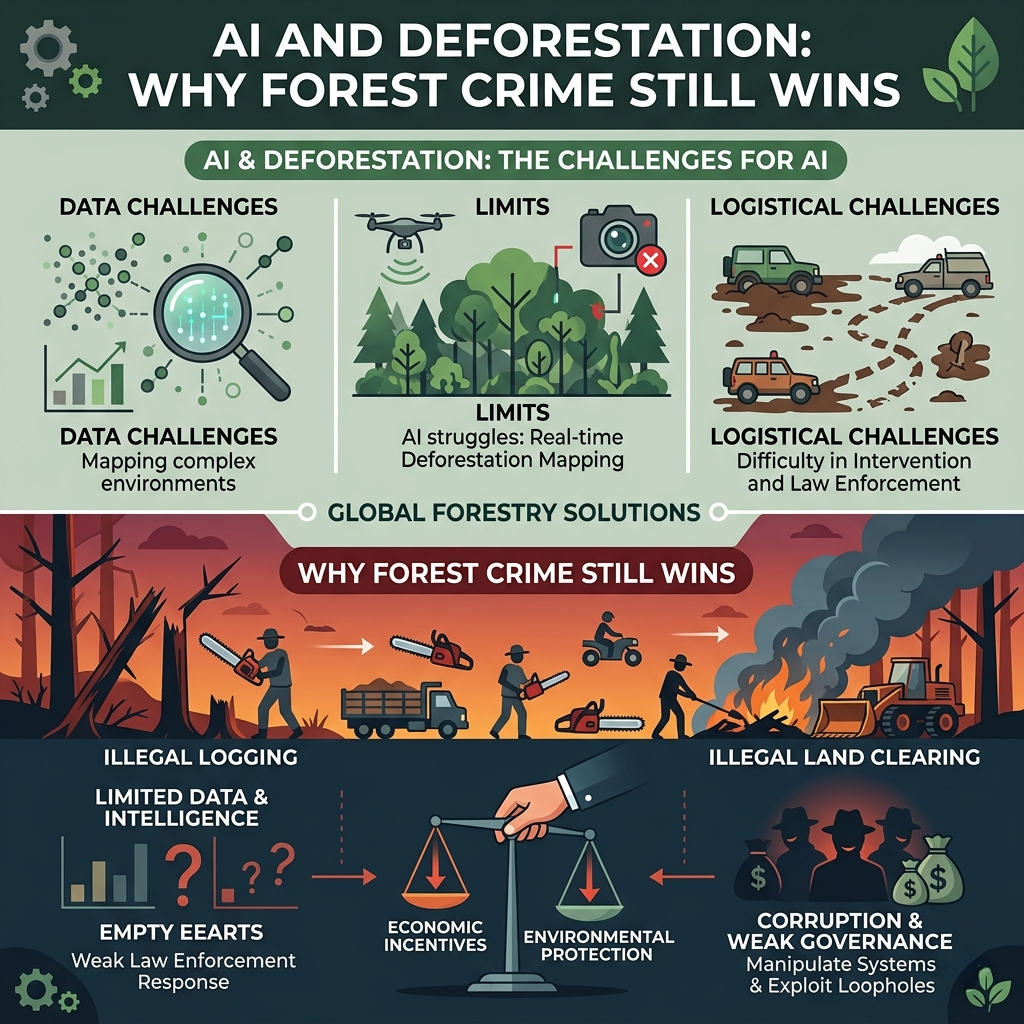
    The Real Problem: Lack of Will, Not Tools

    Despite all this progress, deforestation continues. So, clearly, the issue isn’t technology.

    Instead, it comes down to power and priorities.

    1. Powerful Interests Block Action

    Illegal logging and mining often involve influential groups. Because of that, enforcement becomes weak or selective.

    Even when alerts exist, action doesn’t always follow.

    2. Governments Talk, But Don’t Always Act

    Many governments promote conservation publicly. However, enforcement on the ground often tells a different story.

    Policies exist, but implementation fails.

    3. Corporations Benefit From the System

    Some companies promote “sustainability.” Meanwhile, they still depend on supply chains linked to deforestation.

    So, the system keeps running quietly in the background.

    Prediction vs. Prevention: The Key Difference

    AI gives us a choice.

    • Prediction without action = warning ignored
    • Prediction with action = forests protected

    Right now, many regions stay stuck in the first category.

    That’s the real issue.

    What Needs to Change in 2026

    If AI already works, then the next step is clear: act on the data.

    Here’s what must improve:

    Stronger Enforcement

    Authorities must respond quickly to AI alerts. Otherwise, the technology becomes useless.

    Transparent Supply Chains

    Companies should prove their products are not linked to deforestation. This builds trust and reduces hidden damage.

    Global Accountability

    Countries buying forest-related products must also take responsibility. After all, demand drives destruction.

    A Simple Question That Changes Everything

    If we can predict forest crime before it happens, then one question matters most:

    Who is being protected when the crime still continues?

    That question shifts the focus from technology to responsibility.

    FAQs

    Can AI really stop deforestation?

    AI alone cannot stop it. However, it can provide early warnings. When combined with strong action, it becomes a powerful prevention tool.

    Why is deforestation still happening if we have this technology?

    Because enforcement is weak and powerful interests interfere. In many cases, decisions—not data—are the real barrier.

    Is Brazil successfully using AI for forest protection?

    Yes, Brazil has shown that AI can track and reduce illegal activity when authorities act on the data.

    What role do corporations play in deforestation?

    Many companies rely on supply chains linked to forest destruction. Without transparency, this cycle continues.

    Final Thoughts

    Technology has already given us the ability to protect forests before they are destroyed. However, tools alone cannot solve the problem.

    Real change begins when action matches awareness.

    If governments enforce laws, corporations clean their supply chains, and consumers demand accountability, deforestation can slow down fast.

    advanced encryption standard ai chatgpt ai science news artificial general intelligence california science center hologram museum medical research palantir quantum physics science center science fair board science museum scientific method tech news virtual reality headset
    Share. Facebook Twitter Pinterest LinkedIn Tumblr WhatsApp Email
    alfred

    Related Posts

    How to Grow Instagram from 0 to 10K Followers in 2026 Using Organic Methods

    May 22, 2026

    Smart Wearables Are Reshaping the Future of Everyday Technology

    May 13, 2026

    Everyday Tech How-To Guides for a Smarter and Easier Digital Life

    May 13, 2026

    The Rise of AI Girlfriends and Virtual Companions: Future or Danger?

    May 10, 2026

    The Dark Side of Deepfake Technology in 2026

    May 9, 2026

    How AI Video Generators Are Replacing Traditional Content Creation

    May 9, 2026
    Add A Comment
    Leave A Reply Cancel Reply

    Don't Miss

    How to Grow Instagram from 0 to 10K Followers in 2026 Using Organic Methods

    By alfredMay 22, 2026

    Introduction Starting from zero on Instagram feels tough at first. However, with the right strategy,…

    Smart Wearables Are Reshaping the Future of Everyday Technology

    May 13, 2026

    Everyday Tech How-To Guides for a Smarter and Easier Digital Life

    May 13, 2026

    The Rise of AI Girlfriends and Virtual Companions: Future or Danger?

    May 10, 2026
    Stay In Touch
    • Facebook
    • Twitter
    • Pinterest
    • Instagram
    • YouTube
    • Vimeo
    Our Picks

    How to Grow Instagram from 0 to 10K Followers in 2026 Using Organic Methods

    May 22, 2026

    Smart Wearables Are Reshaping the Future of Everyday Technology

    May 13, 2026

    Everyday Tech How-To Guides for a Smarter and Easier Digital Life

    May 13, 2026

    The Rise of AI Girlfriends and Virtual Companions: Future or Danger?

    May 10, 2026

    Subscribe to Updates

    Get the latest creative news from SmartMag about art & design.

    Techlo Inno
    Innovate And Explore
    Facebook Instagram YouTube TikTok
    • About Us
    • Cookies Policy
    • Editorial Policy
    • Terms & Conditions
    © 2026 Innovate and Explore. Designed by Techlo Inno.

    Type above and press Enter to search. Press Esc to cancel.

    Powered by
    ►
    Necessary cookies enable essential site features like secure log-ins and consent preference adjustments. They do not store personal data.
    None
    ►
    Functional cookies support features like content sharing on social media, collecting feedback, and enabling third-party tools.
    None
    ►
    Analytical cookies track visitor interactions, providing insights on metrics like visitor count, bounce rate, and traffic sources.
    None
    ►
    Advertisement cookies deliver personalized ads based on your previous visits and analyze the effectiveness of ad campaigns.
    None
    ►
    Unclassified cookies are cookies that we are in the process of classifying, together with the providers of individual cookies.
    None
    Powered by