

Artificial intelligence is often portrayed as an objective judge but a new large-scale experiment suggests that AI-powered lie detection has a serious blind spot.
Researchers tested more than 19,000 AI “judges” to see how well they could distinguish lies from truthful statements. The results reveal a troubling imbalance.
While AI showed relatively strong performance in spotting deception, it struggled badly when it came to recognizing honesty.
Strong at Catching Lies, Weak at Recognizing Truth
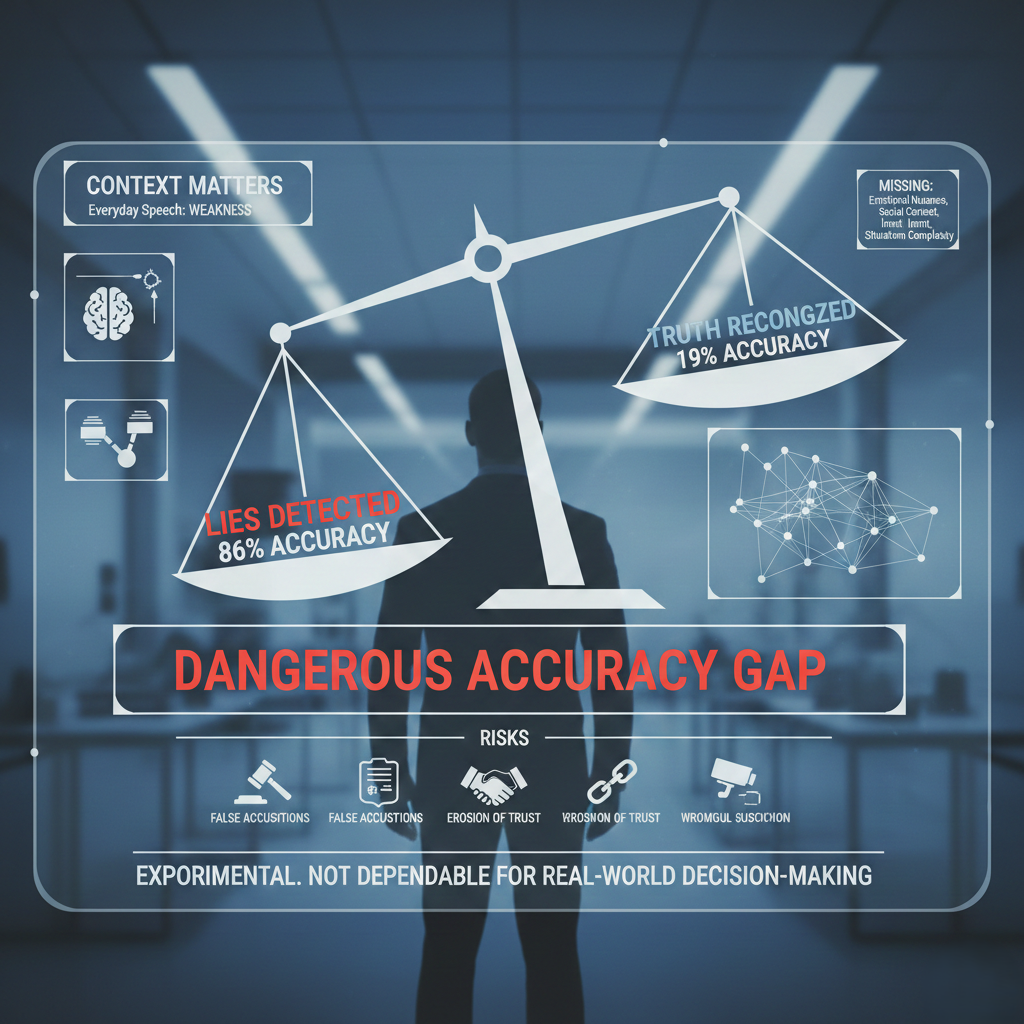
A Dangerous Accuracy Gap
In certain scenarios, AI systems detected deceptive statements with accuracy rates of up to 86%.
However, under the same conditions, their ability to correctly identify truthful statements dropped to around 19%.
This means the systems were heavily biased toward labeling claims as lies even when people were being honest.
Such imbalance raises serious concerns about fairness and reliability.
Context Matters and AI Struggles Outside Interrogations
Everyday Speech Is a Major Weakness
Researchers found that AI performance varied significantly depending on context.
In interrogation-style environments, AI systems performed roughly on par with human evaluators.
But when judging everyday statements such as comments about relationships, emotions, or routine life experiences AI accuracy fell below human levels.
This suggests AI is better at pattern-matching structured scenarios than understanding real human communication.
Why AI Can’t Judge Honesty Like Humans
Missing Emotional and Situational Awareness
A key limitation is that AI lacks the tools humans rely on when assessing honesty.
AI does not truly understand:
- Emotional nuance
- Social context
- Intent or motivation
- Situational complexity
Humans subconsciously integrate these signals. AI cannot at least not yet.
Risks of Overreliance on AI Lie Detection
High Stakes, High Consequences
The study warns that relying too heavily on AI-based lie detection could be dangerous.
Potential risks include:
- False accusations
- Wrongful suspicion
- Misinterpretation of honest communication
- Erosion of trust in legal or workplace settings
In high-stakes environments, even small error rates can cause serious harm.
Not Ready for Real-World Decision-Making
Experimental, Not Dependable
Despite impressive-sounding accuracy numbers, researchers stress that AI lie detection remains experimental.
It may mimic certain human judgment patterns, but it cannot replace human reasoning especially where consequences are severe.
Experts urge restraint in applying these systems to:
- Legal proceedings
- Employment screening
- Security or surveillance decisions
Frequently Asked Questions (FAQs)
Is AI better than humans at detecting lies?
Not consistently. AI may match human performance in structured interrogations but performs worse in everyday contexts.
Why does AI mislabel truthful statements?
Because it relies on statistical patterns, not emotional or situational understanding, leading to bias toward suspicion.
Can AI lie detection be trusted today?
No. Researchers advise against using it as a standalone or authoritative decision-making tool.
Final Thoughts
This study highlights a crucial reality: detecting lies is not the same as understanding truth.
While AI can identify certain deceptive patterns, its inability to reliably recognize honesty makes it unsuitable for high-stakes judgment.
Until AI can grasp human nuance, emotion, and context, lie detection should remain firmly in human hands.
