


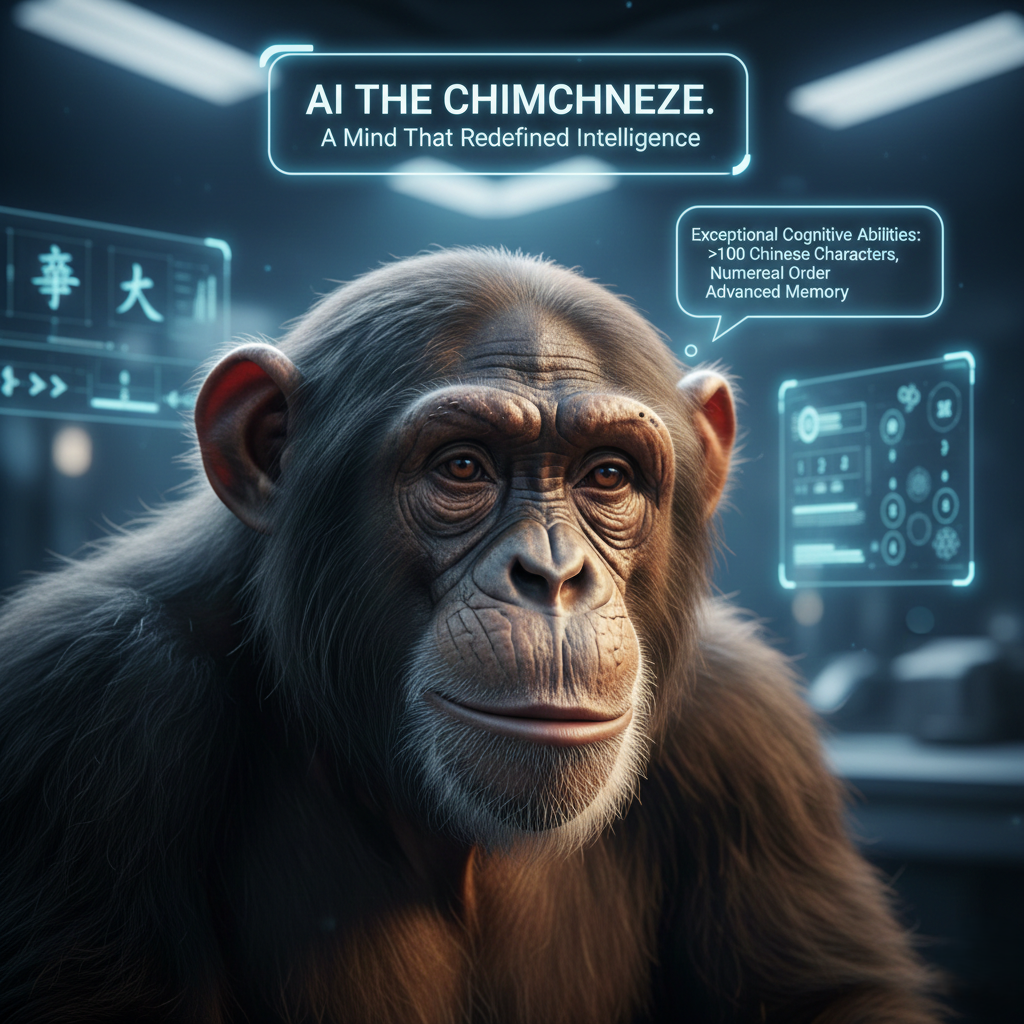
Introduction: A Mind That Redefined Intelligence
Ai, a chimpanzee whose intelligence reshaped scientific thinking, has died at the age of 49.
Her extraordinary cognitive abilities challenged long-held assumptions about human uniqueness.
For decades, Ai amazed researchers by demonstrating skills once thought exclusive to humans.
Her legacy now lives on in modern studies of animal intelligence and human evolution.
Who Was Ai the Chimpanzee?
Ai was a female chimpanzee studied at Kyoto University in Japan.
She became one of the most intensively researched non-human minds in history.
Unlike typical animal studies, Ai’s training focused on complex symbolic understanding.
This approach allowed scientists to explore how intelligence develops across species.
Exceptional Cognitive Abilities That Stunned Scientists
Ai’s abilities went far beyond basic problem-solving or conditioned responses.
She demonstrated advanced learning, memory, and perceptual reasoning skills.
Key Skills That Made Ai Extraordinary
- Recognized over 100 Chinese characters accurately
- Read and identified English alphabet letters
- Understood Arabic numerals and numerical order
- Distinguished a wide range of colors and shapes
- Showed strong working memory and visual perception
These abilities are extremely rare among non-human animals.
They placed Ai at the center of global scientific attention.
Groundbreaking Research at Kyoto University
Ai participated in pioneering research on primate cognition for decades.
Her work helped scientists better understand how intelligence evolves.
Transforming the Study of Animal Minds
Before Ai, many believed symbolic understanding required human language.
Her performance showed that abstract thinking may predate human evolution.
Studies involving Ai appeared in leading scientific journals, including Nature.
These papers reshaped theories about cognition, learning, and awareness.
What Ai Taught Us About Human Evolution
Ai’s intelligence provided clues about the origins of human thinking.
Her abilities suggested that early ancestors may have shared similar cognitive foundations.
Bridging the Gap Between Humans and Animals
- Demonstrated symbolic recognition without spoken language
- Showed intentional learning and curiosity
- Challenged the idea of strict human cognitive superiority
Her life encouraged scientists to rethink intelligence as a spectrum.
Not a boundary, but a shared evolutionary trait.
Global Impact on Science and Public Awareness
Ai became a symbol of animal intelligence worldwide.
Media coverage brought scientific research into public conversation.
Her story helped people view animals with greater respect and curiosity.
She inspired ethical discussions about animal research and cognition.
Researchers Remember Ai’s Curiosity and Spirit
Scientists describe Ai as eager, focused, and highly motivated to learn.
Her curiosity drove many of the breakthroughs associated with her name.
Researchers say her influence will guide future studies for generations.
Her contributions remain foundational in cognitive science today.
Why Ai’s Legacy Still Matters
Ai’s life reminds us that intelligence is not uniquely human.
It exists across species in diverse and surprising forms.
Understanding animal cognition helps us better understand ourselves.
It also shapes how we treat and protect intelligent life.
Conclusion: A Legacy That Transcends Species
Ai was more than a research subject.
She was a pioneer who changed how intelligence is defined.
Her death marks the end of a remarkable life, but not her influence.
Ai’s legacy continues to inspire science, ethics, and curiosity.
As research advances, her story reminds us to explore intelligence with humility and wonder.
Frequently Asked Questions (FAQs)
How old was Ai the chimpanzee when she died?
Ai passed away at the age of 49, an advanced age for a chimpanzee.
Why was Ai considered unique among chimpanzees?
She demonstrated symbolic recognition, numerical understanding, and advanced memory skills rarely seen in non-human animals.
What was the significance of Ai’s research?
Her studies transformed scientific understanding of primate cognition and human intelligence evolution.
Where was Ai studied?
Ai was studied for decades at Kyoto University in Japan.
