

Introduction: A Major Shift in Medical Research
For decades, drug safety testing relied heavily on animals. Mice, rats, and rabbits helped researchers predict how medicines might affect humans.
However, something remarkable is happening now.
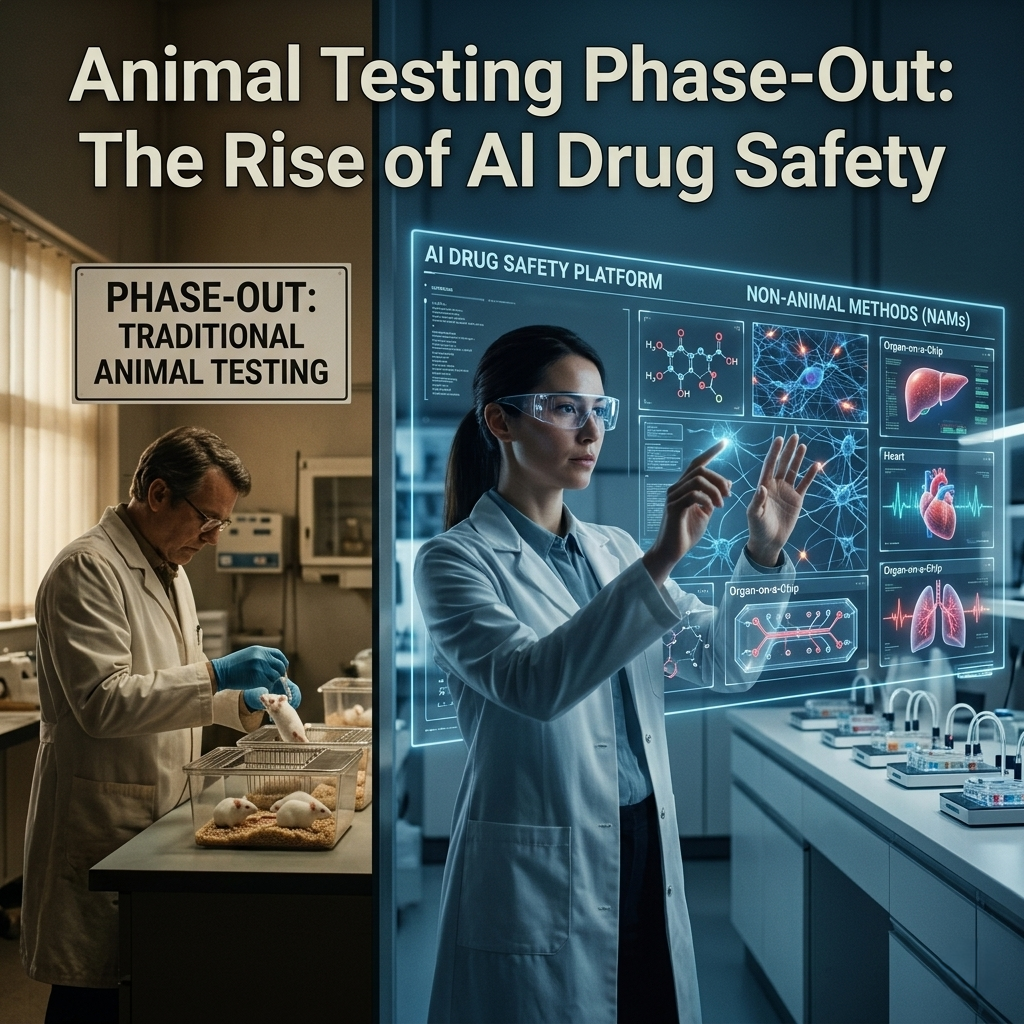
Regulators are starting to phase down animal testing and move toward human-relevant technologies. These include AI simulations, lab-grown human tissues, and organ-on-chip systems.
As a result, thousands of laboratory animals could be spared every year.
More importantly, drug testing could become faster, cheaper, and more accurate for humans.
Recently, regulators including the U.S. Food and Drug Administration signaled that new methods may begin influencing decisions as early as the IND (Investigational New Drug) stage.
In other words, the future of drug safety testing is already beginning.
Why Animal Testing Is Being Reconsidered
Animal models have helped science for decades. Yet they often fail to predict real human responses.
Many drugs that work in mice still fail during human trials.
This problem is sometimes called the “mouse-success, human-failure” gap.
Because of this gap, pharmaceutical companies lose billions in failed research.
Even worse, patients wait longer for potentially life-saving treatments.
Therefore, regulators and scientists now support human-based testing technologies.
These modern tools promise to improve both ethics and scientific accuracy.
What Are New Approach Methodologies (NAMs)?
The new testing strategy revolves around new approach methodologies, commonly called NAMs.
NAMs use technology to predict drug safety without relying on animal experiments.
These methods combine biology, data science, and artificial intelligence.
Key NAM technologies include the following:
- AI-based toxicity modeling
- Human organoids grown from stem cells
- Organ-on-chip microdevices
- Real-world human safety databases
Together, these tools create a human-focused testing system.
As a result, researchers can study drug effects more realistically.
AI Toxicity Modeling: Simulating Drug Safety
Artificial intelligence now plays a central role in safety prediction.
AI models analyze enormous datasets from past drug trials, chemicals, and biological reactions.
Then, they simulate how a new compound might behave inside the human body.
For example, AI systems can quickly predict the following:
- Liver toxicity
- Kidney damage risks
- Drug-drug interactions
- Long-term metabolic effects
Because AI processes millions of data points quickly, researchers gain early safety insights before clinical trials begin.
Consequently, unsafe compounds can be rejected much earlier.
That saves both time and research funding.
Human Organoids: Mini Organs in the Lab
Another breakthrough comes from human organoids.
Organoids are tiny 3D tissue structures grown from stem cells. Despite their size, they mimic real human organs.
Scientists can grow mini versions of:
- Brain tissue
- Liver tissue
- Heart tissue
- Lung tissue
- Intestinal tissue
Researchers expose these organoids to experimental drugs.
Then, they monitor real biological responses.
Because organoids use human cells, they often provide far better insights than animal experiments.
As a result, drug toxicity can be measured with higher accuracy.
Organ-on-Chip Technology: Human Organs on Microchips
Perhaps the most fascinating innovation is organ-on-chip technology.
These microdevices contain living human cells arranged to mimic real organ functions.
Tiny channels circulate fluids that simulate blood flow.
Therefore, researchers can observe realistic biological reactions.
For example, a lung-on-chip can simulate breathing movements.
Meanwhile, a heart-on-chip can replicate heartbeat patterns.
This technology allows scientists to observe how drugs affect living tissues in real time.
Consequently, safety testing becomes both dynamic and human-relevant.
Real-World Human Safety Data
Another important pillar of modern drug testing is real-world data.
Hospitals, electronic health records, and patient registries produce vast health datasets.
Researchers analyze this information to identify patterns of drug safety or toxicity.
For instance, scientists may detect unexpected side effects that appeared in large populations.
Then, AI systems incorporate those insights into predictive models.
Because of this feedback loop, drug development becomes smarter over time.
Real-World Impact on Drug Development
This transformation could reshape the entire pharmaceutical industry.
Several major benefits are already becoming clear.
1. Faster Drug Approvals
Traditional safety testing can take years.
However, NAM technologies accelerate early safety analysis.
Therefore, promising drugs may reach clinical trials sooner.
2. Lower Research Costs
Drug development costs often exceed $2 billion per medicine.
Yet AI simulations and lab-grown tissues reduce expensive animal studies.
Consequently, companies may spend less on early-stage research.
3. More Accurate Human Predictions
Animal biology differs significantly from human biology.
Human-based testing methods therefore provide more reliable safety predictions.
As a result, fewer drugs fail during late clinical trials.
4. Ethical Scientific Progress
Reducing animal experiments also improves research ethics.
Thousands of laboratory animals could be spared each year.
Meanwhile, science still advances rapidly.
Case Example: Toxicity Prediction with AI
Several biotech companies already use AI toxicity prediction systems.
In one study, AI models analyzed chemical structures of experimental drugs.
The system identified liver toxicity risks months before animal studies normally detect them.
Because researchers caught the issue early, they redesigned the compound.
Consequently, the improved drug moved forward successfully.
Without AI prediction, the project might have failed much later.
Challenges That Still Remain
Despite the progress, the transition will not happen overnight.
Scientists must still validate many new technologies.
Regulators also require strong evidence before replacing established methods.
Some current challenges include:
- Standardizing organ-on-chip experiments
- Ensuring AI predictions remain transparent
- Integrating data across research platforms
Nevertheless, momentum is clearly building.
Many regulatory agencies now support gradual replacement of animal testing.
The Future of Drug Testing
The next decade may completely transform regulatory science.
Instead of relying primarily on animals, drug safety will likely combine:
- AI simulations
- human organoids
- organ-on-chip systems
- real-world clinical data
Together, these technologies create a human-centered drug development ecosystem.
Consequently, treatments could reach patients faster and with greater safety confidence.
Most importantly, research will align more closely with human biology.
FAQs
Why is animal testing being phased down?
Animal testing often fails to predict human reactions accurately. Therefore, regulators are exploring human-based technologies like AI models and organoids for safer and more reliable results.
What are New Approach Methodologies (NAMs)?
NAMs are modern testing methods that replace or reduce animal experiments. They include AI toxicity simulations, organoids, organ-on-chip platforms, and real-world human health data.
Can AI completely replace animal testing?
Not immediately. However, AI can reduce many early-stage tests. Over time, improvements in biological modeling may replace a large portion of traditional animal studies.
What are organoids used for?
Organoids are miniature lab-grown organs made from human cells. Scientists use them to study disease, test drugs, and analyze toxicity responses.
How will this change drug development?
Drug testing may become faster, cheaper, and more accurate. As a result, more treatments could successfully reach patients while fewer research animals are required.
Final Thoughts
Drug safety testing is entering a new era.
AI simulations, organoids, and organ-on-chip systems are slowly replacing traditional animal experiments.
Because these tools use human-relevant biology, they promise more accurate safety predictions.
At the same time, they could dramatically reduce research costs and development timelines.
If this transformation continues, the pharmaceutical industry may experience a complete shift in how medicines are discovered and approved.
