


The idea of slowing aging has always sounded like science fiction.
But a new biotech study suggests it might not be so far away.
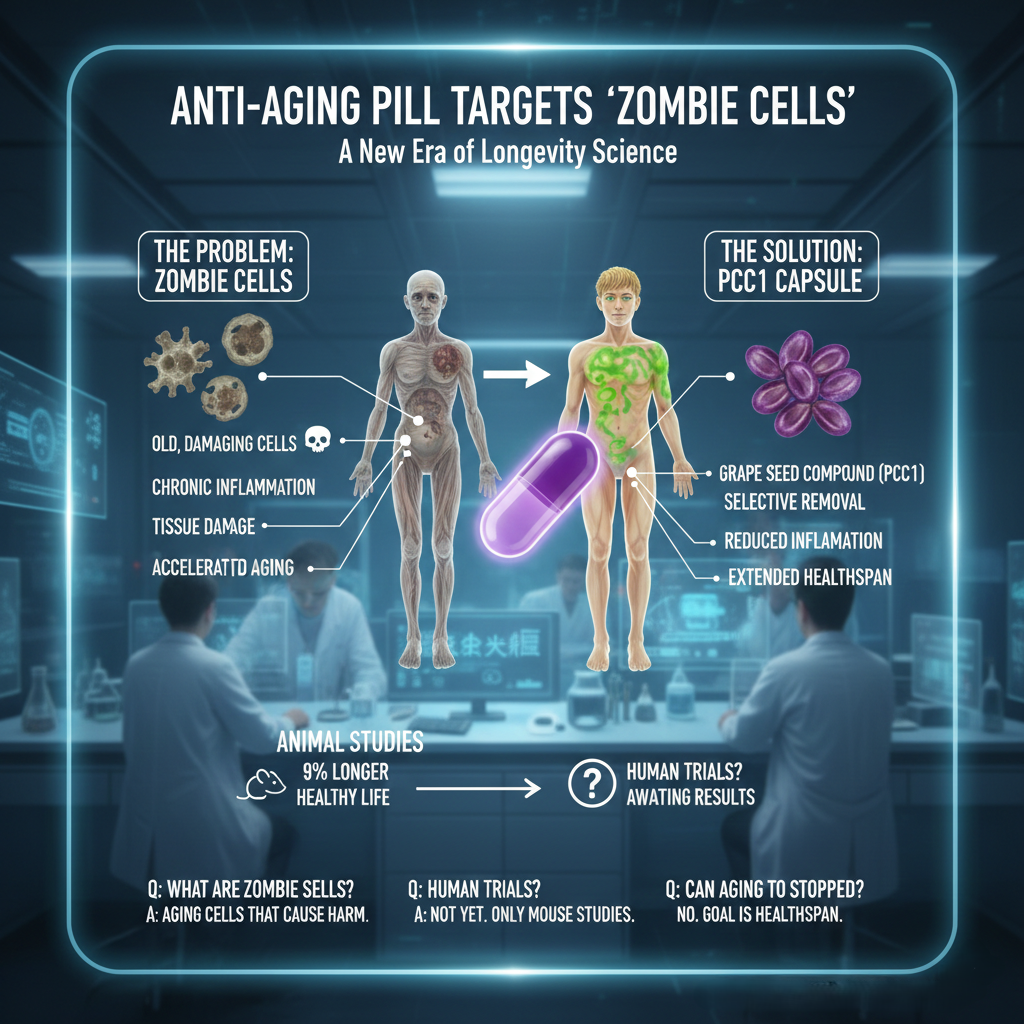
Researchers have developed a capsule designed to target senescent cells, often called “zombie cells.”
What Are Senescent or “Zombie” Cells?
Senescent cells are old cells that no longer divide.
Instead of dying, they stay in the body and cause harm.
They release chemicals that increase inflammation and damage nearby tissue.
Over time, these cells speed up aging and disease.
Why Scientists Target Zombie Cells
Researchers now believe senescent cells are a major driver of aging.
As we age, these cells build up faster than the body can remove them.
This buildup is linked to:
- Chronic inflammation
- Tissue damage
- Weaker immune response
- Age-related diseases
Removing or calming these cells could slow aging itself.
The Capsule Being Tested
The new capsule contains procyanidin C1, a compound taken from grape seeds.
This natural substance showed strong effects in laboratory tests.
It specifically targets senescent cells while leaving healthy cells alone.
What Animal Studies Revealed
In mouse studies, results were promising.
Mice given the compound lived about 9% longer on average.
When treatment started earlier in life, lifespan increased even more.
This suggests timing may be just as important as the treatment.
Extending Health, Not Just Life
Scientists stress this research isn’t about living forever.
The real goal is extending healthy years, not just adding time.
Removing zombie cells could help people stay stronger and healthier as they age.
This approach focuses on quality of life, not just lifespan numbers.
Why Human Results Are Still Uncertain
So far, all results come from animal studies.
No human clinical trials have been completed yet.
Many anti-aging treatments have worked in animals but failed in people.
That makes it too early to call this a true breakthrough.
The Rise of Longevity Science in China
This research highlights the rapid growth of aging science in China.
Longevity studies are expanding alongside AI and biotechnology.
Governments and companies are investing heavily in slowing age-related decline.
This pill is just one example of that growing focus.
Could This Become a Real Anti-Aging Treatment?
It’s possible but not guaranteed.
More testing is needed to confirm safety and effectiveness in humans.
Still, the study shows how fast aging research is moving forward.
What once seemed impossible is now being tested in labs.
Frequently Asked Questions (FAQs)
What are zombie cells?
They are aging cells that no longer divide but damage surrounding tissue.
Has this anti-aging pill been tested in humans?
No. So far, results only exist in laboratory animals.
Does this mean aging can be stopped?
Not yet. The goal is to slow aging and improve health, not stop it.
Final Thoughts
The idea of an anti-aging pill is exciting, but caution is needed.
While results in mice are promising, human biology is far more complex.
Still, targeting senescent cells may be one of the most promising paths yet.
As longevity science grows, the future of aging could look very different.
