


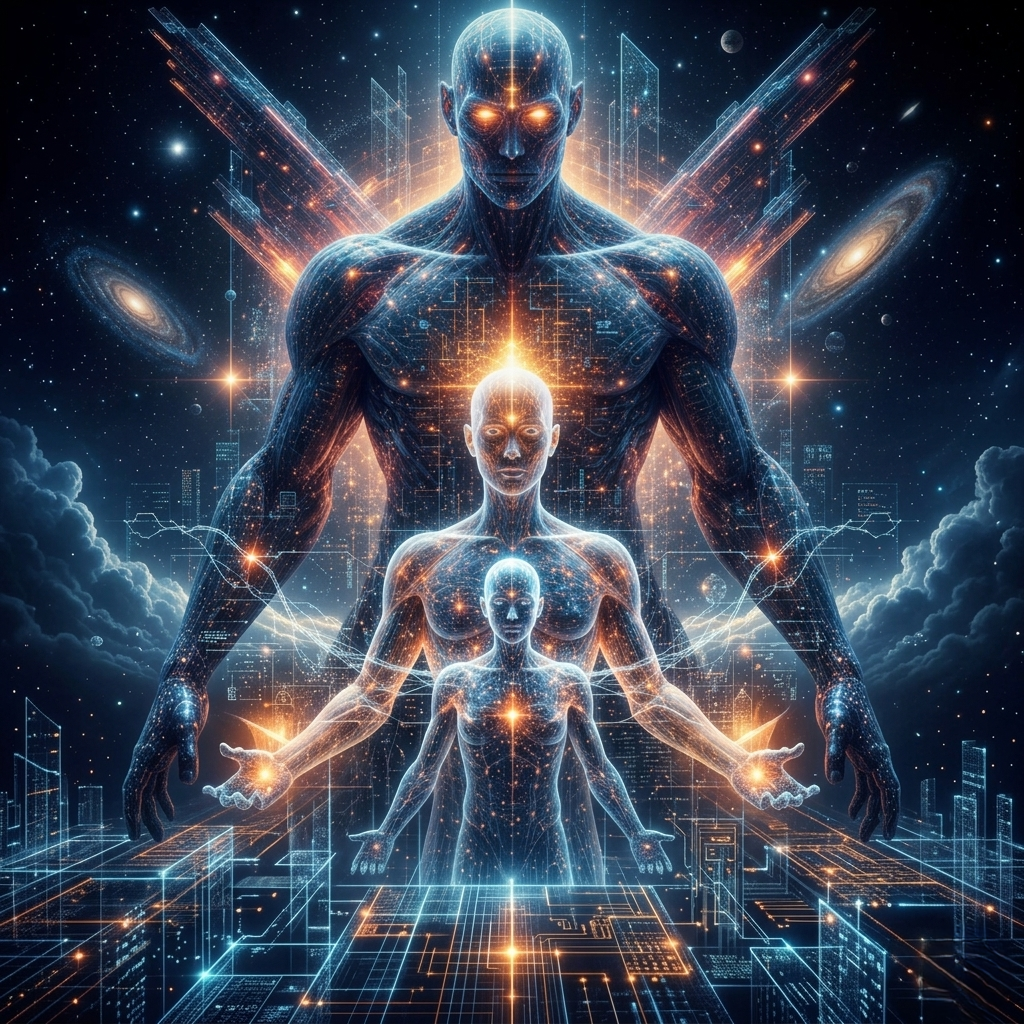
As AI keeps improving, a big question naturally comes up:
If we can build intelligent systems, could something smarter have created us too?
It sounds fascinating. However, this idea sits between science and philosophy, not proven reality.
Let’s explore it in a simple, grounded way.
Why This Question Is Becoming Popular
Today, humans are building machines that can outperform us in specific tasks.
For example:
- AI can diagnose diseases faster than doctors in some cases
- It can beat world champions in games
- It processes huge data in seconds
Because of this, people start thinking:
👉 If we can create intelligence, could we also be created?
While the question makes sense, it doesn’t automatically mean it’s true.
What Science Says About Human Origins
Science already gives a clear explanation of where humans come from.
The field of evolutionary biology explains that humans developed over millions of years through natural processes.
Key ideas include:
- Genetic mutation
- Natural selection
- Environmental adaptation
Together, these explain how life evolved without needing a higher designer.
So far, there is no scientific evidence showing humans were created by advanced intelligence.
Does AI Prove the Idea of a Creator Chain?
It’s tempting to think like this:
Humans create AI → AI becomes smarter → therefore, we must also have a creator
However, this reasoning has a problem.
Being better in one area does not mean total superiority.
For example:
- AI can beat humans in chess
- But it cannot think like humans in everyday life
Even the most advanced systems today depend on human design, data, and control.
So, the “chain of creators” idea sounds logical, but it’s not supported by evidence.
The Difference Between Narrow and General Intelligence
Current AI is powerful but limited.
It is known as “narrow intelligence,” meaning
- It performs very well in specific tasks
- It cannot operate independently across all areas
Humans, on the other hand, have general intelligence.
We can:
- Learn different skills
- Adapt to new environments
- Think creatively and emotionally
Because of this, AI is not truly “greater” than humans overall.
Philosophical Ideas: Simulation Theory
Some thinkers explore this question through philosophy.
One popular idea is simulation theory.
This theory suggests that reality might be created or controlled by a higher intelligence like a simulation.
It’s an interesting concept, but here’s the key point:
👉 It cannot currently be tested or proven.
So, it remains a thought experiment, not scientific fact.
Why Evidence Matters More Than Logic
Just because something is possible does not mean it is real.
Science works differently:
- It relies on observation
- It requires testing
- It demands proof
Right now, there is no measurable evidence that supports the idea of humans being created by a higher intelligence.
That’s why scientists treat it as speculation.
Real-World Perspective
Think of it this way:
Humans create tools all the time: cars, computers, and AI systems.
But creating something useful doesn’t mean that same pattern applies backward to our own existence.
Nature already provides a strong, evidence-based explanation through evolution.
So, there is no need to assume an unseen creator to explain human origins.
FAQs
Could AI ever become more intelligent than humans?
It might surpass humans in specific tasks. However, matching full human intelligence across all areas is still uncertain.
Is there any proof humans were created by advanced beings?
No. There is currently no scientific evidence supporting that idea.
What is simulation theory in simple terms?
It suggests reality could be like a simulation created by higher intelligence. However, it cannot be tested right now.
Why do people believe in higher intelligence creation?
It often comes from philosophical thinking, curiosity, or attempts to explain existence beyond science.
Final Thoughts
The idea that humans were created by a higher intelligence is interesting but not proven.
Science explains our origins through evolution, supported by strong evidence. Meanwhile, ideas like simulation theory remain speculative.
Still, asking these questions matters. They push us to think deeper about intelligence, existence, and our place in the universe.
