


Building underwater has always been difficult.
Engineers usually need to remove water, build barriers, or send divers into risky conditions.
Now, Australia has introduced something groundbreaking—a way to 3D print concrete structures directly underwater.
This innovation could completely change marine construction.
What Is Underwater 3D Concrete Printing?
The new system allows engineers to print concrete structures beneath the surface without draining the area.
Instead of traditional methods, a robotic printer releases a specially designed fast-setting concrete mix.
This mixture is engineered to:
- Keep its shape underwater
- Resist strong currents
- Harden quickly without spreading
That means no large temporary barriers and no major water removal.
Who Developed This Technology?
The breakthrough came through collaboration between Australian universities and marine engineering specialists.
Although the specific institution was not listed in the report, the innovation positions Australia as a leader in advanced marine construction research.
The goal was clear:
Improve efficiency while protecting marine ecosystems.
Why Traditional Underwater Construction Is Challenging
Underwater construction is usually:
- Expensive
- Time-consuming
- Risky for divers and workers
- Disruptive to marine habitats
Projects often require large cofferdams or temporary walls to block water.
These setups increase cost and environmental impact.
The new robotic printing method avoids many of these problems.
How the Robotic Printing System Works
The system uses a specially built underwater robotic printer.
Here’s what makes it unique:
- It precisely deposits fast-setting concrete.
- The material holds its form even in moving water.
- Layers are built up gradually to form stable structures.
Because it’s automated, fewer workers are exposed to dangerous underwater conditions.
Safety improves immediately.
What Can This Technology Build?
Underwater 3D concrete printing could be used for:
- Bridges
- Sea walls
- Offshore foundations
- Artificial reefs
- Coastal reinforcement systems
This opens the door to faster, more flexible marine infrastructure development.
Environmental Benefits
One of the most important advantages is reduced environmental disruption.
Traditional construction can:
- Disturb marine life
- Increase sediment movement
- Damage fragile ecosystems
Robotic underwater printing:
- Minimizes physical disturbance
- Reduces large-scale water displacement
- Supports more precise placement
This is especially important for reef and habitat restoration projects.
Supporting Climate Change Adaptation
As sea levels rise and storms intensify, stronger coastal defenses are becoming essential.
Underwater 3D printing could help:
- Reinforce shorelines
- Build protective barriers faster
- Repair damaged marine infrastructure
This technology may play a role in long-term climate resilience strategies.
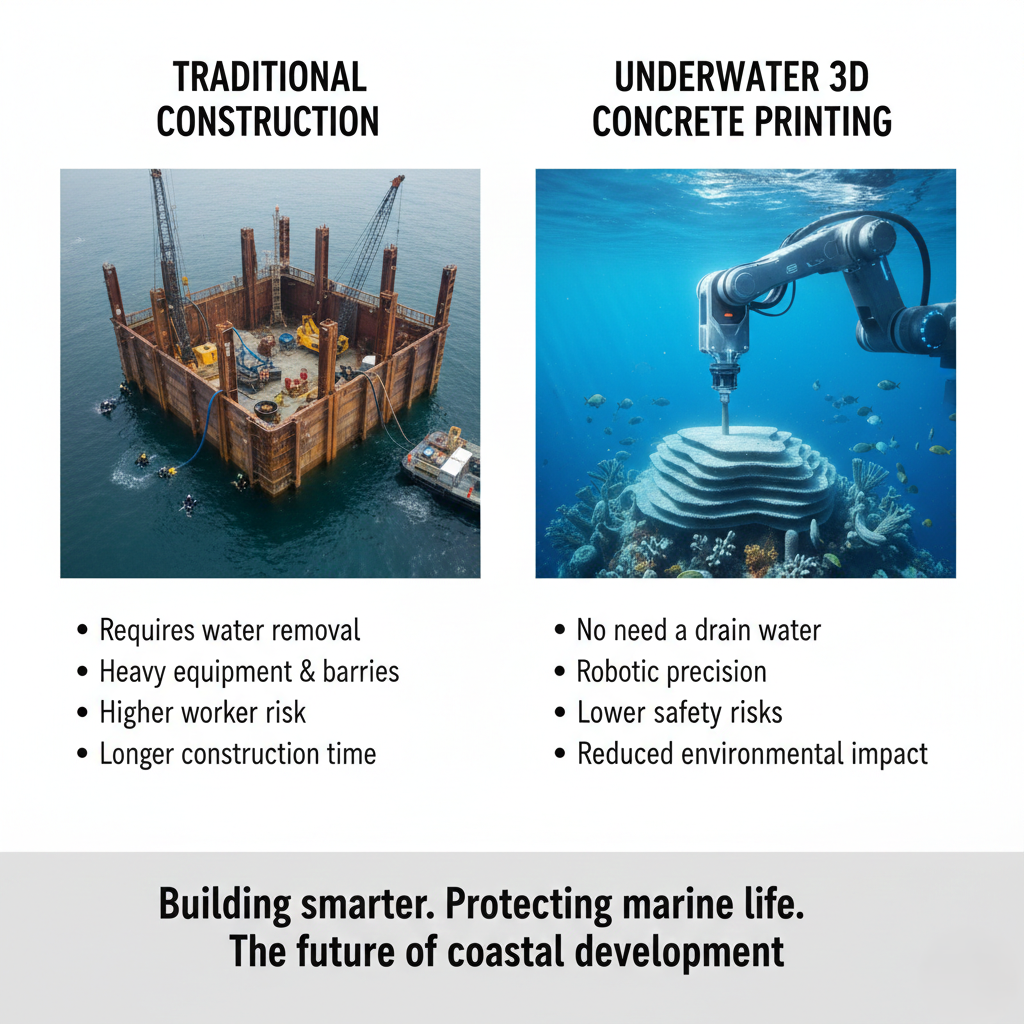
Real-World Comparison: Traditional vs Underwater 3D Printing
Traditional Method
- Requires water removal
- Heavy equipment and barriers
- Higher worker risk
- Longer construction time
Underwater 3D Printing
- No need to drain water
- Robotic precision
- Lower safety risks
- Reduced environmental impact
It’s not just faster—it’s smarter.
Why This Is a Major Engineering Milestone
3D printing has already transformed construction on land.
Now, bringing it underwater expands its potential even further.
By combining robotics, material science, and marine engineering, Australia is pushing the limits of what’s possible in infrastructure development.
This could set a new global standard for coastal construction.
FAQs
What is underwater 3D concrete printing?
It is a method of using robotic systems to print fast-setting concrete structures directly underwater without removing the water.
Why is this innovation important?
It reduces construction costs, improves worker safety, and minimizes environmental disruption.
What types of structures can be built?
Bridges, seawalls, artificial reefs, offshore foundations, and coastal protection systems.
How does the concrete stay in shape underwater?
The mixture is specially engineered to set quickly and resist strong underwater currents.
Could this help with climate change?
Yes. It may strengthen coastlines and improve resilience against rising sea levels and storms.
Final Thoughts
Australia’s underwater 3D concrete printing breakthrough shows how innovation can solve real-world challenges.
By eliminating the need for water removal and reducing environmental damage, this method could reshape marine construction worldwide.
As climate pressures grow and infrastructure demands increase, smarter solutions like this will become essential.
The future of construction may not just be automated.
It may be built beneath the waves.
