


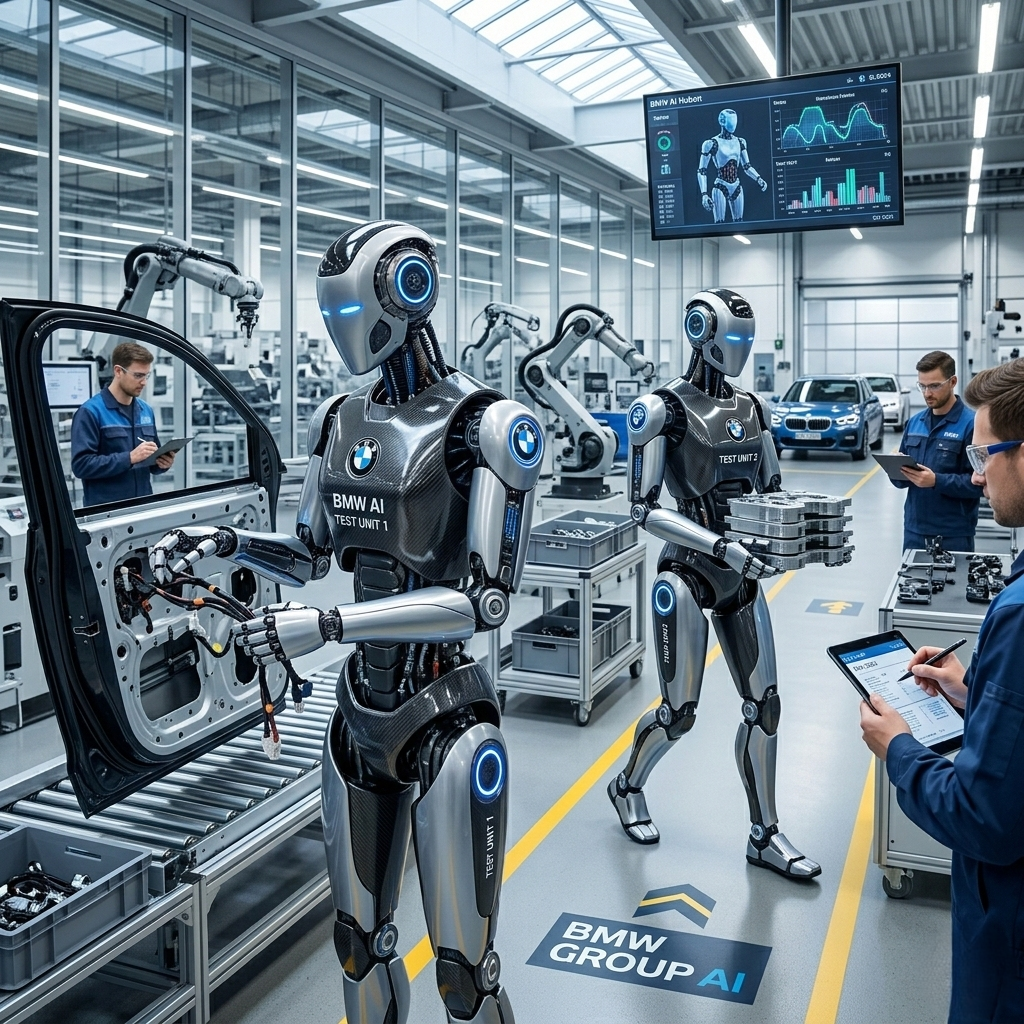
Automation is no longer just about robotic arms behind safety cages. Now, humanoid robots are stepping directly onto factory floors.
Recently, BMW began testing AI-powered humanoid robots at its Leipzig factory in Leipzig.
This marks the first time such robots are being trialed in European automotive production.
And it signals a major shift in how factories may operate in the near future.
Meet Aeon: The AI Humanoid Robot
The robot being tested is called Aeon. It was developed by Swedish tech company Hexagon.
Unlike traditional robots fixed to one position, Aeon moves freely across the factory floor.
Here’s what makes it different:
- Height: About 1.65 meters
- Weight: Around 60 kilograms
- Movement: Two wheels instead of walking legs
- Battery life: Roughly three hours per charge
- Battery swap time: Just 30 seconds
Because of its compact and mobile design, Aeon can work closely with human employees.
How Aeon Robots Work Inside the Factory
Before deployment, BMW fully scans the factory space. This digital mapping allows robots to understand their environment.
Each Aeon robot uses:
- 22 sensors
- Multiple cameras
- AI-based navigation systems
As a result, the robots can move independently while avoiding obstacles and people.
During demonstrations, Aeon robots were seen:
- Scanning car doors
- Picking up vehicle parts
- Transporting components short distances
Therefore, they focus mainly on repetitive and physically demanding tasks.
Why BMW Is Introducing AI Humanoid Robots
Car manufacturing includes many repetitive movements. Over time, these tasks can cause physical strain for workers.
BMW’s goal is not replacement. Instead, the focus is assistance.
By assigning robots to heavy or repetitive duties:
- Workers can focus on complex problem-solving
- Physical fatigue can decrease
- Production efficiency can improve
Consequently, the factory becomes safer and more balanced.
Humans and Robots Working Side by Side
A pilot program is scheduled to begin this summer. During this phase, employees will work directly alongside Aeon robots in real production conditions.
This collaborative model reflects a broader shift in manufacturing.
Instead of separating humans and machines, companies are now integrating them.
In earlier trials at BMW’s U.S. facilities, robotics testing helped refine safety protocols. Now, Europe joins the next phase of experimentation.
How This Compares to Traditional Factory Robots
Traditional industrial robots:
- Stay fixed in one place
- Perform one specialized task
- Operate inside protective cages
Humanoid robots like Aeon, however:
- Move across workspaces
- Adapt to multiple tasks
- Work near human teams
Because of that flexibility, they represent a new generation of industrial automation.
What This Means for the Automotive Industry
The automotive sector has always led in automation. However, AI humanoid robots bring something new: mobility combined with machine intelligence.
If successful, this model could:
- Reduce workplace injuries
- Improve workflow efficiency
- Lower long-term operational costs
- Increase production adaptability
Moreover, as AI systems improve, robots may learn tasks faster and adapt more easily.
Still, large-scale implementation will depend on safety, reliability, and cost-effectiveness.
The Bigger Picture: Automation Is Evolving
Automation is no longer limited to repetitive mechanical motion. Now, it includes AI-driven decision-making and human collaboration.
Factories are slowly transforming into hybrid environments where:
- Humans provide creativity and judgment
- Robots handle physical strain and repetition
This balanced approach may define the next era of manufacturing.
FAQs
What are BMW’s AI humanoid robots used for?
They assist with repetitive and physically demanding tasks such as scanning, lifting, and transporting parts within the factory.
Who developed the Aeon robots?
The robots were developed by Swedish technology company Hexagon.
Are these robots replacing factory workers?
No. BMW states that the robots are designed to support employees, not replace them.
How long can Aeon robots operate on one charge?
They can run for about three hours, and their batteries can be swapped in just 30 seconds.
Is this the first time BMW has tested such robots?
BMW conducted earlier trials in the United States, but this is the first European pilot program involving AI humanoid robots.
Final Thoughts: A Glimpse Into the Future of Work
BMW’s testing of AI humanoid robots shows how factory automation continues to evolve. Instead of removing people from production lines, companies are exploring ways to reduce strain and improve collaboration.
Although the pilot program is still in its early stages, it reflects a clear trend. AI is moving from screens and software into physical workspaces.
If these trials succeed, humanoid robots could soon become a normal part of modern manufacturing.
