

Close Menu
Innovate And ExploreInnovate And Explore

    Subscribe to Updates

    Get the latest creative news from FooBar about art, design and business.

    What's Hot

    How to Grow Instagram from 0 to 10K Followers in 2026 Using Organic Methods

    May 22, 2026

    Smart Wearables Are Reshaping the Future of Everyday Technology

    May 13, 2026

    Everyday Tech How-To Guides for a Smarter and Easier Digital Life

    May 13, 2026
    Facebook Instagram
    Facebook Instagram YouTube TikTok
    Innovate And ExploreInnovate And Explore
    • Artificial Intelligence
    • Medical Research
    • Technology News
    • Science News
    • VR Headset
    • Palantir
    Innovate And ExploreInnovate And Explore
    Home » Brain-Spine Interface Helps Paralysis Patients Walk Again
    Medical Research

    Brain-Spine Interface Helps Paralysis Patients Walk Again

    alfredBy alfredMarch 24, 2026No Comments3 Mins Read
    Facebook Twitter Pinterest LinkedIn Tumblr WhatsApp Email
    Share
    Facebook Twitter LinkedIn WhatsApp Pinterest Email

    Introduction: From Compensation to Reconnection

    For years, paralysis therapy focused on coping, not fixing. Patients learned to adapt rather than recover movement.

    Now, that story is changing. A powerful new system is helping patients walk again, not by replacing movement, but by reconnecting it.

    This breakthrough shifts rehab from compensation to true restoration.

    How the Brain–Spine Interface Works

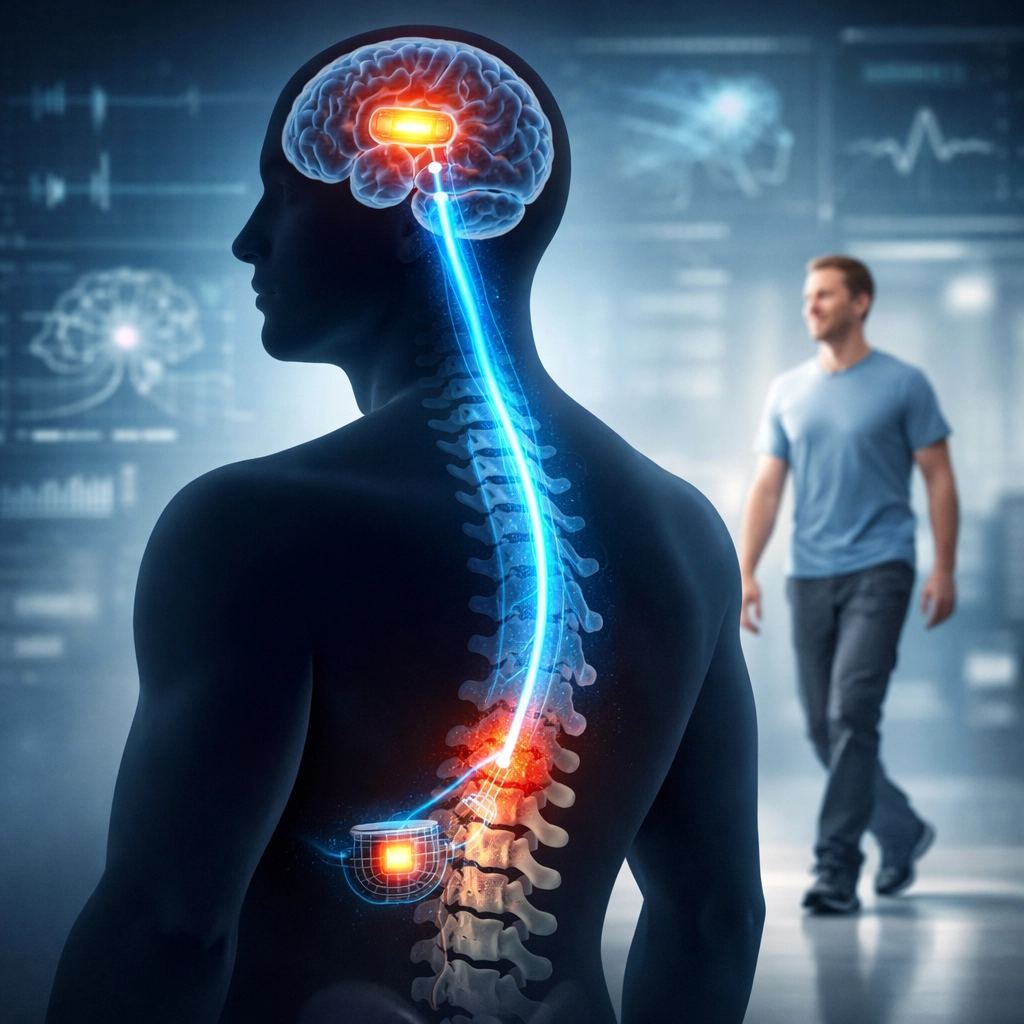
    The system creates a real-time link between the brain and spinal cord. It essentially rebuilds the communication pathway damaged by injury.

    This innovation is rooted in neuroprosthetics.

    Step-by-step process:

    1. Sensors read signals from the brain’s motor cortex
    2. AI decodes the intention to move
    3. Signals are sent to the spinal cord
    4. Electrical pulses activate leg muscles

    As a result, movement becomes smooth and coordinated instead of forced.

    Why Timing Changes Everything

    Older systems used delayed or fixed signals. Because of this, movements often felt robotic and unnatural.

    However, this new system solves that problem.

    Key improvement:

    • Ultra-low latency between brain signal and muscle response

    Because timing is precise, steps feel voluntary. Patients regain rhythm, balance, and control.

    In simple terms, the body starts moving the way it was meant to.

    Real Impact: More Than Just Walking

    Walking again is powerful. However, the benefits go far beyond movement.

    Physical improvements:

    • Better heart health
    • Fewer pressure sores
    • Improved digestion

    Mental and emotional benefits:

    • Increased independence
    • Boosted confidence
    • Better overall mood

    Because of these changes, recovery feels more complete—not just physical.

    How the Body Learns Again

    One of the most exciting parts is how the body adapts over time.

    This system supports neuroplasticity.

    What happens during rehab:

    • The brain sends signals
    • The body responds correctly
    • Feedback returns to the brain

    This loop helps the brain and spinal cord reconnect.

    As a result, the nervous system starts relearning natural movement patterns.

    Real-World Example: Switzerland’s Breakthrough

    Researchers at EPFL Neuroprosthetics Center led this innovation.

    Their results show that patients can take controlled steps with improved balance and coordination.

    Even more importantly, training becomes faster because the body receives clear, consistent signals.

    How This Compares to Older Therapies

    Therapy TypeApproachLimitation
    Traditional rehabStrength + adaptationLimited recovery
    Wheelchair supportMobility assistanceNo reconnection
    Older stimulatorsFixed signalsRobotic movement
    Brain-spine interfaceReal-time connectionStill developing

    Clearly, this new approach focuses on restoring function, not just managing loss.

    Challenges and What Comes Next

    Although the progress is exciting, there are still hurdles.

    Current challenges:

    • Making the system widely accessible
    • Reducing cost and complexity
    • Long-term testing and safety

    However, research is moving fast. Each improvement brings it closer to everyday use.

    The Bigger Question: Can We Fully Repair Nerves?

    This breakthrough raises an important possibility.

    If technology can reconnect signals today, could it help regrow damaged pathways tomorrow?

    Scientists believe that consistent, correct signals may train the body to rebuild itself over time.

    While this is still being studied, the idea is no longer out of reach.

    FAQs About Brain–Spine Interfaces

    1. Can paralysis be fully cured with this technology?

    Not yet, but it can restore controlled movement in some cases.

    2. Is the walking natural?

    Yes, thanks to real-time timing, movements feel more voluntary.

    3. How long does training take?

    It varies, but rehab is often faster due to better feedback loops.

    4. Is this available worldwide?

    Currently, it is still in advanced research stages.

    Conclusion: Rebuilding Human Movement

    This breakthrough is more than a medical upgrade; it’s a new direction.

    By reconnecting the brain and spinal cord, scientists are helping the body move again in a natural way.

    Step by step, technology is rebuilding what was once lost.

    advanced encryption standard ai chatgpt ai science news artificial general intelligence california science center hologram museum medical research palantir quantum physics science center science fair board science museum scientific method tech news virtual reality headset
    Share. Facebook Twitter Pinterest LinkedIn Tumblr WhatsApp Email
    alfred

    Related Posts

    How to Grow Instagram from 0 to 10K Followers in 2026 Using Organic Methods

    May 22, 2026

    Smart Wearables Are Reshaping the Future of Everyday Technology

    May 13, 2026

    Everyday Tech How-To Guides for a Smarter and Easier Digital Life

    May 13, 2026

    The Rise of AI Girlfriends and Virtual Companions: Future or Danger?

    May 10, 2026

    The Dark Side of Deepfake Technology in 2026

    May 9, 2026

    How AI Video Generators Are Replacing Traditional Content Creation

    May 9, 2026
    Add A Comment
    Leave A Reply Cancel Reply

    Don't Miss

    How to Grow Instagram from 0 to 10K Followers in 2026 Using Organic Methods

    By alfredMay 22, 2026

    Introduction Starting from zero on Instagram feels tough at first. However, with the right strategy,…

    Smart Wearables Are Reshaping the Future of Everyday Technology

    May 13, 2026

    Everyday Tech How-To Guides for a Smarter and Easier Digital Life

    May 13, 2026

    The Rise of AI Girlfriends and Virtual Companions: Future or Danger?

    May 10, 2026
    Stay In Touch
    • Facebook
    • Twitter
    • Pinterest
    • Instagram
    • YouTube
    • Vimeo
    Our Picks

    How to Grow Instagram from 0 to 10K Followers in 2026 Using Organic Methods

    May 22, 2026

    Smart Wearables Are Reshaping the Future of Everyday Technology

    May 13, 2026

    Everyday Tech How-To Guides for a Smarter and Easier Digital Life

    May 13, 2026

    The Rise of AI Girlfriends and Virtual Companions: Future or Danger?

    May 10, 2026

    Subscribe to Updates

    Get the latest creative news from SmartMag about art & design.

    Techlo Inno
    Innovate And Explore
    Facebook Instagram YouTube TikTok
    • About Us
    • Cookies Policy
    • Editorial Policy
    • Terms & Conditions
    © 2026 Innovate and Explore. Designed by Techlo Inno.

    Type above and press Enter to search. Press Esc to cancel.

    Powered by
    ►
    Necessary cookies enable essential site features like secure log-ins and consent preference adjustments. They do not store personal data.
    None
    ►
    Functional cookies support features like content sharing on social media, collecting feedback, and enabling third-party tools.
    None
    ►
    Analytical cookies track visitor interactions, providing insights on metrics like visitor count, bounce rate, and traffic sources.
    None
    ►
    Advertisement cookies deliver personalized ads based on your previous visits and analyze the effectiveness of ad campaigns.
    None
    ►
    Unclassified cookies are cookies that we are in the process of classifying, together with the providers of individual cookies.
    None
    Powered by