


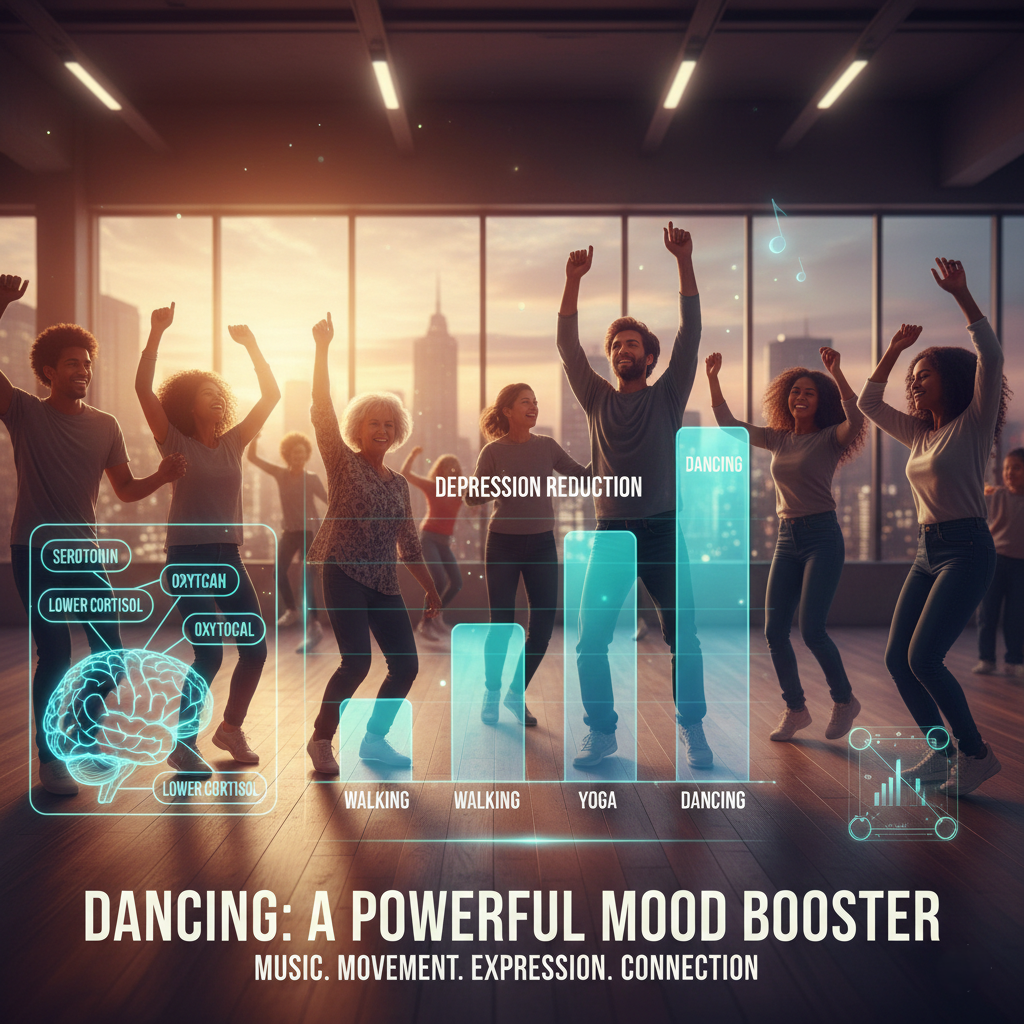
What if one of the most powerful mood boosters isn’t in a pill bottle—but on a dance floor?
A major 2024 scientific review suggests that dancing may significantly reduce depression symptoms, sometimes even more effectively than common treatments like walking, yoga, or medication alone.
Let’s unpack what the research actually found.
What the 2024 Study Revealed
The study, published in The BMJ, analyzed data from 218 clinical trials involving more than 14,000 participants.
Researchers compared different forms of exercise and treatment approaches for depression.
Dance-based activities showed some of the strongest improvements in symptoms.
In several cases, results were stronger than
- Walking programs
- Yoga sessions
- Strength training
- Antidepressants used alone
That doesn’t mean medication doesn’t work.
But it shows dancing may be a powerful option.
Why Dancing Has Such a Strong Effect
Dancing is not just exercise.
It combines several mood-boosting elements at once:
- Physical movement
- Music and rhythm
- Emotional expression
- Creativity
- Social interaction
This multi-layered experience stimulates the brain in unique ways.
When you dance, your body releases:
- Serotonin—improves mood
- Dopamine—boosts motivation
- Oxytocin—strengthens connection
- Lower cortisol—reduces stress
Few activities activate all these systems together.
More Than Just Cardio
Unlike repetitive workouts, dancing requires attention and coordination.
You think about rhythm.
You respond to music.
You move in creative ways.
This helps interrupt negative thought patterns.
It also brings you into the present moment—similar to mindfulness practices.
That mental shift can be especially helpful for people dealing with rumination or anxiety.
The Social Connection Advantage
Group dancing adds another powerful layer.
Depression often isolates people.
Dancing with others builds:
- Shared energy
- Community feeling
- Emotional bonding
Social connection itself is strongly linked to improved mental health.
Even dancing at home with family or friends can create that effect.
A Body-Focused Approach to Healing
Researchers describe dancing as a form of body-focused therapy.
Instead of only talking about emotions, you physically express them.
Music and movement allow people to:
- Release tension
- Reconnect with their bodies
- Experience joy without overthinking
This mind-body link is important in recovery.
Why Experts See It as a First-Line Support Option
Dancing is:
- Affordable
- Accessible
- Low-risk
- Equipment-free
You don’t need a gym membership.
You don’t need advanced skills.
You just need space to move and music you enjoy.
Because of this, experts believe dancing could be used:
- Alongside therapy
- As part of early intervention
- As ongoing mental health support
It’s not about replacing medical care.
It’s about expanding safe, effective options.
Real-Life Example
Imagine two people dealing with mild depression.
One walks alone daily.
The other joins a weekly dance class.
Both get physical activity.
But the dancer also experiences music, expression, laughter, and social interaction.
That added emotional layer may explain the stronger results seen in studies.
FAQs
1. Is dancing better than antidepressants?
Not necessarily. Medication works well for many people. The study suggests dancing can be highly effective, especially as part of a broader treatment plan.
2. What type of dance works best?
The review included different styles. The key factor was regular, enjoyable participation.
3. Can dancing help anxiety too?
Yes. Movement and music can reduce stress hormones and improve emotional regulation.
4. How often should someone dance for benefits?
Many studies used sessions multiple times per week. Consistency appears more important than intensity.
5. Is this safe for all ages?
Generally, yes. Dance can be adapted for different ages and physical abilities.
Final Thoughts
The idea that dancing could rival traditional depression treatments may seem surprising.
But the science is compelling.
By combining movement, music, expression, and connection, dancing activates powerful brain pathways that support emotional healing.
- It’s simple.
- It’s affordable.
- And it’s enjoyable.
While it’s not a replacement for professional care when needed, dancing may be one of the most natural and accessible tools for improving mental health.
Sometimes, the most powerful medicine is simply moving to music.
