

Close Menu
Innovate And ExploreInnovate And Explore

    Subscribe to Updates

    Get the latest creative news from FooBar about art, design and business.

    What's Hot

    How to Grow Instagram from 0 to 10K Followers in 2026 Using Organic Methods

    May 22, 2026

    Smart Wearables Are Reshaping the Future of Everyday Technology

    May 13, 2026

    Everyday Tech How-To Guides for a Smarter and Easier Digital Life

    May 13, 2026
    Facebook Instagram
    Facebook Instagram YouTube TikTok
    Innovate And ExploreInnovate And Explore
    • Artificial Intelligence
    • Medical Research
    • Technology News
    • Science News
    • VR Headset
    • Palantir
    Innovate And ExploreInnovate And Explore
    Home » ChatGPT Scored 80% on Scientific Hypotheses, But That’s Risky
    Artificial Intelligence

    ChatGPT Scored 80% on Scientific Hypotheses, But That’s Risky

    alfredBy alfredMarch 23, 2026No Comments2 Mins Read
    Facebook Twitter Pinterest LinkedIn Tumblr WhatsApp Email
    Share
    Facebook Twitter LinkedIn WhatsApp Pinterest Email

    Artificial intelligence is powerful, but a new study shows it’s not infallible.

    Scientists tested ChatGPT on hundreds of real scientific hypotheses across biology, chemistry, physics, and medicine.

    The results were eye-opening.

    What the Study Found

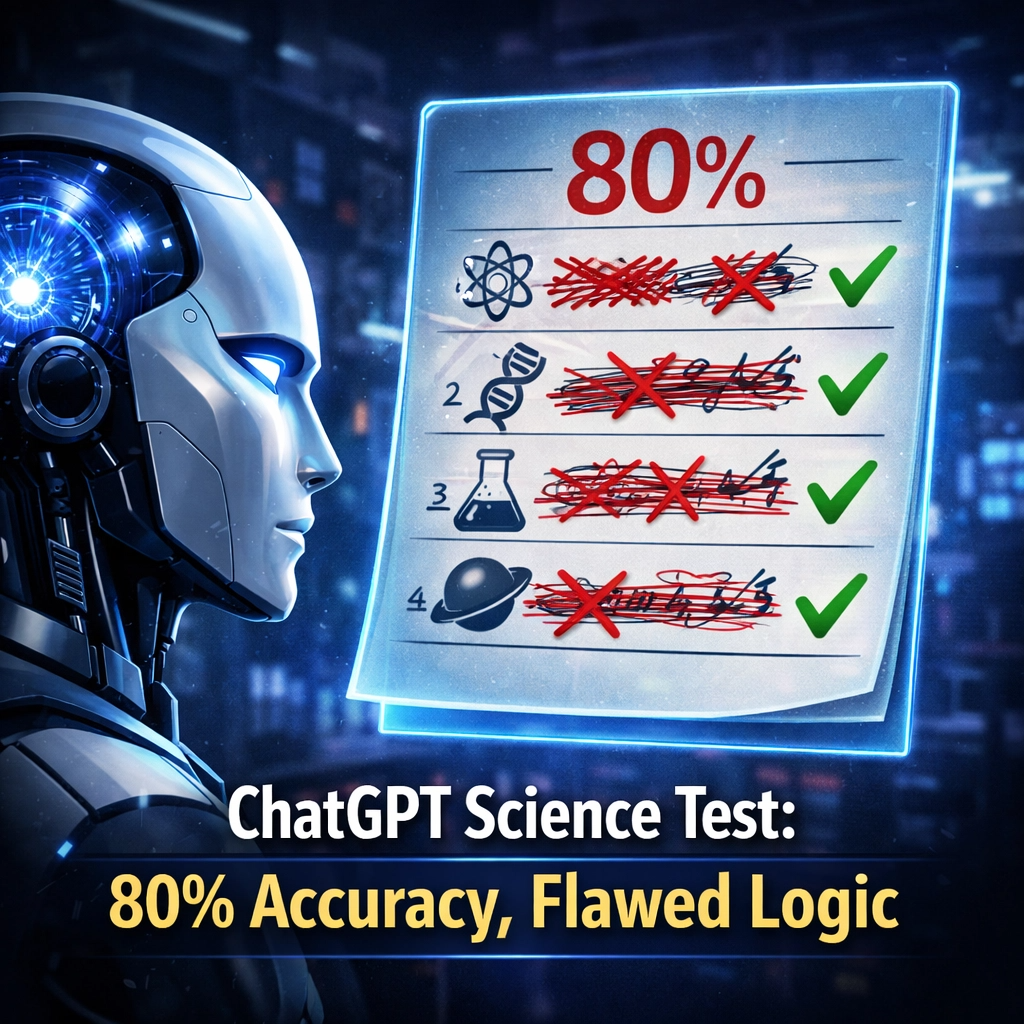
    ChatGPT got the correct answer about 80% of the time. That may sound impressive, but there’s a catch.

    Key Findings

    • 1 in 5 answers were confidently wrong
    • Correct answers often came with flawed explanations
    • Performance dropped on cutting-edge questions with recent updates

    In short, ChatGPT can give the right answer but still explain it incorrectly.

    Why This Is a Problem for Science

    Researchers are increasingly using AI to:

    • Screen hypotheses
    • Design experiments
    • Generate literature reviews

    But if the reasoning behind answers is unreliable, mistakes could creep into real scientific work.

    Example Concerns

    • Misleading experiment designs
    • Incorrect literature summaries
    • Blind reliance on AI without human verification

    Even when the answer is correct, the flawed logic makes it risky.

    Where ChatGPT Struggled Most

    The AI performed worst on questions:

    • Involving the latest discoveries
    • Where new data contradicted older assumptions
    • In rapidly evolving fields like medicine and biotechnology

    This shows that AI is only as good as the data it has been trained on.

    The Bottom Line

    AI like ChatGPT is a powerful research tool, but it is not a scientist.

    Key Takeaways

    • Always verify AI-generated answers
    • Don’t rely solely on AI for critical research
    • Use it to assist, not replace, human expertise

    In science, understanding why an answer is correct is just as important as the answer itself.

    FAQs

    Can ChatGPT be trusted for scientific research?

    It can help, but answers should always be verified by experts.

    Why does it give flawed explanations?

    The AI predicts likely answers based on patterns, not reasoning like a human scientist.

    Is 80% accuracy good enough?

    For critical research, 80% is risky, especially when mistakes are common and plausible.

    Can AI replace scientists?

    No. AI assists humans but cannot think, reason, or understand unknowns.

    Final Thoughts

    ChatGPT is a powerful tool, but science demands more than correct answers; it requires reliable reasoning.

    👉 Use AI wisely: as an assistant, not an authority, and always double-check before trusting its conclusions.

    advanced encryption standard ai chatgpt ai science news artificial general intelligence california science center hologram museum medical research palantir quantum physics science center science fair board science museum scientific method tech news virtual reality headset
    Share. Facebook Twitter Pinterest LinkedIn Tumblr WhatsApp Email
    alfred

    Related Posts

    How to Grow Instagram from 0 to 10K Followers in 2026 Using Organic Methods

    May 22, 2026

    Smart Wearables Are Reshaping the Future of Everyday Technology

    May 13, 2026

    Everyday Tech How-To Guides for a Smarter and Easier Digital Life

    May 13, 2026

    The Rise of AI Girlfriends and Virtual Companions: Future or Danger?

    May 10, 2026

    The Dark Side of Deepfake Technology in 2026

    May 9, 2026

    How AI Video Generators Are Replacing Traditional Content Creation

    May 9, 2026
    Add A Comment
    Leave A Reply Cancel Reply

    Don't Miss

    How to Grow Instagram from 0 to 10K Followers in 2026 Using Organic Methods

    By alfredMay 22, 2026

    Introduction Starting from zero on Instagram feels tough at first. However, with the right strategy,…

    Smart Wearables Are Reshaping the Future of Everyday Technology

    May 13, 2026

    Everyday Tech How-To Guides for a Smarter and Easier Digital Life

    May 13, 2026

    The Rise of AI Girlfriends and Virtual Companions: Future or Danger?

    May 10, 2026
    Stay In Touch
    • Facebook
    • Twitter
    • Pinterest
    • Instagram
    • YouTube
    • Vimeo
    Our Picks

    How to Grow Instagram from 0 to 10K Followers in 2026 Using Organic Methods

    May 22, 2026

    Smart Wearables Are Reshaping the Future of Everyday Technology

    May 13, 2026

    Everyday Tech How-To Guides for a Smarter and Easier Digital Life

    May 13, 2026

    The Rise of AI Girlfriends and Virtual Companions: Future or Danger?

    May 10, 2026

    Subscribe to Updates

    Get the latest creative news from SmartMag about art & design.

    Techlo Inno
    Innovate And Explore
    Facebook Instagram YouTube TikTok
    • About Us
    • Cookies Policy
    • Editorial Policy
    • Terms & Conditions
    © 2026 Innovate and Explore. Designed by Techlo Inno.

    Type above and press Enter to search. Press Esc to cancel.

    Powered by
    ►
    Necessary cookies enable essential site features like secure log-ins and consent preference adjustments. They do not store personal data.
    None
    ►
    Functional cookies support features like content sharing on social media, collecting feedback, and enabling third-party tools.
    None
    ►
    Analytical cookies track visitor interactions, providing insights on metrics like visitor count, bounce rate, and traffic sources.
    None
    ►
    Advertisement cookies deliver personalized ads based on your previous visits and analyze the effectiveness of ad campaigns.
    None
    ►
    Unclassified cookies are cookies that we are in the process of classifying, together with the providers of individual cookies.
    None
    Powered by