


This isn’t just another research project. It’s something the world has never seen before.
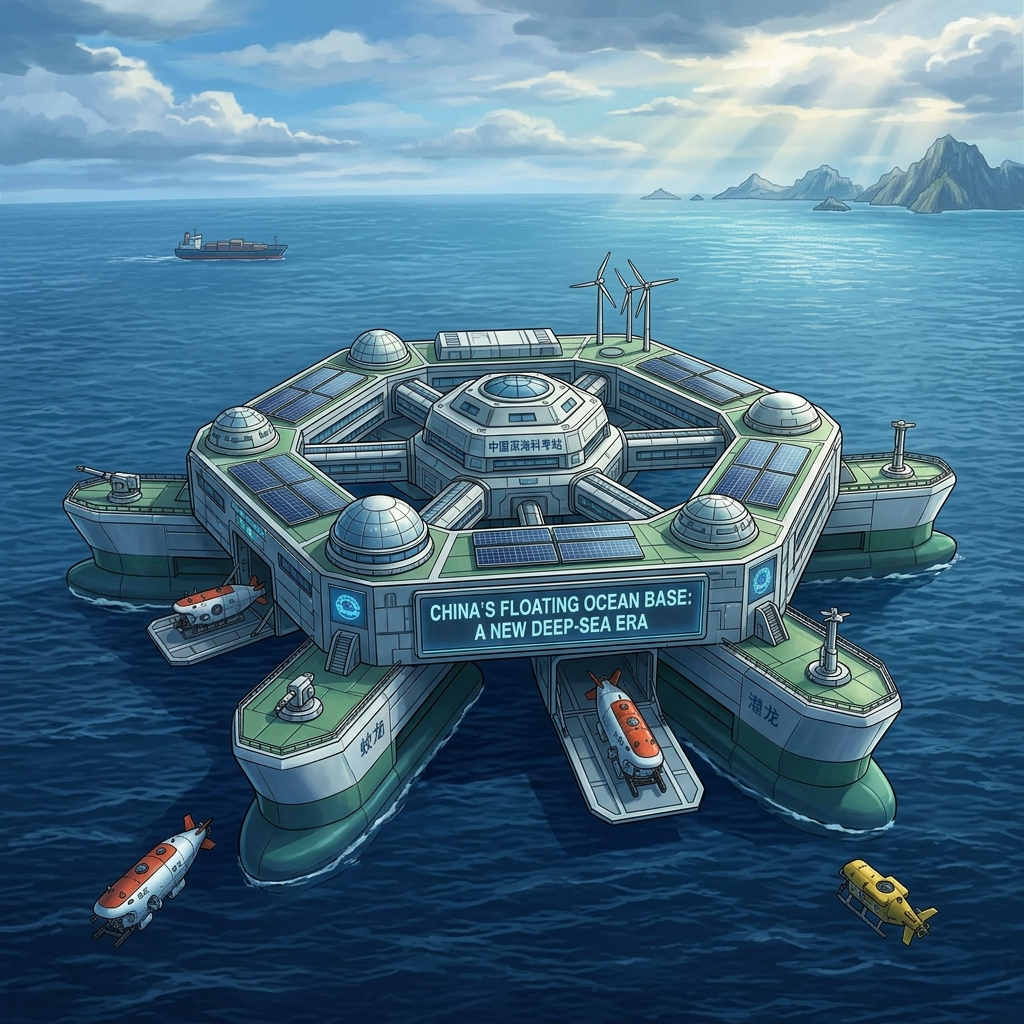
China has launched a massive “open-sea floating island” designed for deep-sea exploration. At first glance, it looks like a scientific breakthrough. However, the timing makes it much bigger than that.
What Is This Floating Ocean Platform?
The new platform, developed by Shanghai Jiao Tong University, is an ultra-large marine research base.
It’s designed to operate in extreme ocean conditions, even during storms.
Key features include the following:
- Semi-submersible twin-hull design
- Stability in rough, open-sea conditions
- Ability to stay on-site for long missions
- Support for deep-sea operations up to 10,000 meters
In simple terms, it acts like a floating laboratory in the middle of the ocean.
Why This Technology Is a Big Deal
Until now, scientists faced a trade-off.
Ships could move easily but couldn’t stay long. Fixed platforms could stay put but lacked flexibility.
This new system solves both problems.
As a result:
- Researchers can travel and stay in one place
- Long-term experiments become possible
- Deep-sea exploration becomes more efficient
Because of this, it fills a major gap in ocean research.
What Will It Be Used For?
The platform is not just for one purpose; it has multiple roles.
Main uses include:
- Testing deep-sea mining systems
- Studying marine ecosystems
- Supporting offshore oil and gas research
- Developing advanced marine equipment
In addition, it will improve typhoon forecasting and disaster response.
The Bigger Picture: Why Timing Matters
Here’s where things get more interesting.
Reports, including investigations by Reuters, suggest that Chinese research vessels have been mapping ocean floors across multiple regions.
Areas reportedly studied:
- Pacific Ocean
- Indian Ocean
- Arctic Ocean
Because of this, some experts believe the data could have strategic uses beyond science.
Could This Have Military Implications?
While the platform is officially for research, some analysts are cautious.
Mapping the ocean floor is useful for:
- Submarine navigation
- Underwater communication systems
- Strategic military planning
As a result, naval experts are closely watching these developments.
Scientific Benefits Still Matter
Despite concerns, the platform offers real scientific advantages.
Positive impacts include the following:
- Better understanding of deep-sea ecosystems
- Improved climate and weather predictions
- Stronger disaster preparedness systems
These benefits could help countries worldwide, especially in managing natural disasters.
A Glimpse Into the Future
The platform is expected to be fully completed by 2030.
By then, it could become one of the most advanced ocean research systems on Earth.
Looking ahead:
- Deep-sea exploration will expand rapidly
- New resources may be discovered
- Ocean data could become highly valuable
Because of this, control over ocean knowledge may shape global influence.
A Simple Way to Understand It
Think of this platform like a space station but for the ocean.
Instead of orbiting Earth, it explores the deepest parts of our seas.
FAQs
What is the “floating island” platform?
It’s a large marine research base designed for deep-sea exploration and long-term missions.
Who developed it?
It was developed by Shanghai Jiao Tong University.
How deep can it operate?
It supports exploration down to 10,000 meters.
Why are experts concerned?
Because ocean mapping data can have both scientific and military uses.
When will it be completed?
The full project is expected to be completed by 2030.
Final Thoughts
China’s floating ocean platform is more than just a scientific tool; it’s a signal of where the future is heading. With support from institutions like Shanghai Jiao Tong University and growing global attention from outlets like Reuters, this development sits at the intersection of science, technology, and geopolitics.
👉 The real question isn’t just what we’ll discover in the oceans but who will control that knowledge.
