


Quantum computing has always felt distant and exclusive. However, that may be starting to change.
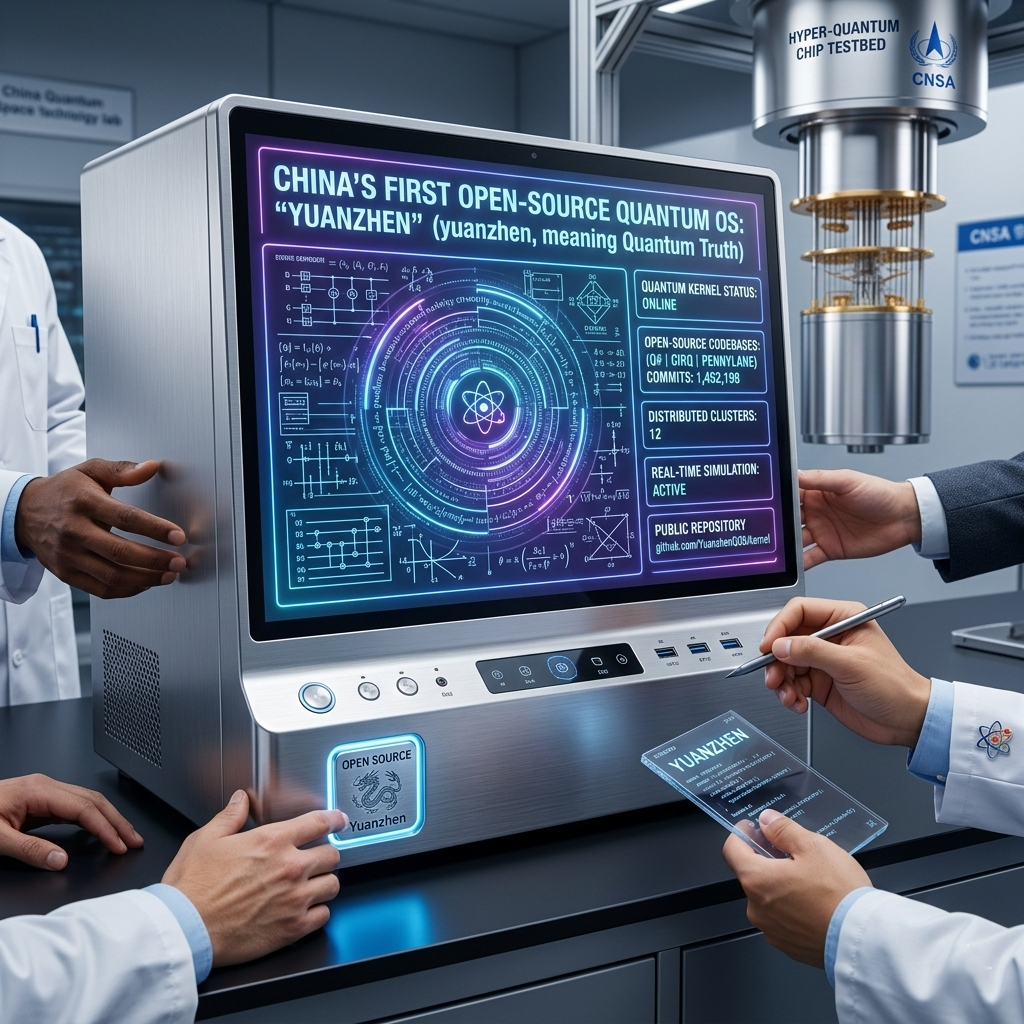
Recently, China introduced the world’s first open-source quantum operating system. Even more importantly, it made the platform freely available to anyone, anywhere.
That decision could reshape how the world explores quantum technology.
Let’s understand why this matters.
What Is a Quantum Operating System?
A quantum operating system manages how quantum computers function.
Just like Windows or Linux controls your laptop, a quantum OS controls:
- Quantum bits (qubits)
- Quantum circuits
- Algorithm execution
- Hardware communication
However, quantum systems behave very differently from classical computers.
Instead of using 0s and 1s, qubits can exist in multiple states at once. Therefore, the operating system must handle complex quantum behavior like superposition and entanglement.
Why Going Open-Source Changes Everything
Traditionally, quantum platforms remained restricted. Only selected institutions or corporations could access advanced tools.
Now, things look different.
By releasing an open-source quantum OS, China allows:
- Researchers to test new algorithms
- Students to learn quantum programming
- Developers simulate quantum systems
- Innovators to experiment without licensing barriers
As a result, access is no longer limited to elite labs.
How This Levels the Playing Field
Before this release, quantum research often required:
- Expensive hardware
- Institutional backing
- Proprietary software access
- Specialized lab infrastructure
Consequently, smaller universities and independent developers struggled to participate.
Now, anyone with internet access can download the system and start exploring.
That shift encourages wider global participation.
Tools Included in the Platform
The open-source quantum OS equips users with practical tools, such as
- Quantum circuit design environments
- Simulation engines
- Programming frameworks
- Educational resources
Therefore, beginners can learn step by step, while experts can build advanced experiments.
In simple terms, it acts as both a classroom and a laboratory.
Real-World Applications of Quantum Computing
Although large-scale quantum computers are still evolving, research already targets major industries.
Here’s where quantum systems could make a difference:
1. Cryptography
Quantum machines may break traditional encryption. At the same time, they can create stronger security systems.
2. Materials Science
Researchers can simulate molecules more accurately. Consequently, this may speed up drug discovery and battery innovation.
3. Optimization Problems
Quantum algorithms could improve logistics, supply chains, and traffic systems.
4. Artificial Intelligence
Quantum computing may enhance complex AI training processes in the future.
Because of these possibilities, open access matters.
How This Compares to Proprietary Quantum Platforms
Companies like IBM and Google already offer cloud-based quantum tools.
However, most commercial platforms include restrictions, usage limits, or proprietary controls.
In contrast, open-source systems provide:
- Code transparency
- Community contributions
- Custom modification
- Fewer financial barriers
Therefore, researchers gain more flexibility.
Why This Is a Strategic Move
This decision is not just technical. It is strategic.
By promoting open collaboration, China positions itself as
- A leader in quantum accessibility
- A supporter of global research cooperation
- A catalyst for innovation
Moreover, open ecosystems often evolve faster than closed systems. Developers worldwide can now improve, test, and refine the platform together.
That collaborative momentum could accelerate breakthroughs.
The Bigger Picture: Democratizing Next-Generation Computing
Large-scale practical quantum computing is still under development. However, innovation grows when more minds participate.
Open-source access means:
- More experiments
- Faster error detection
- Broader educational outreach
- Stronger global knowledge exchange
Instead of concentrating expertise in a few labs, this model spreads opportunity.
And that changes the innovation landscape.
FAQs
What is China’s open-source quantum operating system?
It is the world’s first publicly available quantum OS that anyone can download to study, simulate, and experiment with quantum computing.
Why is open source important in quantum computing?
Open-source allows global collaboration, transparency, and faster research development without licensing restrictions.
Do I need a quantum computer to use it?
No. Most quantum operating systems include simulation tools, so users can experiment without owning physical quantum hardware.
How does this impact global research?
It lowers barriers to entry. Therefore, universities, startups, and individuals can contribute to quantum innovation.
Is large-scale quantum computing already practical?
Not yet. However, initiatives like this help speed up progress toward scalable quantum systems.
Final Thoughts: A Shared Path Toward a Quantum Future
Quantum computing once felt like a closed club. Now, that door is opening.
By launching the first open-source quantum operating system, China has taken a bold step toward making next-generation computing more accessible.
Of course, challenges remain. Quantum hardware still faces scalability issues. However, wider participation increases the chance of faster breakthroughs.
If innovation thrives on collaboration, then this move could shape the future of global science.
