

Close Menu
Innovate And ExploreInnovate And Explore

    Subscribe to Updates

    Get the latest creative news from FooBar about art, design and business.

    What's Hot

    This Hydrogen Stove Uses Water Instead of Gas: How It Works

    April 19, 2026

    Utah Measles Outbreak: Why Cases Are Rapidly Rising

    April 19, 2026

    Why AI Tools Are Driving Massive Traffic in 2026

    April 19, 2026
    Facebook Instagram
    Facebook Instagram YouTube TikTok
    Innovate And ExploreInnovate And Explore
    • Artificial Intelligence
    • Medical Research
    • Technology News
    • Science News
    • VR Headset
    • Palantir
    Innovate And ExploreInnovate And Explore
    Home » China’s Solar Robots Are Planting Trees in the Desert
    Technology News

    China’s Solar Robots Are Planting Trees in the Desert

    alfredBy alfredFebruary 20, 2026No Comments3 Mins Read
    Facebook Twitter Pinterest LinkedIn Tumblr WhatsApp Email
    Share
    Facebook Twitter LinkedIn WhatsApp Pinterest Email

    Planting trees in a desert sounds nearly impossible.

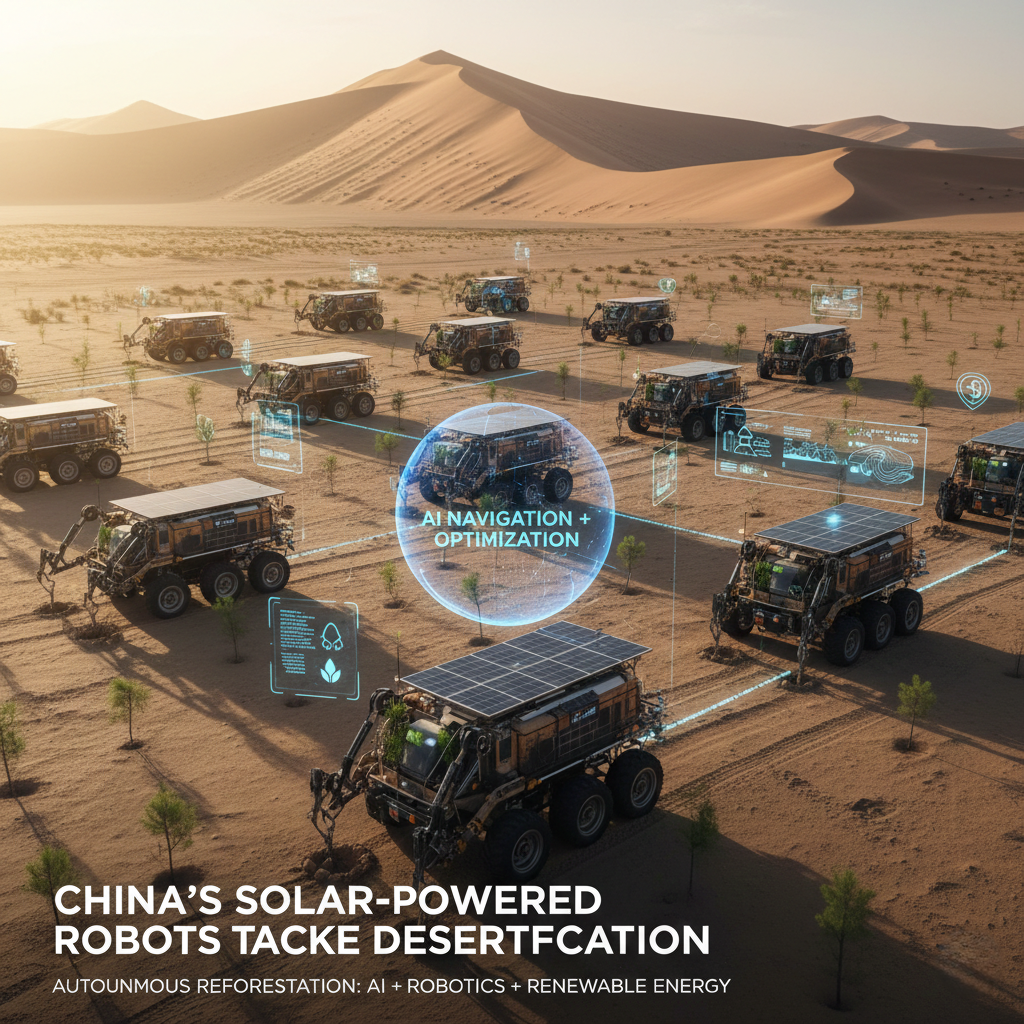
    But China is now using solar-powered robots to do exactly that—automatically, efficiently, and at scale.

    In large restoration projects, autonomous machines are moving across dry, sandy landscapes and planting trees without direct human control.

    This is technology meeting environmental protection in a powerful way.

    Why Desertification Is a Major Problem

    Desertification happens when fertile land turns into desert.

    In regions like the Gobi Desert, years of climate pressure and land misuse have damaged vast areas.

    This leads to:

    • Loss of farmland
    • Stronger sandstorms
    • Reduced biodiversity
    • Higher carbon levels

    Restoring vegetation is one of the most effective solutions.

    But planting trees in extreme heat and shifting sand is physically demanding and risky.

    How Solar-Powered Robots Do the Work

    Engineers developed autonomous robots that run entirely on solar energy.

    These machines can:

    • Move across unstable sand dunes
    • Dig precise planting holes
    • Place young tree saplings
    • Cover roots with soil

    All without human assistance on-site.

    Because they are solar-powered, they can operate for long hours in sunny desert conditions without needing fuel refills.

    The Role of Artificial Intelligence

    Artificial intelligence helps the robots navigate and make decisions.

    AI systems allow them to:

    • Identify stable planting spots
    • Adjust digging depth
    • Avoid obstacles
    • Optimize planting patterns

    This improves survival rates for young trees.

    It also speeds up large-scale afforestation compared to manual methods.

    Why This Approach Matters for Climate Action

    Reforestation in desert regions can:

    • Stabilize loose soil
    • Reduce sandstorm intensity
    • Improve local air quality
    • Absorb carbon dioxide

    Trees act as natural carbon sinks.

    In climate strategies, afforestation is considered a key tool for long-term environmental protection.

    Using robots makes this process faster and more scalable.

    Real-World Advantages of Robotic Afforestation

    Traditional desert planting requires large teams working in harsh conditions.

    Robotic systems reduce:

    • Physical strain on workers
    • Long-term labor costs
    • Fuel consumption
    • Environmental footprint

    Solar energy also means fewer emissions during operations.

    It’s a cleaner solution from start to finish.

    Challenges and Limitations

    While promising, robotic tree planting is not a complete solution.

    Success depends on:

    • Proper tree species selection
    • Long-term irrigation strategies
    • Ongoing ecological monitoring

    Desert ecosystems are complex.

    Technology helps, but ecological planning remains essential.

    A Glimpse Into the Future of Environmental Restoration

    This project shows how AI, robotics, and renewable energy can work together.

    Instead of relying only on manual labor, countries may increasingly turn to automated systems for:

    • Forest restoration
    • Soil protection
    • Large-scale climate projects

    It’s a shift toward smarter environmental management.

    FAQs

    1. Are the robots fully autonomous?

    Yes, they are designed to operate independently using AI navigation and solar power.

    2. Why use robots instead of workers?

    Desert environments are harsh and physically demanding. Robots can work longer hours safely and efficiently.

    3. Does planting trees really stop desertification?

    It can help stabilize soil and reduce sandstorms, but it must be part of a broader environmental strategy.

    4. Why is solar power important in this project?

    Deserts receive strong sunlight, making solar energy an ideal and sustainable power source.

    5. Could other countries adopt this technology?

    Yes. Any region facing desert expansion could potentially use similar robotic afforestation systems.

    Final Thoughts

    China’s solar-powered tree-planting robots show how innovation can tackle environmental challenges in new ways.

    By combining artificial intelligence, robotics, and renewable energy, large-scale desert restoration becomes more practical.

    While technology alone won’t solve climate change, it can support smarter and faster action.

    As desertification affects more regions worldwide, robotic afforestation may become a key tool in protecting fragile ecosystems.

    The future of reforestation might not just involve shovels and seedlings—but smart machines powered by the sun.

    advanced encryption standard ai chatgpt ai science news artificial general intelligence california science center hologram museum medical research palantir quantum physics science center science fair board science museum scientific method tech news virtual reality headset
    Share. Facebook Twitter Pinterest LinkedIn Tumblr WhatsApp Email
    alfred

    Related Posts

    This Hydrogen Stove Uses Water Instead of Gas: How It Works

    April 19, 2026

    Utah Measles Outbreak: Why Cases Are Rapidly Rising

    April 19, 2026

    Why AI Tools Are Driving Massive Traffic in 2026

    April 19, 2026

    Lake Mead Water Crisis: Why Water Levels Are Falling Fast

    April 18, 2026

    New York AI Law 2026: Why Chatbots Could Face Lawsuits

    April 18, 2026

    Is AI Quietly Making Life More Expensive? Here’s What You Should Know

    April 18, 2026
    Add A Comment
    Leave A Reply Cancel Reply

    Don't Miss

    This Hydrogen Stove Uses Water Instead of Gas: How It Works

    By alfredApril 19, 2026

    Introduction: Cooking Without Gas Is Now Possible Imagine cooking your meals without a gas cylinder…

    Utah Measles Outbreak: Why Cases Are Rapidly Rising

    April 19, 2026

    Why AI Tools Are Driving Massive Traffic in 2026

    April 19, 2026

    Lake Mead Water Crisis: Why Water Levels Are Falling Fast

    April 18, 2026
    Stay In Touch
    • Facebook
    • Twitter
    • Pinterest
    • Instagram
    • YouTube
    • Vimeo
    Our Picks

    This Hydrogen Stove Uses Water Instead of Gas: How It Works

    April 19, 2026

    Utah Measles Outbreak: Why Cases Are Rapidly Rising

    April 19, 2026

    Why AI Tools Are Driving Massive Traffic in 2026

    April 19, 2026

    Lake Mead Water Crisis: Why Water Levels Are Falling Fast

    April 18, 2026

    Subscribe to Updates

    Get the latest creative news from SmartMag about art & design.

    Techlo Inno
    Innovate And Explore
    Facebook Instagram YouTube TikTok
    • About Us
    • Cookies Policy
    • Editorial Policy
    • Terms & Conditions
    © 2026 Innovate and Explore. Designed by Techlo Inno.

    Type above and press Enter to search. Press Esc to cancel.

    Powered by
    ►
    Necessary cookies enable essential site features like secure log-ins and consent preference adjustments. They do not store personal data.
    None
    ►
    Functional cookies support features like content sharing on social media, collecting feedback, and enabling third-party tools.
    None
    ►
    Analytical cookies track visitor interactions, providing insights on metrics like visitor count, bounce rate, and traffic sources.
    None
    ►
    Advertisement cookies deliver personalized ads based on your previous visits and analyze the effectiveness of ad campaigns.
    None
    ►
    Unclassified cookies are cookies that we are in the process of classifying, together with the providers of individual cookies.
    None
    Powered by