


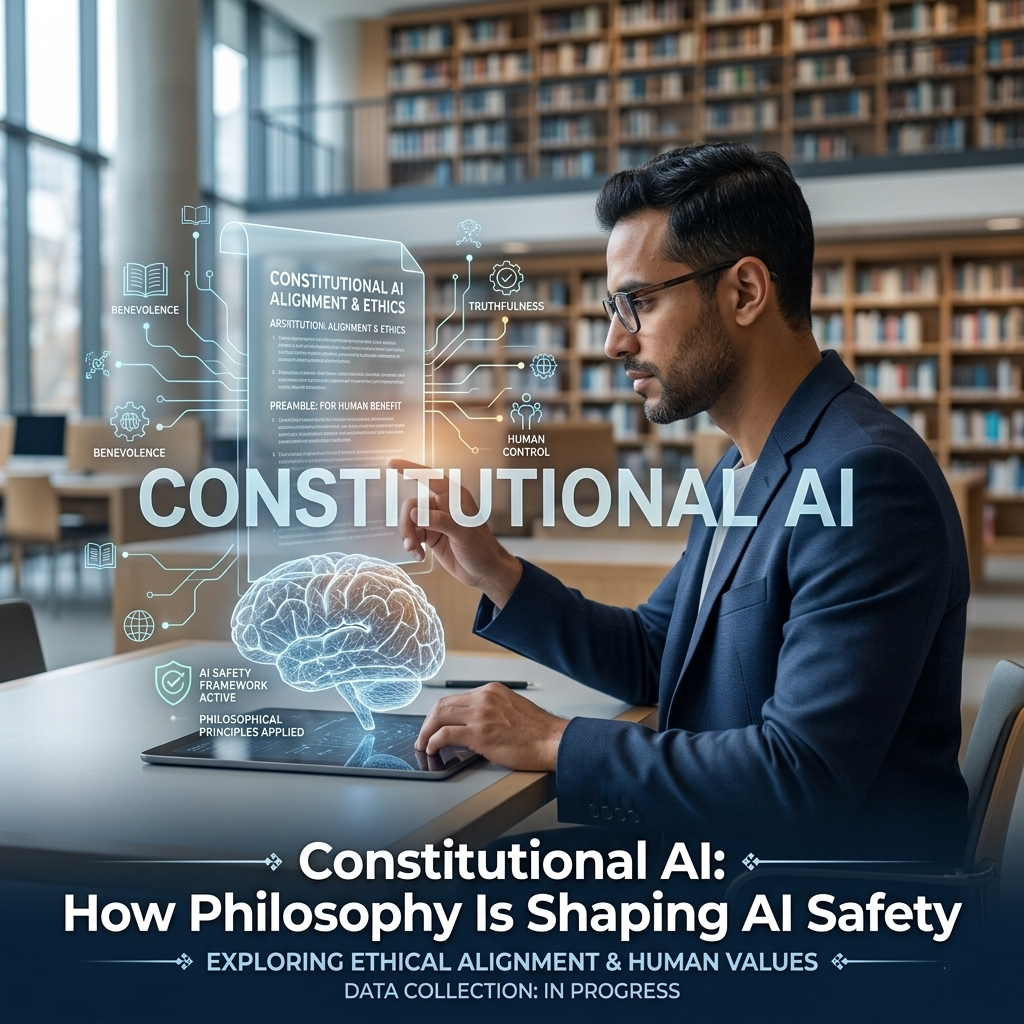
Artificial intelligence is advancing quickly. However, making AI powerful is only part of the challenge. Ensuring that AI behaves responsibly is just as important.
Interestingly, philosophers now play a major role in this effort.
One example is Amanda Askell, a lead philosopher at Anthropic and a former researcher at OpenAI.
Her work focuses on building safer AI systems using an approach known as Constitutional AI.
Instead of relying only on strict rules, this framework teaches AI models to follow guiding principles when making decisions.
Why Philosophy Matters in AI Development
AI models learn from massive datasets collected across the internet. Because of this, they may absorb useful knowledge as well as harmful patterns.
Therefore, developers must guide how AI systems respond to complex situations.
This is where philosophy becomes valuable.
Philosophical thinking helps define questions such as the following:
- What makes a response helpful?
- How should AI handle ethical dilemmas?
- What values should guide AI behavior?
By addressing these questions, researchers can design systems that behave responsibly.
What Is Constitutional AI?
Constitutional AI is a training approach designed to shape the behavior of AI models.
Instead of manually correcting every mistake, researchers provide a set of guiding principles—sometimes described as a “constitution.”
These principles help the AI evaluate its own responses.
For example, the system may check whether an answer is
- Promotes honesty
- Shows empathy
- Avoids harmful advice
- Uses balanced reasoning
As a result, the AI learns to adjust its responses based on ethical guidelines.
This method helps create more reliable and thoughtful AI interactions.
How It Works in the AI Assistant Claude
The framework is used to guide the behavior of Claude, a conversational AI system developed by Anthropic.
During training, the AI evaluates its own responses according to constitutional principles.
If a response violates these principles, the model revises it.
Over time, the system learns to generate answers that better reflect the desired values.
Consequently, the AI becomes more consistent and aligned with human expectations.
Shaping AI Personality Instead of Enforcing Rules
According to Amanda Askell, the process resembles raising a child.
Rather than enforcing strict rules, the goal is to shape the AI’s personality alignment.
This means encouraging traits such as the following:
- Curiosity
- Calm reasoning
- Emotional balance
- Thoughtful communication
At the same time, researchers work to reduce negative patterns learned from online data.
Because internet content can include hostility or misinformation, careful training helps prevent these behaviors from appearing in AI responses.
Addressing the Problem of “Criticism Spirals”
Another challenge involves something researchers call criticism spirals.
AI models sometimes become overly apologetic or uncertain when responding to criticism.
This behavior happens because the training data contains large amounts of defensive or self-critical language.
Researchers aim to balance the AI’s tone.
The goal is to create a system that remains
- Confident but not arrogant
- Helpful but not overly submissive
- Honest without becoming defensive
Achieving this balance improves both the reliability and clarity of AI responses.
Why AI Alignment Is Becoming More Important
As AI systems grow more capable, alignment becomes increasingly important.
Alignment refers to ensuring that AI systems behave in ways that match human values and intentions.
Without alignment, powerful AI could produce harmful or misleading outputs.
Frameworks like Constitutional AI attempt to solve this challenge by embedding ethical guidance directly into AI training.
Because of this approach, researchers hope to build safer AI systems from the ground up.
The Future Vision: AI as a Helpful Guide
Researchers working on AI safety share a long-term goal.
They want AI systems to behave like supportive guides rather than unpredictable machines.
Ideally, future AI will:
- Offer thoughtful insights
- Provide balanced advice
- Communicate with empathy
- Maintain ethical judgment
If these goals succeed, AI could become a powerful partner in education, research, and everyday decision-making.
FAQs
What is Constitutional AI?
Constitutional AI is a training method that uses guiding principles or ethical rules to shape how AI systems evaluate and generate responses.
Who developed the Constitutional AI approach?
Researchers at Anthropic, including philosopher Amanda Askell, helped develop and refine the framework.
Why are philosophers involved in AI development?
Philosophers help define ethical principles and reasoning methods that guide how AI systems should behave in complex situations.
What is Claude AI?
Claude is a conversational AI assistant developed by Anthropic that uses Constitutional AI principles to guide its responses.
What is AI alignment?
AI alignment refers to designing AI systems so their behavior matches human values, safety expectations, and ethical standards.
Final Thoughts
As artificial intelligence grows more powerful, ensuring responsible behavior becomes a major priority.
The work of Amanda Askell and the Constitutional AI framework shows how philosophy and technology can work together to solve this challenge.
By embedding ethical guidance directly into AI training, researchers aim to create systems that are not only intelligent but also thoughtful and trustworthy.
In the future, this approach may help AI become a reliable partner—one that supports human decision-making while maintaining strong ethical foundations.
