


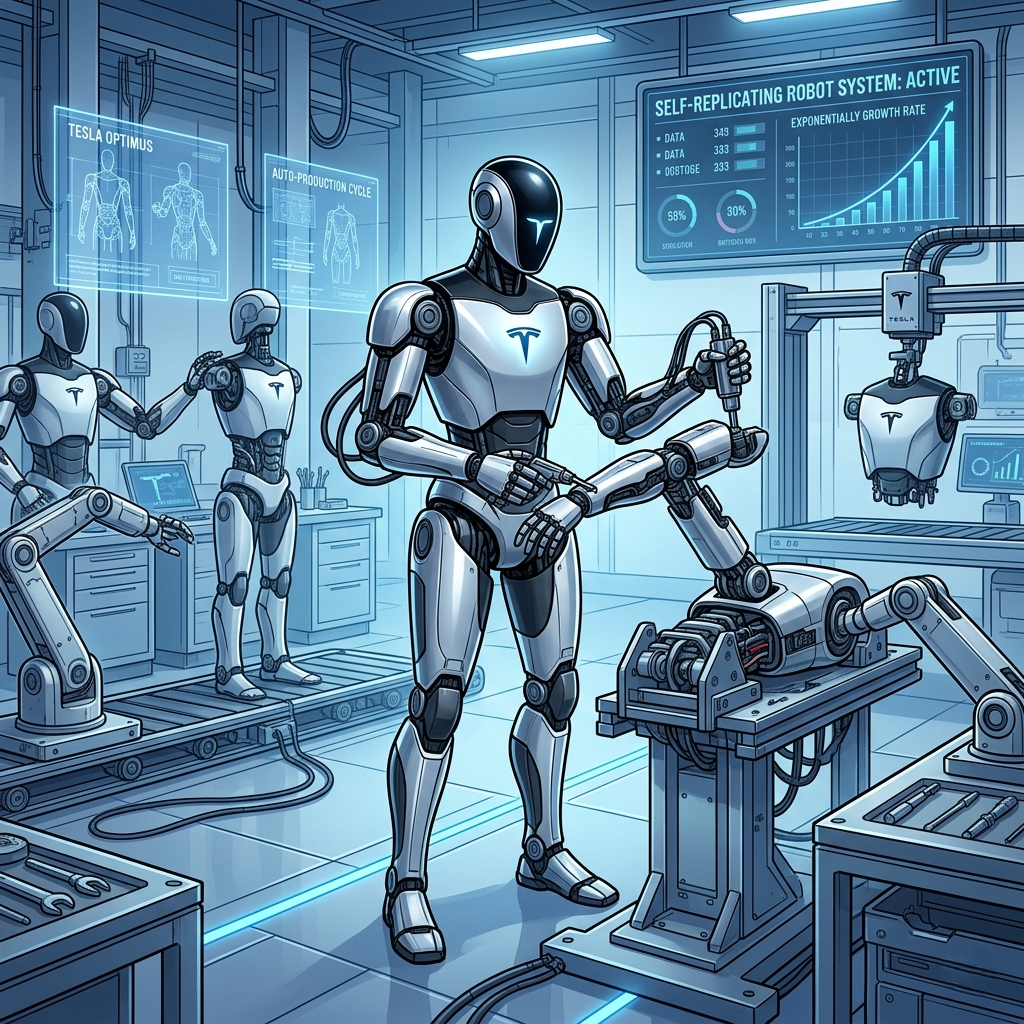
It sounds like science fiction, but Elon Musk believes it could become reality.
He recently suggested that Optimus might one day evolve into a self-replicating machine capable of building copies of itself.
If achieved, this would be a huge leap in robotics and automation.
What Is a Self-Replicating Machine?
The idea comes from a concept called a Von Neumann machine.
This is a theoretical system that can:
- Gather raw materials
- Manufacture parts
- Assemble a full copy of itself
In simple terms, it’s a machine that can “reproduce.”
How Optimus Could Achieve This
Right now, Optimus is designed to perform tasks like lifting, sorting, and assisting humans.
However, Musk’s long-term vision goes much further.
What Would Be Needed
- Advanced AI for planning and decision-making
- Precision manufacturing abilities
- Access to raw materials
- Fully automated production systems
If all these pieces come together, robots could build other robots without human help.
Why This Idea Is So Powerful
Self-replicating robots could completely change how industries work.
Potential Benefits
- Rapid scaling of production
- Lower manufacturing costs
- Reduced need for human labor in dangerous environments
- Faster infrastructure development
Because machines could multiply, growth would become exponential.
Space Exploration: The Bigger Vision
Musk connects this idea to space exploration.
He believes self-replicating robots could help build infrastructure on other planets before humans arrive.
Possible Use Cases
- Building habitats on Mars
- Mining resources on distant planets
- Creating automated factories in space
This could make space colonization much more practical.
Challenges and Concerns
While exciting, this idea also raises serious questions.
Key Challenges
- Technical complexity
- Resource availability
- Safety and control
- Ethical concerns
Uncontrolled self-replication could create risks if not managed properly.
Real-World Example
Imagine sending a few robots to Mars.
Instead of relying on constant human support, they begin building tools, factories, and even more robots.
Over time, a small system grows into a fully functional base all before humans arrive.
FAQs
Is Optimus currently self-replicating?
No, it’s still in early development and cannot build copies of itself yet.
What is a Von Neumann machine?
It’s a theoretical machine that can reproduce itself using raw materials.
When could this become real?
There’s no clear timeline. It’s a long-term vision that may take decades.
Is this safe?
It could be, but strong controls and safeguards would be essential.
Final Thoughts
The idea of self-replicating machines may sound futuristic, but it represents a powerful direction for technology.
If Optimus ever reaches this level, it could transform industries and even help humans expand beyond Earth.
👉 For now, it remains a bold vision. But as technology advances, the line between science fiction and reality keeps getting thinner. 🚀
