


Introduction: A Breakthrough That Could Change Lives
Imagine fixing a genetic condition at its root. That idea once felt impossible. Now, thanks to modern science, it’s slowly becoming real.
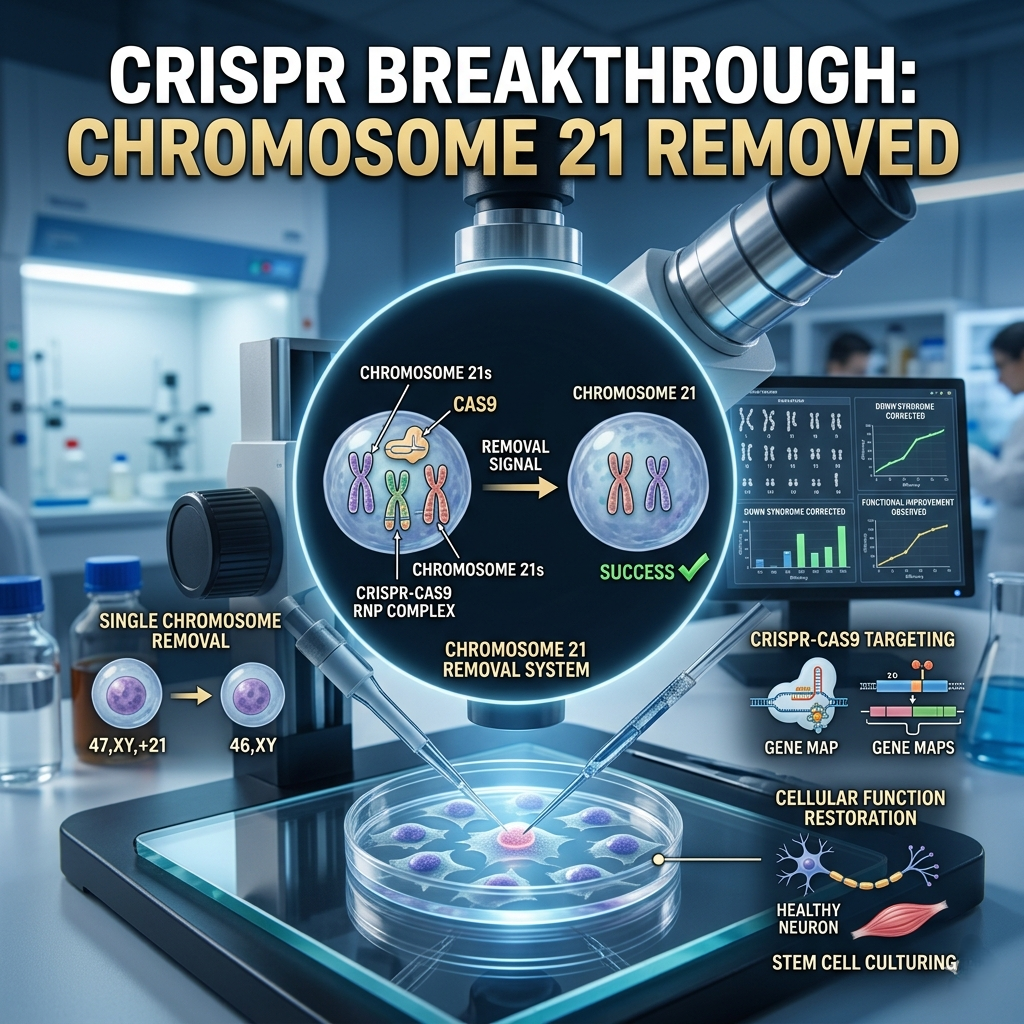
In a groundbreaking study, researchers successfully removed the extra chromosome responsible for Down syndrome from human cells. As a result, treated cells began to function more normally.
This early success brings hope. At the same time, it raises important questions about the future of genetic medicine.
What Causes Down Syndrome?
Down syndrome happens because of an extra copy of chromosome 21. This condition is also known as Trisomy 21.
Normally, people have 46 chromosomes. However, individuals with Down syndrome have 47. This extra chromosome affects development in several ways.
Common effects include:
- Learning difficulties
- Delayed growth
- Distinct facial features
- Higher risk of certain health conditions
Because the condition starts at the genetic level, treatments have always been limited. Until now, no method could directly target the root cause.
The CRISPR Breakthrough Explained
The study was led by Dr. Ryotaro Hashizume and published in Cell Reports.
Researchers used CRISPR gene editing to remove the extra chromosome from human cells in the lab.
What makes this special?
Instead of editing small parts of DNA, scientists removed an entire chromosome. That’s a huge leap forward.
As a result:
- Over 30% of treated cells returned to typical function
- Cellular stress decreased
- Gene expression improved significantly
In simple terms, the cells started behaving more like healthy ones.
Why This Matters So Much
This breakthrough is not just technical. It changes how we think about genetic conditions.
Here’s why it’s important:
- Targets the root cause
Instead of managing symptoms, it addresses the actual genetic issue - New direction for medicine
Opens doors for treating other chromosomal disorders - Boosts precision medicine
Shows how accurate gene editing is becoming
For years, treatments focused on support and care. Now, scientists are exploring real genetic solutions. Real-World Impact: What Could This Mean?
Although this research is still in the lab stage, the future possibilities are exciting.
Potential benefits could include:
- Improved cognitive development
- Better overall health outcomes
- Reduced lifelong complications
For example, early intervention at the cellular level might one day change how Down syndrome develops in a person.
However, this is not a cure yet. It’s a first step.
Challenges and Ethical Concerns
While the results are promising, scientists remain cautious. Moving from lab cells to human treatments is complex.
Key challenges include the following:
- Ensuring safety in living patients
- Avoiding unintended genetic changes
- Delivering CRISPR accurately inside the body
Ethical questions also matter:
- Should genetic conditions always be edited?
- Who decides what gets treated?
- How do we ensure fair access?
Because of these concerns, progress will be careful and gradual.
How This Compares to Previous Research
In the past, scientists could only edit small gene sections. That approach helped, but it didn’t solve chromosomal disorders.
Now, this new method goes further.
| Approach | What It Does | Limitation |
|---|---|---|
| Traditional gene editing | Fixes small DNA errors | Cannot remove whole chromosome |
| New CRISPR method | Removes extra chromosome | Still experimental |
Clearly, this breakthrough moves the field forward in a big way.
FAQs About CRISPR and Down Syndrome
1. Can CRISPR cure Down syndrome today?
No, not yet. This research only works in lab-grown cells so far.
2. Is removing a chromosome safe?
Scientists are still studying safety. So far, results are promising but limited.
3. When could this become a treatment?
It may take many years. Clinical trials and safety testing must come first.
4. What is the biggest achievement here?
The ability to remove an entire extra chromosome using CRISPR.
Conclusion: A Promising Step Toward the Future
This breakthrough marks a turning point in genetic science. For the first time, researchers have removed the extra chromosome behind Down syndrome in human cells.
While real-world treatments are still far away, the direction is clear. Science is moving closer to addressing genetic conditions at their source.
As research continues, one thing is certain: the future of medicine is becoming more precise, more powerful, and more hopeful.
