


Introduction: A New Hope for the Tiniest Lives
Babies born at 22 weeks face almost impossible odds.
Their lungs are not ready.
Their organs are fragile.
Survival rates are painfully low.
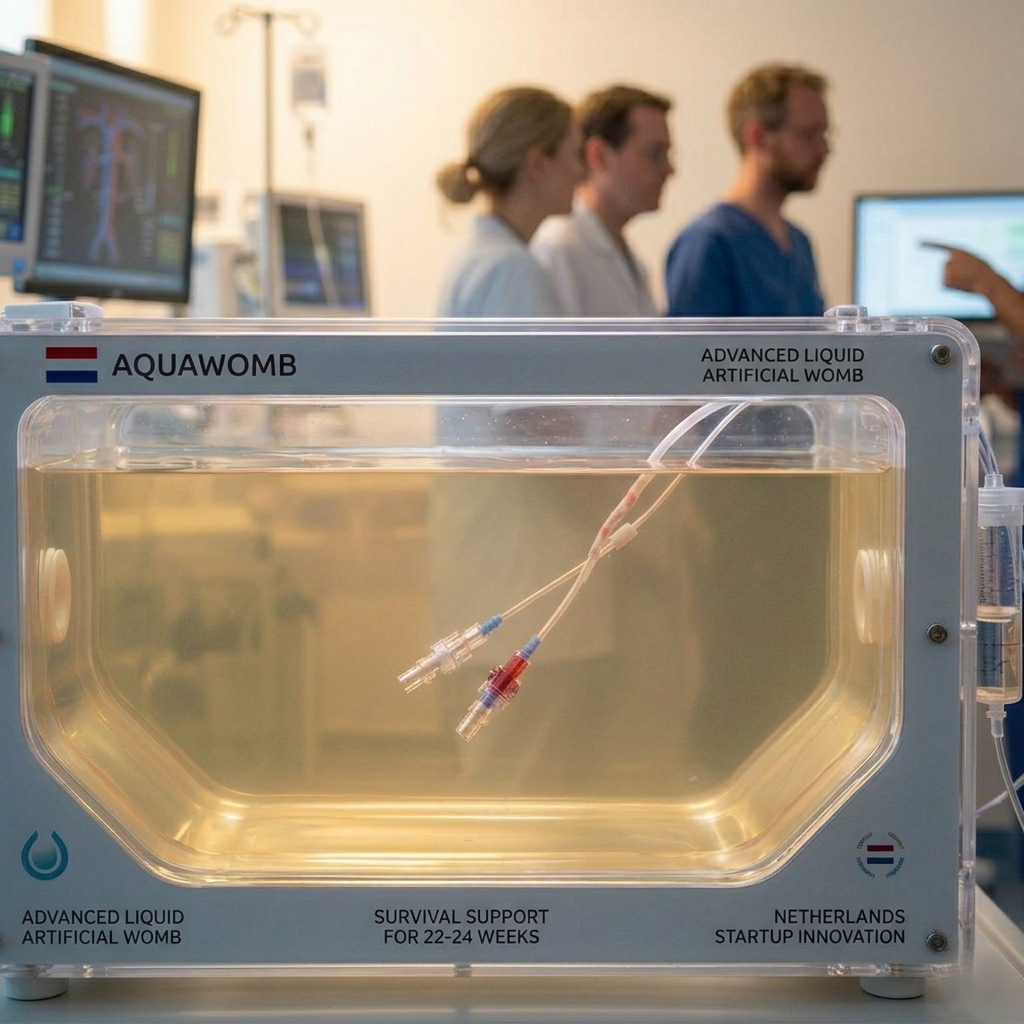
Now, a Dutch startup called AquaWomb is working on something groundbreaking — an artificial womb designed to help extremely premature infants survive and grow safely.
If successful, this could transform neonatal care forever.
What Is the Artificial Womb System?
The system, called the Perinatal Life Support system, recreates the environment of a mother’s womb.
Instead of placing premature babies in traditional incubators, the technology:
- Immerses the infant in synthetic amniotic fluid
- Uses a silicone-lined glass chamber
- Connects to an artificial placenta
- Delivers oxygen and nutrients through the umbilical cord
This setup allows the baby’s organs to continue developing naturally.
In simple terms, it gives nature more time to do its job.
Why Babies Born at 22–24 Weeks Need a New Solution
Infants born between 22 and 24 weeks are known as “micro-preemies.”
At this stage:
- Lungs are too immature for normal breathing
- Brain development is still very early
- Survival often requires intense medical support
Traditional ventilators can damage fragile lungs.
Even when babies survive, long-term complications may include:
- Chronic lung disease
- Neurological injury
- Developmental delays
An artificial womb may reduce these risks by avoiding early exposure to air.
How the Technology Works
Let’s break it down simply.
1. Liquid Environment
The baby remains in a warm, sterile, fluid-filled space that mimics amniotic fluid.
This prevents lung strain.
2. Artificial Placenta
Instead of breathing air, oxygen enters through a device attached to the umbilical cord.
Carbon dioxide leaves the same way.
This mirrors how oxygen exchange happens during pregnancy.
3. Gradual Transition
As the baby grows stronger, doctors can slowly prepare them for air breathing.
The goal is a smoother and safer transition.
How This Could Change Neonatal Care
If approved for human use, the impact could be massive.
Potential benefits include:
- Higher survival rates for micro-preemies
- Reduced risk of brain injury
- Lower chance of chronic lung disease
- Better long-term developmental outcomes
For families facing extreme prematurity, this could mean hope where there was once only fear.
Regulatory and Ethical Challenges Ahead
As promising as this sounds, it’s not ready for hospitals yet.
The U.S. Food and Drug Administration (FDA) is reviewing safety data to decide whether human trials can begin.
Before approval, researchers must prove:
- The system is safe
- Infection risks are controlled
- Long-term outcomes are positive
There are also serious ethical questions.
Artificial wombs push boundaries in how we define viability, birth, and early development.
These conversations will shape the future of this technology.
Artificial Womb vs. Traditional Incubator
Here’s a simple comparison:
| Feature | Incubator | Artificial Womb |
|---|---|---|
| Environment | Air-based | Fluid-based |
| Oxygen delivery | Ventilator | Artificial placenta |
| Lung strain | Possible | Minimized |
| Development simulation | Limited | Womb-like |
Incubators support survival.
Artificial wombs aim to continue development.
That difference is significant.
Is This Science Fiction?
It may sound futuristic, but similar systems have been tested in animal studies with promising results.
The Dutch innovation builds on years of research in neonatal science.
While clinical trials are not yet scheduled, this development signals a major shift.
It’s not about replacing pregnancy.
It’s about extending it safely when needed.
FAQs: Artificial Womb Technology
Is the artificial womb available now?
No. It is still in development and under regulatory review.
Will this replace traditional pregnancy?
No. It is designed only for extremely premature births where survival chances are very low.
Is it safe?
Safety testing is ongoing. Human trials must be approved before clinical use.
Could this reduce long-term disabilities?
That is one of the main goals — to reduce lung damage and neurological complications.
The Bigger Ethical Conversation
Artificial womb technology opens new questions:
- When does viability truly begin?
- How might this affect premature birth laws?
- What rights and protections would apply?
These discussions will involve doctors, ethicists, lawmakers, and families.
Innovation often moves faster than policy.
Careful balance will be essential.
Conclusion: A Possible Lifeline for the Most Vulnerable
The artificial womb developed by AquaWomb represents one of the boldest advances in neonatal medicine.
For babies born at the edge of survival, it could provide the extra time needed for lungs and brains to mature safely.
There are still regulatory and ethical hurdles ahead.
But the potential is undeniable.
This technology may redefine how we care for the tiniest and most fragile lives.
