


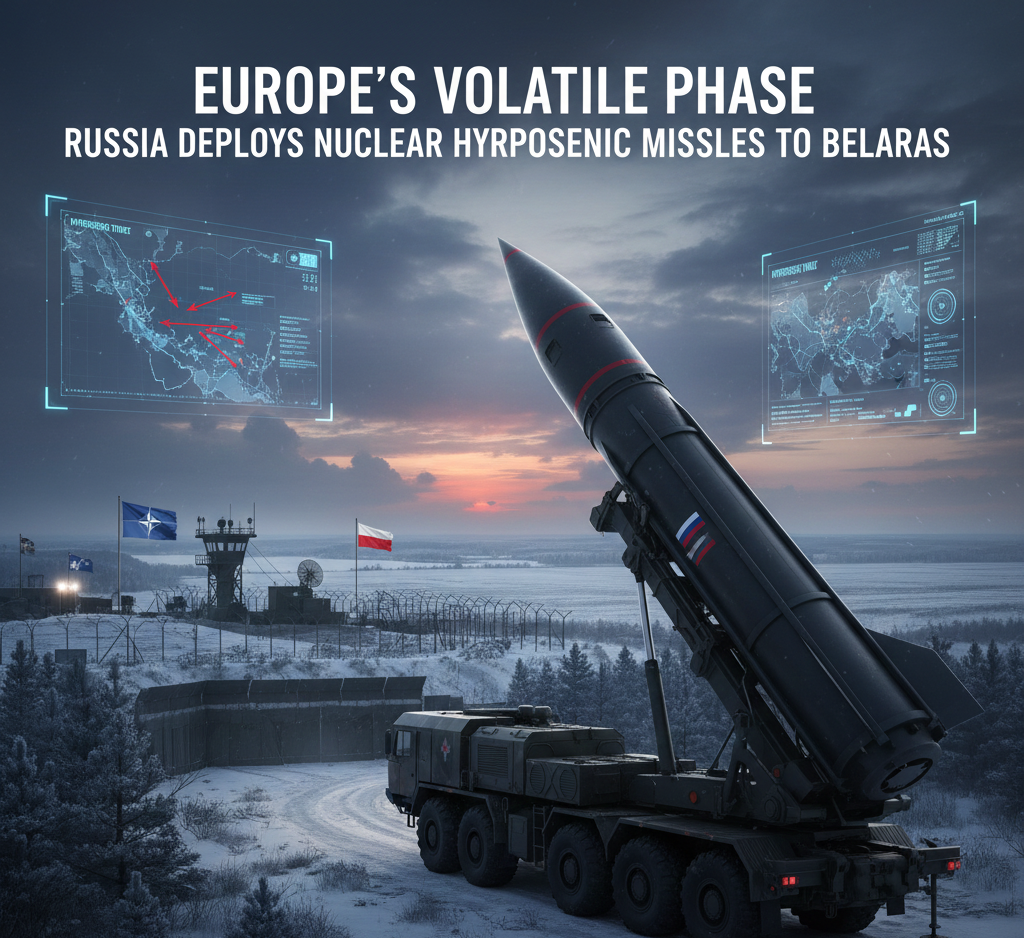
Europe’s security environment is becoming increasingly tense.
Russia’s decision to deploy nuclear-capable hypersonic missiles to Belarus has triggered widespread concern.
By positioning these weapons closer to NATO territory, Moscow has altered the strategic balance.
Defense officials warn the move could significantly shorten response times during a crisis.
This is not just another weapons deployment it reflects a deeper shift in modern warfare.
Why Hypersonic Missiles Are Especially Concerning
Hypersonic missiles travel at speeds exceeding Mach 5.
They can also maneuver mid-flight, making interception extremely difficult.
What Sets Hypersonic Weapons Apart
These systems are dangerous because they:
- Reduce early warning and detection time
- Evade traditional missile defense systems
- Increase pressure on decision-makers
- Raise the risk of rapid escalation
For European security planners, this combination is deeply destabilizing.
Why Belarus Matters in This Deployment
Belarus’s geographic location is critical.
It places advanced Russian weapons closer to NATO’s eastern members.
Countries such as Poland, Lithuania, and Latvia now face increased strategic pressure.
Military analysts say this proximity complicates regional defense planning.
The deployment effectively tightens Russia’s reach into Europe’s security core.
European Leaders Sound the Alarm
Major European powers have reacted swiftly.
Germany and France have described the move as a serious threat to regional stability.
Eastern European NATO members say it intensifies an already fragile security situation.
These concerns reflect fears that miscalculation could lead to rapid confrontation.
NATO and EU Response: Coordination Under Pressure
In response, NATO and the European Union have launched consultations.
Diplomatic and military leaders are evaluating both defensive and political options.
Key Areas Under Review
- Strengthening air and missile defense systems
- Increasing military readiness on NATO’s eastern flank
- Enhancing intelligence and early-warning coordination
- Maintaining diplomatic communication channels
The focus remains deterrence without provocation.
The Role of the United States and United Kingdom
The United States and the United Kingdom have reaffirmed their commitment to European defense.
Both emphasize the importance of collective security under NATO.
Their statements aim to reassure allies and signal unity.
Deterrence, officials say, relies on clarity and consistency.
Global Reactions Highlight Wider Concerns
China has urged restraint, calling on all sides to avoid escalation.
This response underscores how advanced weapons affect global stability, not just Europe.
Hypersonic technology is reshaping military doctrine worldwide.
Its spread raises new questions about arms control and crisis management.
A Shift Toward Next-Generation Deterrence
Officials describe the deployment as part of a broader strategic shift.
Deterrence is increasingly built around speed, precision, and technological advantage.
Unlike Cold War-era standoffs, modern conflicts may unfold faster than diplomacy can react.
That reality makes misjudgment more dangerous than ever.
Frequently Asked Questions (FAQs)
Why are hypersonic missiles harder to defend against?
Their speed and maneuverability limit detection and interception time.
Does this deployment increase the risk of conflict?
It raises tension and shortens decision windows, which increases escalation risks.
Is NATO likely to respond militarily?
Current responses focus on deterrence, readiness, and coordination rather than direct escalation.
The Bigger Picture: Technology Is Redefining Security
Russia’s hypersonic missile deployment highlights a new reality.
Military technology is advancing faster than traditional security frameworks.
Europe now faces a future where reaction time is measured in minutes, not hours.
Managing stability in this environment will require restraint, coordination, and constant dialogue.
